
Navigation
Top News
Statistics
Advertisement
Аrchives
Votes
| Rate the site |
P0797 Code — Pressure Control Solenoid “C” Stuck On (Causes, Symptoms & Fix Guide)
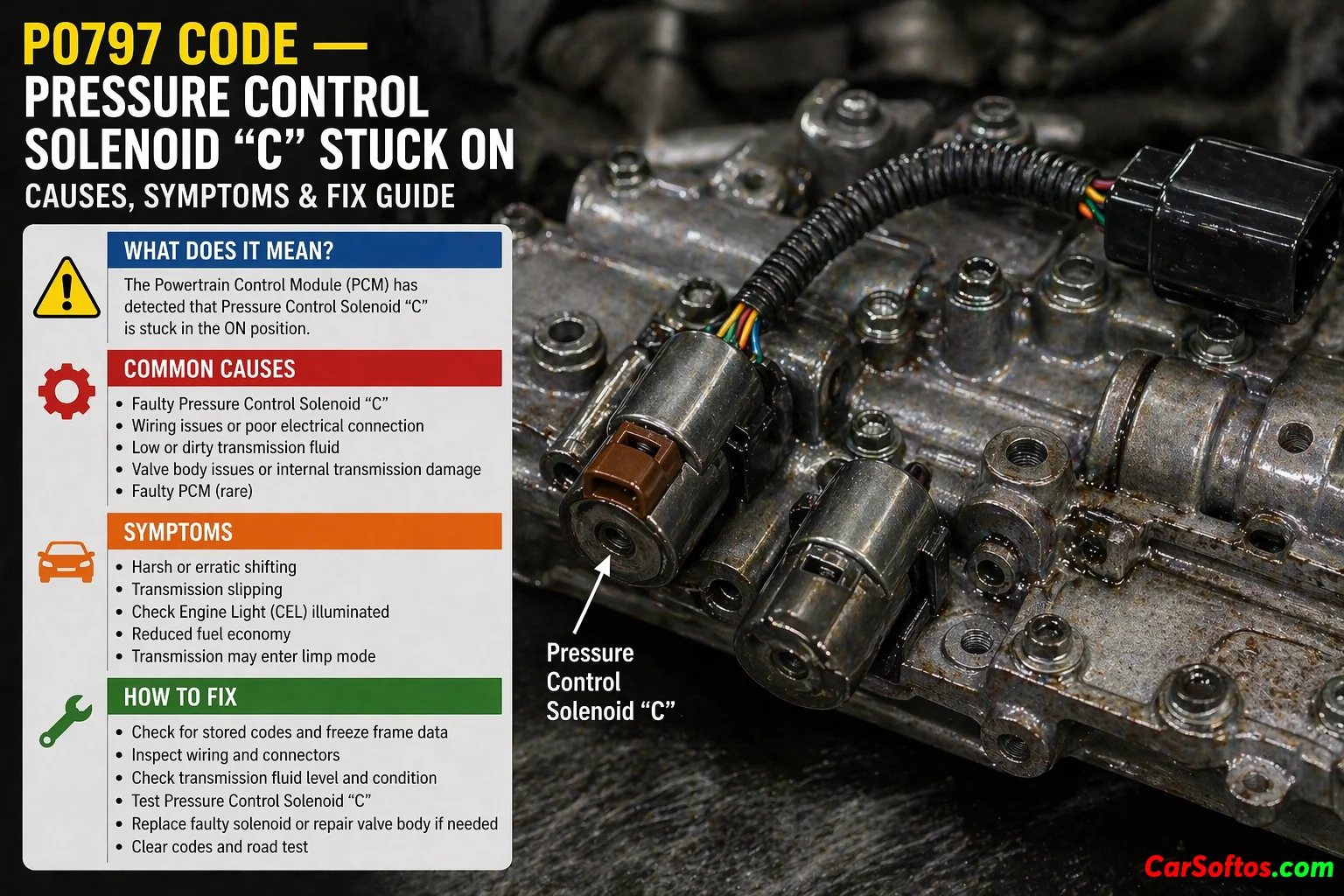
P0797 means Pressure Control Solenoid “C” is stuck on. In practice, the transmission controller commands pressure control through solenoid C, but the hydraulic response stays on when it should not, or line pressure does not follow the expected control strategy. Generic references describe it as a mismatch between commanded and actual pressure control behavior.
👉 Simple explanation
The transmission is trying to regulate pressure, but solenoid C is acting like it is continuously energized or hydraulically stuck in that state. That can make shifts harsh, delayed, or unstable because clutch apply pressure is no longer being modulated correctly.
⚙️ Why this code matters
Pressure control solenoids are not minor parts. They help control:
- clutch apply pressure
- shift feel
- line pressure stability
- transmission heat generation
If solenoid C is stuck on, pressure can become excessive or abnormal in parts of the shift sequence, which can cause harsh shifts, slip in some ranges, limp mode, and overheating. Over time, wrong pressure can damage clutch packs, seals, and the valve body.
⚠️ How serious is P0797?
Severity: High 🚨
This code can move from “annoying shift problem” to “expensive internal damage” fairly quickly. Multiple repair references describe symptoms such as limp mode, slip, harsh shifts, overheating, and loss of drive, all of which point to a pressure-control problem that should not be ignored.
🚨 Common symptoms of P0797
Typical symptoms include:
- ⚠️ Check Engine Light
- ⚠️ harsh or erratic shifting
- ⚠️ delayed engagement
- ⚠️ slipping on shifts
- ⚠️ limp mode
- ⚠️ transmission overheating
- ⚠️ stuck in one gear or reduced range operation
- ⚠️ lower fuel economy or weak drivability under load
🔥 Real-world pattern
If the transmission feels like it bangs into gear, hangs between shifts, or behaves worse as it warms up, that strongly fits a pressure-control problem rather than a simple gear-ratio-only code. That is an inference from the symptom patterns and the role of pressure control solenoids in hydraulic line pressure regulation.
🧠 Most common causes of P0797
1️⃣ Faulty pressure control solenoid C
This is the most direct cause. If the solenoid is mechanically stuck or internally failed, the transmission can no longer modulate pressure correctly. Generic P0797 references consistently list the solenoid itself as a primary cause.
2️⃣ Dirty or degraded transmission fluid
Low-quality, dirty, or worn ATF can cause valves and solenoids to stick. Several P0797 references include low or dirty fluid as a common contributor.
3️⃣ Valve body sticking or hydraulic restriction
If passages in the valve body are dirty or sticking, the commanded solenoid action may not create the expected pressure change. This is one of the biggest reasons pressure-control codes get misdiagnosed as “just a bad solenoid.” That is an inference based on how solenoid-controlled hydraulic systems work together with the symptoms described in P0797 sources.
4️⃣ Transmission pump or pressure supply issue
At least one generic reference includes the transmission pump and pressure supply side among possible causes. If the pump cannot support stable pressure, the TCM may interpret pressure control performance incorrectly.
5️⃣ Wiring / connector issues
Even though P0797 is the “stuck on” version, connector damage or control-side wiring faults can still distort solenoid behavior. If the control side cannot properly switch the solenoid, the hydraulic result may look like it is stuck on. This is an inference supported by the presence of the neighboring P0798 electrical code in the same family.
🔧 Step-by-step diagnosis for P0797
1️⃣ Scan all transmission codes first
Look for:
- P0798 → electrical fault version
- P0796 → performance / stuck off
- P0730 → incorrect gear ratio
- overheat or temperature codes such as P0218
If P0797 appears with ratio or overheating codes, the problem may already be affecting clutch holding ability and transmission health. That is an inference based on how pressure control impacts ratio stability and heat.
2️⃣ Check fluid level and condition
This is one of the highest-value checks. Look for:
- burnt smell
- dark color
- low level
- debris
Dirty or low fluid is repeatedly listed as a common cause or contributor.
3️⃣ Review live data / commanded pressure if available
If your scanner can show commanded pressure or pressure-solenoid behavior, compare what the TCM is requesting with the shift behavior you feel. A mismatch supports a real pressure-control fault rather than a random sensor issue. This is an inference based on the code meaning and pressure mismatch descriptions.
4️⃣ Inspect connector and harness
Check for:
- corrosion
- bent pins
- fluid contamination
- damaged insulation
- poor ground or power feed
This matters especially if you are trying to distinguish P0797 stuck on from P0798 electrical.
5️⃣ Inspect / test solenoid C and valve body
If fluid and wiring look okay, solenoid C itself and the valve body become the main suspects. Pressure-control faults commonly require pan removal and deeper hydraulic inspection. This is an inference supported by the failure pattern described in P0797 references.
🛠️ How to fix P0797
✔️ Service the fluid and filter
If fluid is old or contaminated, this is often the first corrective step. It may help if the issue is early-stage sticking rather than hard failure.
✔️ Replace pressure control solenoid C
If the solenoid is stuck or fails testing, replacement is the direct fix.
✔️ Repair the valve body
If the valve body is sticking or hydraulically restricted, cleaning or rebuilding may be required. This is a common mid-level fix when the solenoid itself is not the only problem. This is an inference from the code behavior and hydraulic control design.
✔️ Repair wiring if control-side issues are found
If the fault overlaps with electrical issues, repair the circuit before replacing expensive hard parts.
✔️ Rebuild transmission if internal damage is already present
If the transmission has been slipping or overheating for too long, internal clutches and seals may already be damaged.
💰 Typical repair cost for P0797
Practical market-style estimates:
| Repair | Typical cost |
|---|---|
| Fluid / filter service | $150–$400 |
| Solenoid replacement | $150–$500 |
| Valve body repair | $300–$900 |
| Wiring repair | $50–$250 |
| Rebuild / major internal repair | $1,500–$5,000+ |
These are broad market ranges, not OEM flat-rate prices. The cost swing depends mostly on whether the problem is limited to fluid/solenoid/valve body, or whether internal clutch damage has already happened. That conclusion is consistent with the symptom severity in the cited sources.
❗ Common mistakes with P0797
❌ Ignoring harsh shifts
Harsh or unstable shifts are often the first sign that pressure is no longer being controlled correctly. Continued driving can turn a solenoid/valve-body problem into clutch damage.
❌ Replacing the whole transmission too early
P0797 does not automatically mean the gearbox is dead. Solenoid, fluid, valve body, or connector issues can come first.
❌ Not separating P0797 from P0798
P0797 is stuck on / hydraulic-performance style behavior.
P0798 is electrical.
That distinction matters for diagnosis.
🚗 Can you drive with P0797?
Only short-term and gently.
If the vehicle is still moving, you may be able to drive a short distance. But if it is slipping, overheating, or banging into gear, continuing to drive risks fast wear and internal damage.
📌 Final verdict
P0797 usually means pressure control solenoid C is hydraulically or functionally stuck on, or pressure is not responding correctly to its command. The most common real causes are the solenoid itself, dirty fluid, valve body sticking, or broader hydraulic pressure issues.

Tags:
Users of Guests are not allowed to comment this publication.