
Navigation
Top News
Statistics
Advertisement
Аrchives
Votes
| Rate the site |
P0750 Code — Shift Solenoid “A” Malfunction (Causes, Symptoms & Fix Guide)
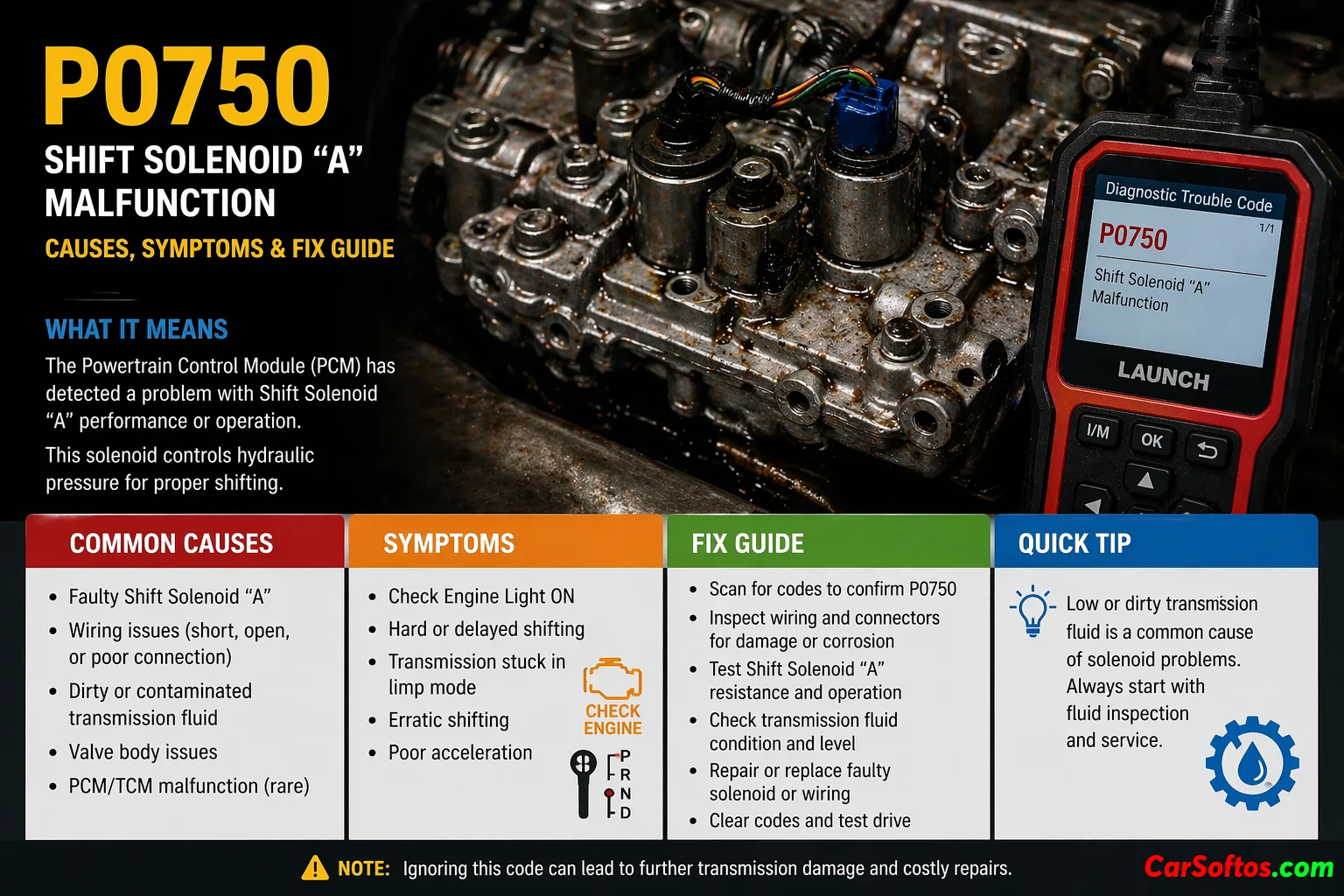
📌 What Does P0750 Mean?
P0750 is the generic OBD-II code for Shift Solenoid “A” Malfunction. In Toyota factory manuals, this is described as shift solenoid valve SL1 / S1 malfunction, and the usual fault tree includes a stuck-open or stuck-closed solenoid, a blocked or sticking valve body passage, ECM issues, torque-converter-clutch-related faults, or internal automatic transaxle problems.
👉 In simple words:
The transmission computer is saying that the A shift solenoid is not doing what it should. That does not automatically mean the circuit is dead. In many OEM diagnostic charts, P0750 is the mechanical/function fault, while the neighboring P0753 is the more direct electrical open/short version for the same solenoid family.
That difference matters a lot for diagnosis. A P0750 can be caused by:
- a bad solenoid that sticks mechanically
- a blocked or sticking valve body
- contaminated fluid affecting hydraulic control
- internal transmission problems
- on some applications, even a control-module software issue.
⚙️ What a Shift Solenoid Actually Does
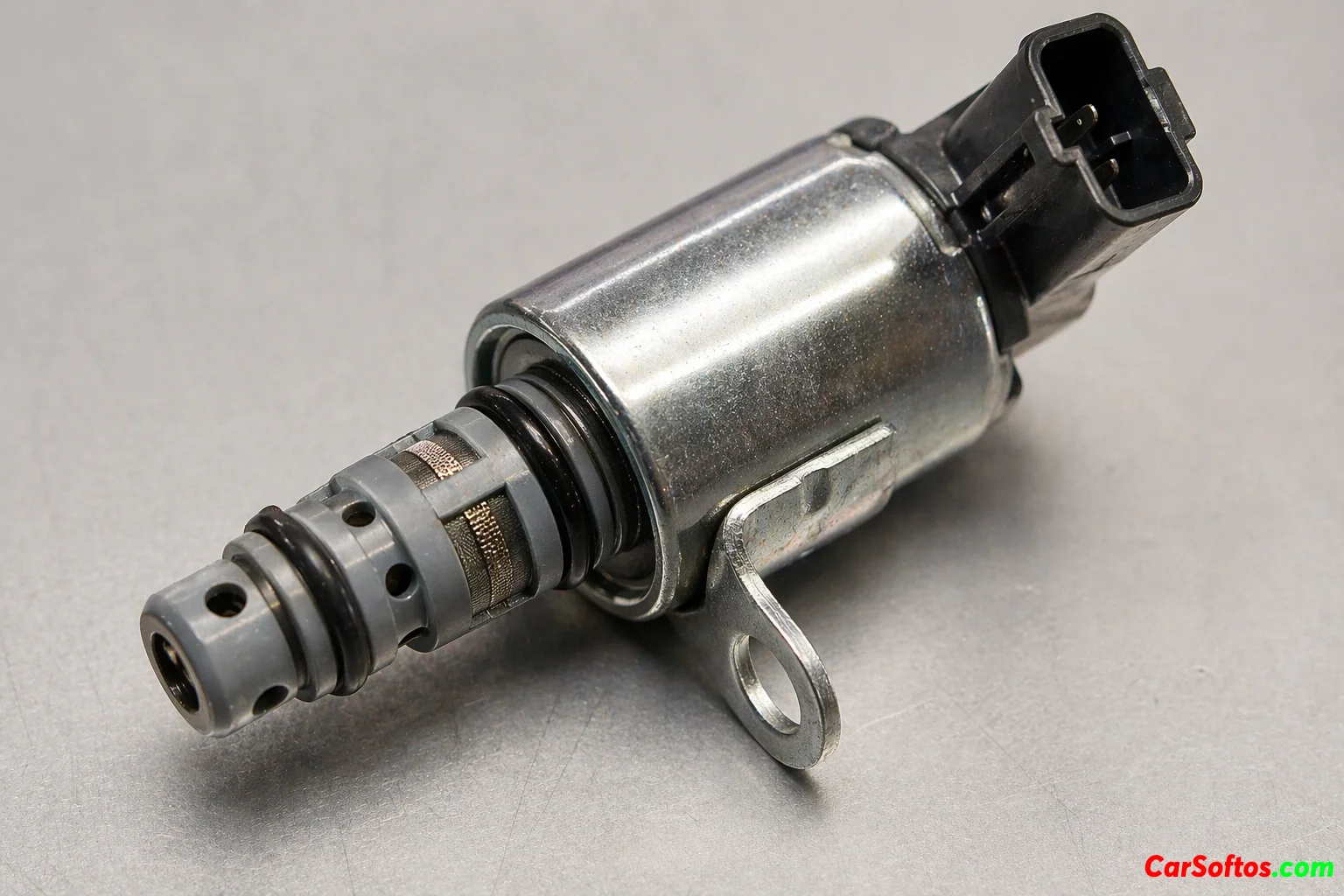
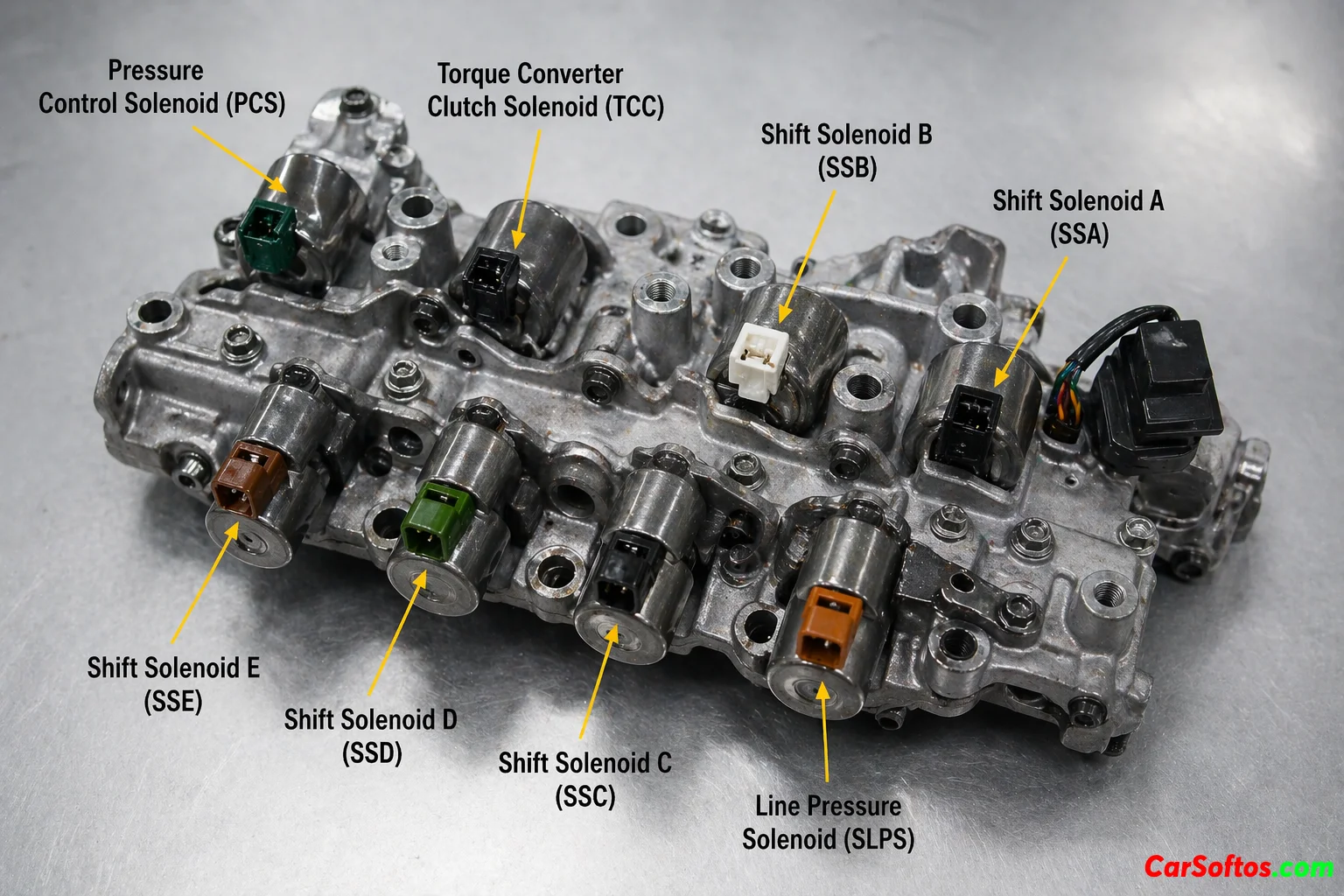
A shift solenoid is an electro-hydraulic valve inside the transmission valve body. The TCM/ECM energizes it to route hydraulic pressure to the right clutch pack or brake band so the transmission can change gears. Toyota technical material shows that when a solenoid like SL1/S1 fails, the controller may fall back to substitute gear control using the remaining solenoids, which is why some vehicles with P0750 still move but shift badly or get stuck in limited gears.
⚠️ How Serious Is P0750?
Severity: ⭐⭐⭐⭐☆ (Medium to High)
P0750 is not a “maybe sometime later” code. It often causes clear drivability problems because gear changes depend on the solenoid working correctly. Toyota service charts tie P0750 directly to solenoid sticking, blocked valve body issues, torque converter clutch issues, and internal automatic transaxle faults. That means the problem can range from a relatively simple solenoid repair to a much deeper hydraulic or internal transmission problem.
A VAG technical bulletin also shows that on some vehicles P0750 can appear with harsh shift, delay and shudder from a stop, and limp-home behavior, and in that specific case the manufacturer linked it to a TCM software error rather than only mechanical failure. That is a reminder that the code must be diagnosed in context, not guessed.
🚨 Common Symptoms of P0750
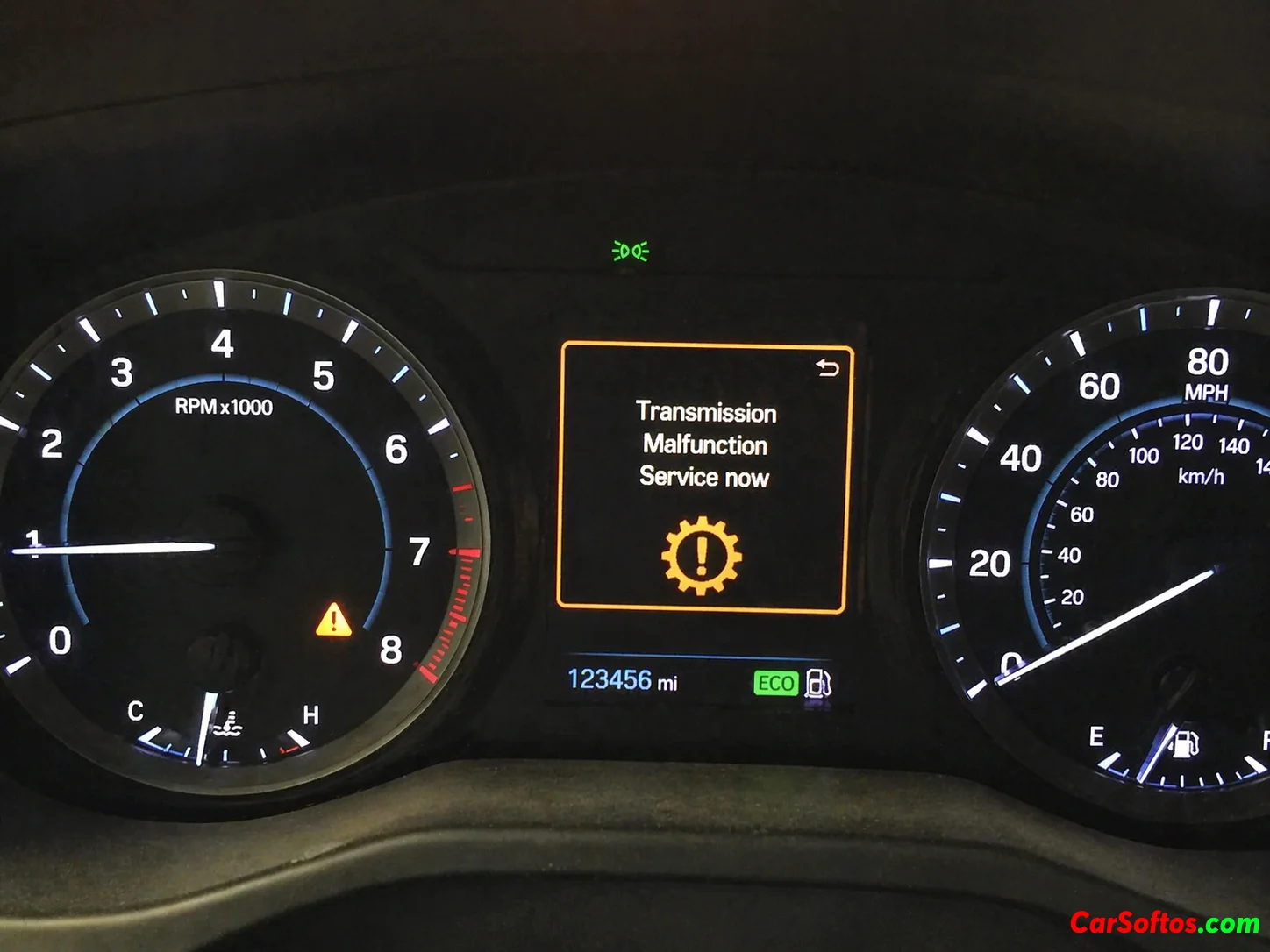
Typical symptoms include:
- ⚠️ Check Engine Light
- ⚠️ harsh shifting
- ⚠️ delayed shifting
- ⚠️ transmission stuck in one gear or limited gears
- ⚠️ limp mode on some vehicles
- ⚠️ poor acceleration from a stop
- ⚠️ shudder or flare during gear changes
- ⚠️ reduced fuel economy if the gearbox no longer shifts efficiently.
🔥 Real-world clue:
If the transmission is electrically alive but shifts hard, skips gears, or seems stuck in a fallback pattern, P0750 often points more toward solenoid function, valve body sticking, or hydraulic contamination than a total electrical failure. That inference is strongly supported by the way Toyota separates P0750 from P0753 in the diagnostic charts.
🧠 Most Common Causes of P0750
1️⃣ Shift Solenoid A stuck open or stuck closed — very common
This is the most direct factory-listed cause. Toyota diagnostic charts repeatedly list SL1 / S1 solenoid stuck open or closed as the primary cause of P0750.
2️⃣ Valve body blocked or sticking
This is one of the biggest reasons P0750 gets misdiagnosed. The solenoid may be fine electrically, but varnish, debris, or sticking valves in the valve body can prevent the hydraulic command from actually working. Toyota specifically lists blocked or stuck valve body as a likely cause.
3️⃣ Dirty, burnt, or contaminated ATF
While not always listed as a one-line code definition, contaminated fluid is one of the most common real-world reasons for valve-body sticking and poor solenoid performance. That is a mechanical inference supported by the OEM valve-body fault paths and by the fact that the code is often functional rather than purely electrical.
4️⃣ Internal transmission problem
Toyota fault charts include the automatic transaxle itself, including clutch/brake/gear problems, among the possible causes. That means P0750 can sometimes be a symptom of deeper internal wear rather than just a simple solenoid replacement job.
5️⃣ Torque converter clutch related issue
Some Toyota charts explicitly include torque converter clutch in the possible fault list for P0750. That does not mean every P0750 is a converter problem, but it means the controller can sometimes see this code in a broader hydraulic control failure pattern.
6️⃣ ECM / TCM or software fault
This is less common, but real. Toyota published a service bulletin for some vehicles where P0750, P0753, P0755, P0758, and P1760 with harsh shifting were linked to a condition corrected by ECM replacement/reprogramming in that specific campaign. A VAG bulletin also ties P0750 on some applications to TCM software error.
🌡️ Why P0750 Gets Confused With P0753
This matters a lot for search traffic and for giving readers real value.
P0750
Usually means Shift Solenoid A Malfunction — often more about mechanical function / hydraulic response. Toyota lists stuck-open/stuck-closed solenoids, blocked valve body, torque converter clutch, ECM, and internal transmission faults.
P0753
Usually means Shift Solenoid A Electrical Malfunction — more directly about open or short in the circuit. Toyota lists open/short in the SL1 circuit, the solenoid itself, and ECM.
👉 Simple explanation:
- P0750 = the solenoid system isn’t functioning right
- P0753 = the solenoid circuit has an electrical problem
🔧 Step-by-Step Diagnosis
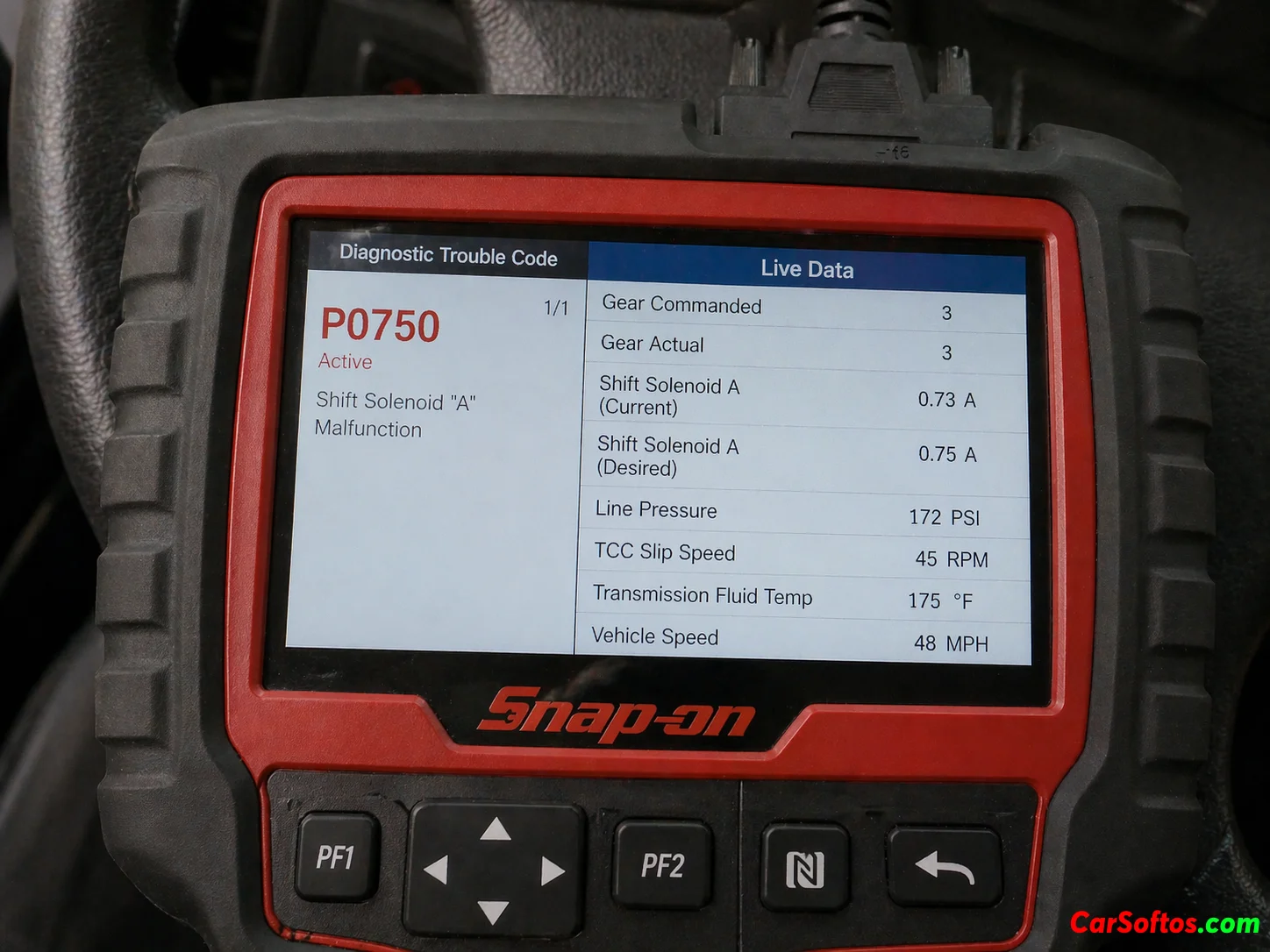
1️⃣ Scan all transmission codes first
Check whether P0750 appears alone or with related codes such as:
- P0753 — Shift Solenoid A Electrical Malfunction
- P0755 / P0758 — Shift Solenoid B faults
- P1760 or other transmission-related control faults
- torque converter clutch or ratio-related codes.
If P0750 appears with multiple shift-solenoid or harsh-shift codes, the problem may be broader than one single solenoid. In some Toyota cases, the manufacturer even tied that pattern to ECM-related logic rather than just hardware.
2️⃣ Check live data and actual shift behavior
Look for:
- commanded gear vs actual gear
- delayed shifts
- flare during shifts
- limp-home behavior
- whether the car starts in a higher gear than normal.
Toyota system descriptions show that when SL1 is abnormal, the transmission can fall back to alternate shift logic using the remaining solenoids, which helps explain why the vehicle may still move but behave abnormally.
3️⃣ Inspect fluid level and condition
This is a high-value step.
Check whether ATF is:
- low
- overfilled
- burnt-smelling
- very dark
- contaminated with debris.
This is not just generic advice. It matters because P0750 is often a function/hydraulic problem, and dirty fluid is one of the most common reasons a valve body or solenoid begins sticking. That conclusion is an inference supported by the OEM valve-body and internal-transmission fault trees.
4️⃣ Test the solenoid itself
Toyota diagnostic procedures for solenoid faults include checking whether the solenoid opens when battery voltage is applied and whether it leaks air when tested pneumatically. That is a strong reminder that a solenoid can fail mechanically even if the circuit looks okay.
5️⃣ Inspect the valve body
If the solenoid tests okay electrically and mechanically, the next suspect is the valve body. Toyota’s diagnostic path explicitly says to inspect the transmission valve body assembly if the solenoid test passes.
6️⃣ Decide whether the problem is deeper than the solenoid
If the valve body is okay but the problem remains, the OEM fault chart allows for:
- torque converter clutch issues
- ECM/TCM control issues
- internal transmission clutch/brake/gear problems.
That is why replacing one solenoid without checking the rest can waste money.
🛠️ How to Fix P0750
✔️ Replace Shift Solenoid A
If testing proves the solenoid is stuck or not responding correctly, replacement is the direct fix. Toyota diagnostic steps support replacing the specific solenoid assembly when it fails the actuation/leak test.
✔️ Repair or clean the valve body
If the solenoid itself passes but hydraulic control is still wrong, the valve body may need cleaning, repair, or replacement. Toyota explicitly sends the technician to valve-body inspection when the solenoid test passes.
✔️ Service the transmission fluid
If ATF is contaminated, servicing the fluid may be an important part of the repair. It may not fix a dead solenoid, but it absolutely matters when the real problem is sticking hydraulics or varnish in the valve body. That is an inference from the OEM fault path and transmission hydraulic behavior.
✔️ Update or replace control module only where OEM guidance specifically applies
On some vehicles, harsh shift plus P0750-family codes were linked by the manufacturer to ECM/TCM software or module issues. This is not the first guess on every car, but it is important enough that it should not be ignored on affected applications.
✔️ Repair internal transmission faults if necessary
If P0750 is being caused by clutch, brake, or gear-related internal problems, the repair may go far beyond the solenoid. Toyota’s fault chart explicitly leaves that possibility open.
💰 Typical Repair Cost
Practical market-style estimates:
| Repair | Typical cost |
|---|---|
| Shift solenoid replacement | $100–$350 |
| Pan removal + fluid/filter service | $150–$400 |
| Valve body cleaning / repair | $300–$900 |
| ECM/TCM reflash or replacement on affected models | $150–$900+ |
| Internal transmission repair | $1,500–$4,500+ |
These are practical market estimates, not factory flat-rate pricing. The big swing happens because P0750 can be a simple solenoid job or a deeper hydraulic/internal transmission problem. That cost framing is strongly supported by the OEM fault trees.
❗ Common Mistakes
❌ Replacing the whole transmission too early
P0750 does not automatically mean the transmission is dead. OEM diagnostics clearly start with the solenoid and valve body before condemning the whole unit.
❌ Treating P0750 like P0753
This is one of the biggest mistakes. P0750 is usually about function/malfunction, not automatically a dead electrical circuit.
❌ Ignoring dirty fluid
Sticking valve-body passages and sticky solenoids often come from bad ATF condition. That is why fluid inspection matters early. This conclusion follows from the OEM valve-body fault path for P0750.
❌ Skipping software bulletins on affected models
Some vehicles with P0750-family complaints were covered by manufacturer bulletins for ECM/TCM-related corrections. Ignoring that can lead to unnecessary parts replacement.
⚖️ P0750 vs Related Codes
P0750
Shift Solenoid A Malfunction — usually more functional/hydraulic in nature.
P0753
Shift Solenoid A Electrical Malfunction — more directly open/short circuit related.
P0755 / P0758
Similar faults for Shift Solenoid B and its electrical circuit, depending on the exact code.
P0770 / P0773
Other transmission solenoid faults that can overlap with shift complaints, but affect different solenoid functions.
👉 Simple explanation:
- P0750 = solenoid A not functioning right
- P0753 = solenoid A electrical circuit problem
- P0755/P0758 = same idea but for solenoid B
🚗 Can You Drive With P0750?
Sometimes, yes — but not for long without diagnosis.
If the vehicle still moves, short-term driving may be possible. But if it is stuck in limp mode, shifts violently, hesitates badly from a stop, or shudders during shifts, it should be diagnosed quickly. That guidance is supported by OEM bulletins and system descriptions showing fallback gear strategies and harsh-shift complaints.
📌 Final Verdict
P0750 usually means Shift Solenoid A is not functioning correctly, but that does not always mean the solenoid is electrically dead. The most common real causes are a stuck solenoid, blocked or sticking valve body, contaminated ATF, control-module issues on some applications, or deeper internal transmission faults. Toyota factory-style diagnostics support exactly that pattern.

Tags:
Users of Guests are not allowed to comment this publication.