
Navigation
Top News
Statistics
Advertisement
Аrchives
Votes
| Rate the site |
Audi P119A Code — Fuel Pressure Sensor Implausible: Causes, Symptoms and Fix
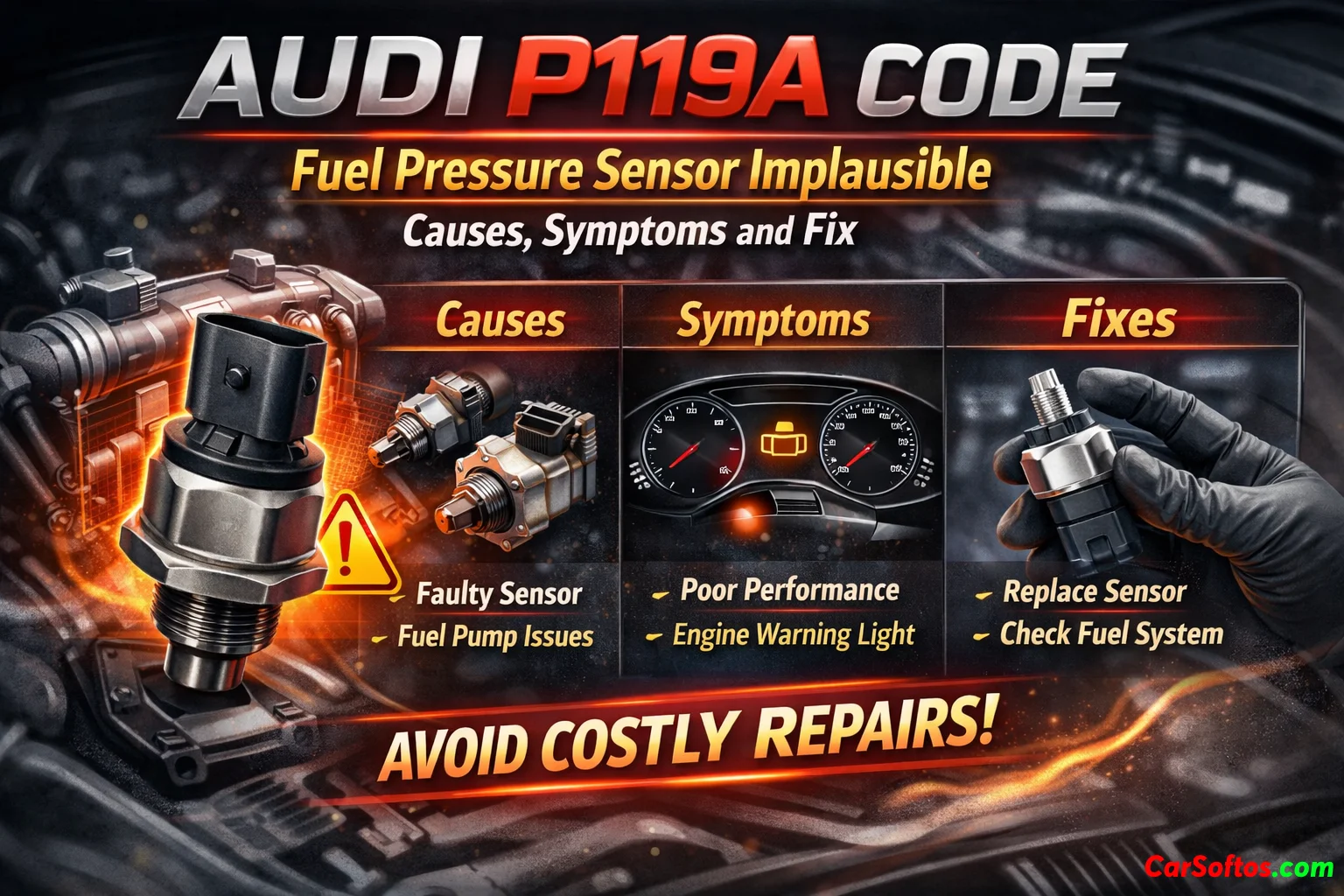
⚠️ What does P119A mean on Audi?
On Audi/VW applications, P119A / 004506 is commonly listed as “Fuel Pressure Sensor (G247): Malfunction.” Ross-Tech notes the usual symptoms as MIL on plus reduced fuel economy and engine performance. It also lists the main causes as a faulty fuel pressure sensor (G247), wiring/connector problems, a faulty HPFP, a leaking fuel injector, and even an exhaust leak in some cases.
In plain English, P119A means the ECU no longer trusts the fuel-pressure signal enough to use it normally. That is why this code is best thought of as an implausible fuel-pressure data fault rather than a guaranteed one-part failure. The key word is implausible: the measured value, expected value, and engine operating conditions no longer match the way they should.
🧠 Why this code matters
Modern Audi FSI/TFSI engines depend on accurate fuel-pressure feedback to control the high-pressure pump, rail pressure, and injector delivery. If the pressure signal is wrong or unstable, the ECU can over-correct, under-fuel, enrich excessively, or fall into protective strategies that hurt performance. Ross-Tech explicitly links P119A to reduced engine performance and reduced fuel economy.
This is also why P119A often appears with other fuel and mixture faults, such as P0087 or lean/rich/misfire codes. Real Audi/VW forum cases show P119A commonly appearing alongside P0087, misfires, and mixture faults when the fuel system problem becomes more severe.
⛽ How the fuel-pressure system works
The basic chain
- Low-pressure fuel pump (LPFP) sends fuel forward from the tank.
- The high-pressure fuel pump (HPFP) raises pressure dramatically for direct injection.
- The fuel rail pressure sensor (G247) reports pressure back to the ECU.
- The ECU adjusts fuel control using that feedback.
On many Audi/VW applications, G247 is the key sensor in this loop. If it gives bad data, the ECU may think fuel pressure is too low, too high, unstable, or simply not believable anymore. Ross-Tech’s fault page and VAG parts references both identify G247 as the relevant fuel-pressure sensor.
🚨 Common symptoms of P119A
Typical real-world symptoms
- Check Engine Light
- reduced engine performance
- poor fuel economy
- hesitation under load
- rough idle
- misfires
- hard starting in some cases
- fuel-related companion codes like P0087 or mixture faults
Ross-Tech directly supports the first two symptoms. The rest are commonly seen in real Audi/VW cases where P119A appears together with low-pressure, rail-pressure, and misfire faults.
🔥 Most common causes of Audi P119A
1️⃣ Faulty fuel pressure sensor (G247)
This is the most direct and most important cause. Ross-Tech lists Fuel Pressure Sensor (G247) first in the possible causes, and the code description itself is built around that sensor. If G247 reads wrong, sticks, spikes, or drifts out of range, the ECU can no longer trust the pressure signal.
Typical sensor-failure clues
- intermittent P119A
- fuel pressure data that jumps or makes no sense
- code returns after clearing without obvious drivability change
- pressure-related faults with no clear pump failure yet
2️⃣ Wiring or connector problem
Ross-Tech also lists wiring and/or connector(s) from and to G247 as a direct cause. This is critical because a bad connector, corroded pin, open circuit, or short can mimic a failed sensor perfectly. Some real VAG owner cases describe damaged sensor connectors causing fuel-pressure implausibility faults.
High-risk areas
- sensor plug itself
- harness section near the rail
- oil/heat-exposed sections
- prior repair areas where connectors were disturbed
3️⃣ Faulty high-pressure fuel pump (HPFP)
Ross-Tech lists a faulty HPFP as a possible cause. This makes sense because if the HPFP cannot build or hold commanded pressure, the sensor may report values that the ECU sees as implausible. On Audi direct-injection engines, HPFP problems often bring P119A together with P0087 or other fuel-pressure faults.
HPFP-like behavior
- pressure falls under load
- hesitation during acceleration
- hard starts or longer cranking
- companion low-rail-pressure codes
4️⃣ Leaking fuel injector
Ross-Tech explicitly lists a faulty (leaking) fuel injector as a cause. A leaking injector can distort rail-pressure behavior enough to confuse the ECU, especially during hot soak, restart, or idle stabilization. Audi/VW forum cases discussing P119A often bring injectors into the picture when the pressure system behaves inconsistently.
Injector-related clues
- fuel smell
- rich-start behavior
- rough idle or hot restart issues
- misfires together with P119A
5️⃣ Fuel pressure regulating valve / metering valve issue
Ross-Tech notes that the fuel pressure regulating valve (N276) or fuel metering valve (N290) on the HPFP can fail, and even provides typical resistance ranges as diagnostic guidance. That is important because P119A may not always be the sensor itself — it can be the control hardware on the pump side causing implausible pressure behavior.
6️⃣ Exhaust leak
This sounds odd, but Ross-Tech specifically includes exhaust leak as a possible cause. The likely reason is that on some setups an exhaust leak can distort engine operation and feedback enough to complicate the fuel-control picture, especially when other lean/misfire issues are present.
7️⃣ Related intake / lean condition issues
Ross-Tech also notes that on some TFSI engines, if P0171 is present with P119A, the underlying cause can even be something like a failed rear main seal, which creates a major unmetered-air problem. Owner reports also show P119A sometimes appearing together with P2279 and lean faults. This is a huge diagnostic clue: sometimes the fuel system is reacting to a broader air/fuel imbalance, not failing alone.
📉 Why P119A is so often misdiagnosed
P119A gets misdiagnosed because owners and even shops often jump straight to HPFP replacement. That can be expensive and wrong.
Ross-Tech’s cause list shows that sensor, wiring, HPFP, injectors, and even exhaust or mixture-related issues can all be behind the same code. Real Audi cases with P119A + P0087 show exactly why proper diagnosis matters: sometimes it is pressure supply, sometimes the sensor, sometimes injectors, and sometimes a broader fueling problem.
The single biggest mistake
Treating P119A like a guaranteed pump failure instead of a fuel-pressure plausibility problem.
🔍 Common code combinations that appear with P119A
P119A + P0087
This is one of the most important combinations. It strongly suggests the pressure system is not just reporting bad data — it may actually be running too low under load. Audi forum cases show this pairing repeatedly.
P119A + misfire codes
This points more toward injector leak, fuel-delivery instability, or pressure dropping badly enough to affect combustion.
P119A + P0171 / P2279
This suggests a broader air/fuel imbalance, where the engine may be lean because of unmetered air and the fuel system is struggling to compensate. Ross-Tech specifically notes the P0171 relationship on some TFSI applications.
🛠️ How to diagnose Audi P119A properly
Step 1: Read all codes, not just P119A
Check whether you also have:
- P0087
- misfire codes
- lean/rich mixture codes
- intake leak codes
This changes the direction of diagnosis immediately.
Step 2: Check live fuel-pressure data
Look for:
- pressure that makes no sense
- spikes or dropouts
- mismatch between requested and actual values
If the data is irrational, the sensor or wiring becomes more suspicious.
Step 3: Inspect G247 and its connector
Since Ross-Tech identifies G247 directly, inspect:
- connector fit
- corrosion
- harness damage
- contamination around the sensor body
Step 4: Evaluate HPFP behavior under load
If the car loses power and logs P0087 with P119A, the HPFP and its control side move much higher on the suspect list.
Step 5: Check for leaking injectors
If hot starts are rough, fuel smell is present, or pressure bleeds off abnormally, injectors deserve attention. Ross-Tech lists leaking injectors directly.
Step 6: Don’t ignore air-intake issues
If lean faults are present too, intake leaks and related TFSI sealing issues can be part of the root cause.
⚠️ Common mistakes
- replacing the HPFP first
- ignoring the sensor connector
- ignoring companion lean/misfire codes
- replacing injectors before checking pressure data
- assuming “sensor implausible” always means “bad sensor”
Ross-Tech’s cause list alone shows why these shortcuts are risky.
💰 Typical repair cost range
Repair cost depends on the real cause:
- G247 fuel pressure sensor: usually low to moderate
- wiring/connector repair: low to moderate
- HPFP replacement: expensive
- injector replacement: moderate to expensive
- N276/N290 or other pump-control-side repair: moderate to expensive
That spread is exactly why P119A is such a valuable diagnostic article topic: the reader needs to avoid a wrong expensive guess.
🚗 Can you drive with P119A?
Sometimes yes, but it is not smart to ignore it.
If the car only has a stored code and drives mostly normally, you may still be able to drive short-term. But if P119A comes with:
- reduced power
- rough running
- misfires
- P0087
- hard starting
then continuing to drive is a bad idea, because the fuel-pressure problem may be getting worse. Ross-Tech specifically lists reduced performance and reduced fuel economy as typical symptoms.
✅ Final verdict
P119A on Audi/VW means the ECU no longer trusts the fuel-pressure signal or fuel-pressure behavior. The most common real causes are:
- faulty fuel pressure sensor (G247)
- wiring or connector issue
- faulty HPFP
- leaking injector
- pressure-regulating / metering valve issue
- sometimes broader lean or intake-related problems.
The most important takeaway
Do not replace the HPFP just because you saw P119A. Check G247, its wiring, live fuel data, and companion codes first. That is the most evidence-based diagnostic order from the available sources.

Tags:
Users of Guests are not allowed to comment this publication.