
Navigation
Top News
Statistics
Advertisement
Аrchives
Votes
| Rate the site |
P0713 Trouble Code: Transmission Fluid Temperature Sensor High Input Explained
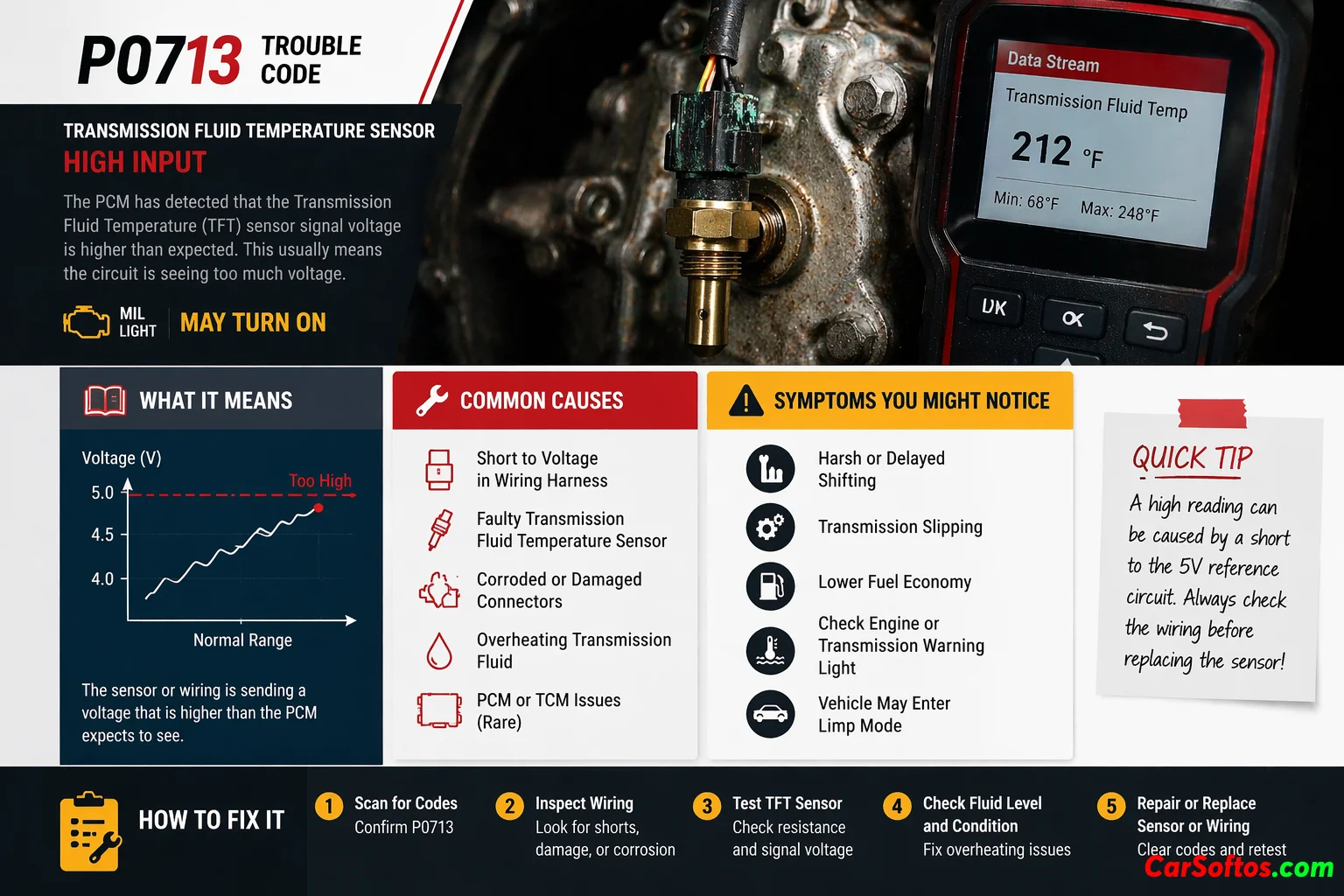
P0713 is the generic OBD-II code for Transmission Fluid Temperature Sensor “A” Circuit High Input. OEM-style service material uses that definition consistently, and Toyota transmission diagnostics place P0713 in the same family as P0711 and P0712, but specifically as the high-input version of the transmission fluid temperature sensor fault.
👉 In simple words:
The transmission computer is seeing a voltage signal that is too high from the transmission fluid temperature sensor circuit. On many thermistor-based systems, a high signal voltage usually makes the module calculate an extremely low transmission fluid temperature, even when the transmission is warm or hot. Toyota-style diagnostic hints specifically contrast this with P0712, where the module sees an unrealistically hot value.
⚙️ How the Transmission Fluid Temperature Sensor Works
The transmission fluid temperature sensor is usually a thermistor. Toyota service information explains that the ECM applies voltage to the ATF temperature sensor, the sensor resistance changes with temperature, and the signal voltage changes accordingly. The same materials note that sensor resistance and voltage decrease as temperature gets higher, which is why a high-input code often points to an open circuit or very high resistance rather than real overheating.
That temperature input is used for more than just warning lights. The transmission controller relies on it for shift timing, torque converter clutch behavior, line pressure strategy, and temperature protection logic. When that signal becomes unreliable, shift quality and protection behavior can change even if the transmission itself is not physically overheating.
⚠️ How Serious Is P0713?
Severity: ⭐⭐⭐⭐☆ (Medium to Medium-High)
P0713 is usually not as immediately dangerous as a confirmed overheat code like P0218, but it still should not be ignored. A false cold reading can distort shift strategy, delay normal operation, and on some vehicles trigger warning messages or limp behavior. Repair references and OEM guidance for the P0711/P0712/P0713 family treat this as a fault that needs diagnosis rather than something to simply clear and ignore.
The most important nuance is this: P0713 usually points first to a sensor or circuit problem, not automatically to a transmission that is actually overheating. That makes it very different from P0218. Still, if P0713 appears with slipping, burnt ATF, or multiple transmission faults, you should not assume it is electrical only. That conclusion is an inference based on the code family definitions and how transmission complaints overlap in real diagnostics.
🚨 Common Symptoms of P0713
Typical symptoms can include:
- ⚠️ Check Engine Light or transmission warning light
- ⚠️ harsh, delayed, or erratic shifting
- ⚠️ limp mode on some vehicles
- ⚠️ incorrect transmission temperature value in live data
- ⚠️ poor drivability during warm-up
- ⚠️ sometimes no strong symptoms at first, especially if the signal fault is intermittent.
🔥 Real-world clue:
A strong clue is a scan tool showing unrealistically low transmission temperature from a cold start or after normal driving. On Toyota-style systems, P0713 is associated with the high-input side of the circuit, which typically matches an open circuit or very high resistance condition.
🧠 Most Common Causes of P0713
1️⃣ Open circuit in the TFT sensor signal path — very common
This is one of the biggest causes. Nissan-style service information for P0713 describes it as the A/T temperature sensor open circuit, and Toyota-style diagnostics place P0713 on the high-input side of the TFT circuit logic. That makes an open circuit one of the most important first suspects.
2️⃣ Faulty transmission fluid temperature sensor
A failed sensor can internally go open or otherwise produce a high-input condition. Hyundai service bulletins for the P0711/P0712/P0713 family specifically direct technicians to replace the correct related part, which may be the temperature sensor or a harness/module assembly depending on the transmission design.
3️⃣ Damaged or corroded connector
Loose terminals, fluid intrusion, corrosion, or broken connector locks can raise circuit resistance enough to set P0713. Generic diagnostic references for P0713 consistently include bad connectors and wiring faults among the common causes.
4️⃣ Internal transmission harness problem
On many vehicles, the TFT sensor is part of the internal harness or closely integrated with internal transmission wiring. Hyundai’s TSB for this code family is especially useful because it shows that the proper fix may be an internal harness with the oil temperature sensor or an integrated module, not a whole transmission.
5️⃣ Rarely, control module or calibration issue
This is less common, but possible. Hyundai service guidance for this family notes that if the DTC returns after the repair procedure and drive cycles, PCM-related diagnosis becomes relevant. That does not make the module the first suspect, but it means the fault is not always just the sensor itself.
🌡️ Why P0713 Gets Confused With P0711 and P0712
This matters a lot for correct diagnosis.
- P0711 = the temperature reading exists, but behaves implausibly or out of expected range
- P0712 = the signal is too low
- P0713 = the signal is too high.
👉 Simple explanation:
- P0711 = reading acts wrong
- P0712 = signal too low
- P0713 = signal too high
That means P0713 often points more directly toward an open circuit, poor connection, or sensor fault than P0711 does. P0712 and P0713 are the “harder” low/high circuit-side faults, while P0711 is the rationality/performance version.
🔧 Step-by-Step Diagnosis
1️⃣ Scan all codes first
Check whether P0713 appears alone or together with related transmission codes such as:
- P0711 — Transmission Fluid Temperature Sensor Range/Performance
- P0712 — Transmission Fluid Temperature Sensor Low Input
- P0218 — Transmission Over Temperature Condition
- shift or pressure-related transmission codes.
If P0713 appears together with real overheat or slip codes, the issue may not be only electrical. But if it appears mostly by itself and live temperature looks impossible, the sensor circuit becomes the stronger suspect. That is an inference based on the OEM definitions and common transmission fault interactions.
2️⃣ Check live data with a cold vehicle
This is one of the best first checks. On a vehicle that has sat overnight, TFT should usually be somewhere near ambient temperature. If the scan tool shows a very low or clearly implausible temperature immediately, that strongly supports a high-input / open-circuit diagnosis. Toyota-style diagnostic logic is especially helpful here because it clearly distinguishes the high-input and low-input sides of the TFT circuit.
3️⃣ Inspect the sensor connector and harness
Look for:
- corrosion
- fluid intrusion
- bent or spread terminals
- damaged wiring near the transmission
- broken lock tabs
- rubbed or pulled wiring.
The image results are also a useful reminder that on many transmissions the TFT sensor is not in some simple external location; it may be integrated with internal transmission harnessing or mounted where connector damage from heat, fluid, and vibration is common.
4️⃣ Check for an open circuit
This is a load-bearing diagnostic step. Nissan-style documentation for P0713 directly identifies the code as an open circuit problem, and Toyota service material places it on the high-input side of the thermistor logic. That means continuity, connector contact quality, and internal harness integrity matter a lot here.
5️⃣ Verify fluid condition too
Even though P0713 is primarily a high-input circuit code, you should still inspect ATF level and condition. If the fluid is burnt, low, or contaminated, you may be dealing with a sensor-circuit problem and a real transmission issue at the same time. This is a practical inference based on the broader transmission fault patterns described in repair references.
6️⃣ Confirm whether the sensor is separate or integrated
This changes the repair a lot. On some vehicles, the TFT sensor is serviced separately. On others, the correct repair is an internal harness or E-module. Hyundai’s TSB is especially useful here because it explicitly lists those possibilities instead of recommending complete transaxle replacement first.
🛠️ How to Fix P0713
✔️ Replace the TFT sensor
If the sensor itself has failed open and the rest of the wiring checks out, replacing the temperature sensor is a common fix. OEM and repair references both support this where the sensor is serviceable separately.
✔️ Repair the connector or wiring
If the signal wire is open, the connector is corroded, or the harness has high resistance, wiring repair can solve the fault without replacing larger components. Generic P0713 references consistently point to these causes.
✔️ Replace the internal harness / module assembly when required
On some Hyundai/Kia-style applications, the correct repair is replacing the internal harness with the oil temperature sensor or the E-module, depending on the transmission design. The official TSB is clear that the repair should target the specific related part rather than the whole transaxle.
✔️ Service the transmission fluid if needed
If ATF is old, low, or contaminated, servicing it may be necessary as part of the overall repair, even though fluid alone will not fix an electrical open circuit.
💰 Typical Repair Cost
Practical market-style estimates:
| Repair | Typical cost |
|---|---|
| TFT sensor | $50–$250 |
| Connector repair / cleaning | $20–$100 |
| Wiring repair | $50–$250 |
| Internal harness / E-module repair | $150–$700+ |
| ATF service | $100–$350 |
| Advanced diagnosis | $100–$250 |
These are broad market estimates, not OEM flat-rate pricing. The biggest cost swing depends on whether the TFT sensor is simple and external or part of an internal harness/module assembly. Hyundai’s service bulletin strongly supports that distinction.
❗ Common Mistakes
❌ Replacing the whole transmission too early
Hyundai service guidance for the P0711/P0712/P0713 family explicitly points technicians toward the correct sensor/harness/module repair path rather than whole-transaxle replacement first.
❌ Ignoring live-data checks
P0713 is one of those codes where live-data behavior is extremely revealing. If the transmission is cold and the scan tool already shows an implausibly low temperature, that is a huge clue.
❌ Confusing P0713 with real overheat
P0218 is the code more directly associated with actual transmission overtemperature. P0713 is primarily a high-input circuit fault.
❌ Forgetting integrated sensor designs
Some vehicles do not let you replace only a tiny external sensor. The proper repair may require an internal harness or module assembly, which is why service information matters before ordering parts.
⚖️ P0713 vs Related Codes
P0713
Transmission fluid temperature sensor high input — signal too high, often associated with an open circuit or unrealistically low displayed temperature.
P0711
Transmission fluid temperature sensor range/performance — reading exists, but behaves implausibly.
P0712
Transmission fluid temperature sensor low input — signal too low, often associated with an unrealistically high displayed temperature.
P0218
Transmission over temperature condition — usually a real overheating event rather than just a sensor-circuit problem.
👉 Simple explanation:
- P0711 = temp reading acts wrong
- P0712 = temp signal too low
- P0713 = temp signal too high
- P0218 = transmission actually too hot.
🚗 Can You Drive With P0713?
Sometimes, yes — but not for long without diagnosis.
If the transmission still shifts acceptably and there is no real overheat warning, short-term driving may be possible. But if the car is shifting badly, entering limp mode, or showing additional transmission faults, it should be diagnosed soon. The key question is whether the problem is only a faulty signal or whether it is happening together with a real transmission issue.
📌 Final Verdict
P0713 usually means the transmission computer is seeing a TFT signal voltage that is too high. The most common real causes are an open circuit, a failed transmission fluid temperature sensor, connector corrosion, wiring damage, or an internal harness/module issue depending on the transmission design. OEM-style diagnostic material strongly supports that pattern.

Tags:
Users of Guests are not allowed to comment this publication.