
Navigation
Top News
Statistics
Advertisement
Аrchives
Votes
| Rate the site |
P0218 Code — Transmission Over Temperature Condition (Causes, Symptoms & Fix Guide)
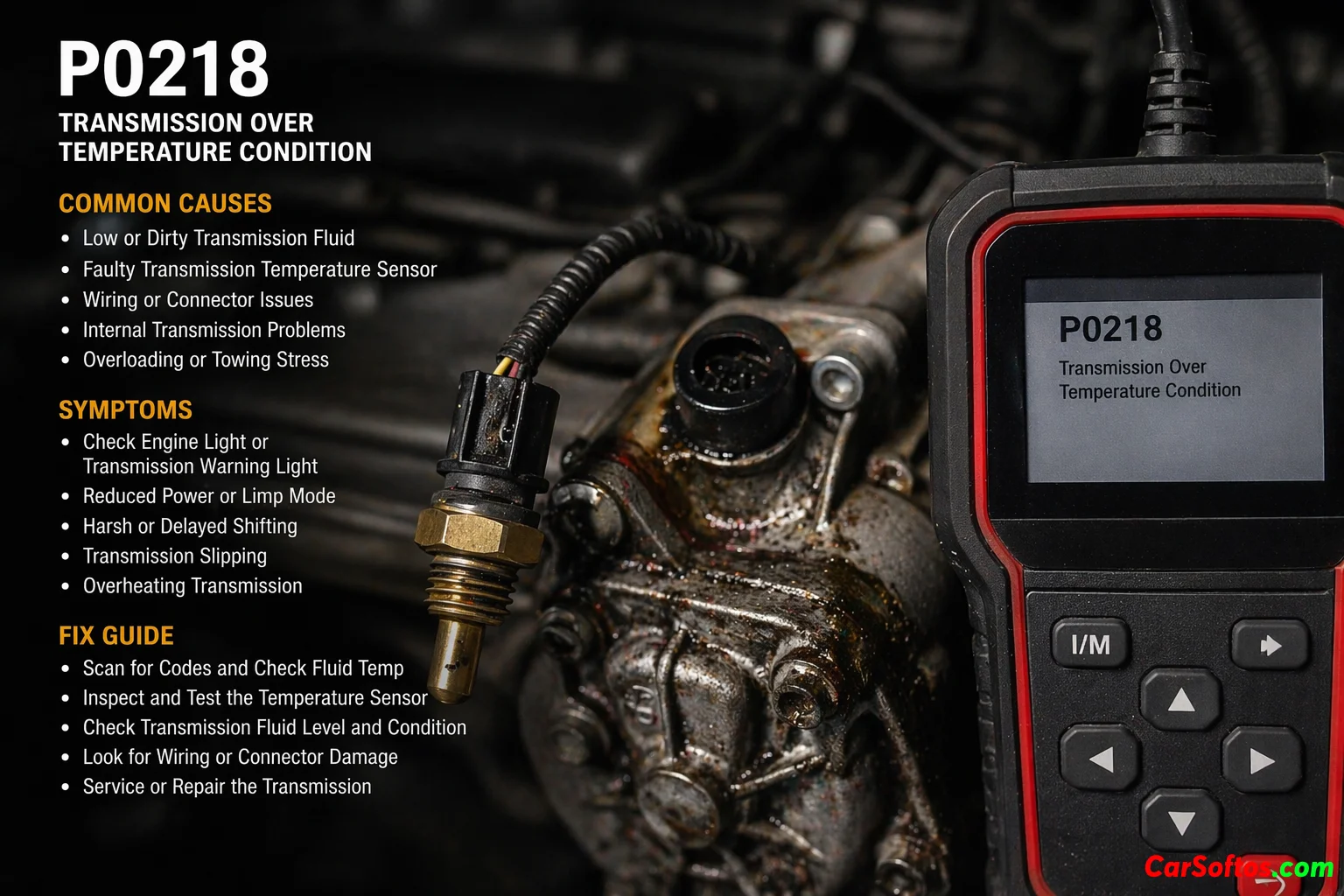
P0218 is the generic OBD-II code for Transmission Over Temperature Condition or Transmission Fluid Over Temperature Condition. Heavy-duty and OEM service references use essentially that same definition, and one published diagnostic reference shows the code setting when transmission sump temperature exceeds 126°C / 252°F for 10 seconds on that application.
👉 In simple words:
Your transmission computer is saying:
- the transmission fluid got too hot
- or the temperature was high enough to trigger overheat protection
- so the vehicle may reduce performance or change shift behavior to protect the gearbox.
⚙️ Why Transmission Temperature Matters
Automatic transmissions depend on fluid not only for lubrication, but also for hydraulic pressure, clutch application, and cooling. When ATF gets too hot, shift quality can worsen, fluid can darken or smell burnt, and the transmission may enter a protective strategy. Repair references for P0218 commonly list harsh shifting, slipping, delayed engagement, and reduced performance as typical consequences of overheating.
⚠️ How Serious Is P0218?
Severity: ⭐⭐⭐⭐⭐ (Very High)
P0218 is not a minor sensor code. It usually means the transmission actually overheated enough for the controller to notice and store a fault. Repair references warn that continued driving can damage the fluid and the transmission itself, and some vehicles may trigger limp mode or reduced-power behavior.
🚫 Can you keep driving?
Usually only long enough to get somewhere safe. If the transmission warning is active, shifting becomes harsh, or the car shows a “Transmission Hot” message, the safer move is to stop, let it cool, and diagnose the cause instead of continuing normally. Volkswagen Vans’ owner guidance and Hyundai owner guidance both treat transmission overheat warnings as a stop-and-cool-down situation.
🚨 Common Symptoms of P0218
Typical symptoms include:
- ⚠️ Check Engine Light
- ⚠️ transmission temperature warning or “Transmission Hot” message
- ⚠️ harsh or delayed shifts
- ⚠️ slipping transmission
- ⚠️ reduced performance or limp mode
- ⚠️ dark, burnt-smelling transmission fluid
- ⚠️ some vehicles refusing to shift normally until temperature drops.
🔥 Real-world clue:
If overheating happens mainly while towing, climbing hills, or in stop-and-go traffic, that strongly points toward a cooling-capacity problem, low fluid, slipping, or restricted cooler flow rather than a random electrical glitch. That is an inference from the most commonly documented P0218 causes and overheat-driving conditions.
🧠 Most Common Causes of P0218
1️⃣ Low transmission fluid — very common
Low ATF reduces cooling and hydraulic stability. It is one of the most commonly listed causes in P0218 repair references because low fluid makes the transmission work hotter and can quickly lead to slipping and overheat.
2️⃣ Burnt, old, or incorrect transmission fluid
Old fluid loses cooling and friction-control performance. Several P0218 references connect overheating with burnt or degraded fluid, and burnt fluid smell/discoloration is repeatedly listed as a symptom clue.
3️⃣ Clogged or restricted transmission cooler
A blocked cooler, cooler line restriction, or cooler integrated with the radiator not rejecting heat properly can trigger P0218. Diagnostic references specifically mention plugged transmission oil coolers and cooling-related restrictions as causes.
4️⃣ Cooling fan problem or poor airflow
On vehicles where transmission cooling depends partly on radiator airflow, a bad cooling fan, fan clutch, or missing air dam/spoiler can contribute to overheating. Repair references explicitly list broken cooling fans and missing airflow aids among the causes.
5️⃣ Heavy towing, high load, steep grades, sand, or repeated stop-and-go driving
These conditions generate a lot of heat in the torque converter and clutch packs. OEM owner guidance for transmission-overheat warnings specifically mentions repeated launches, steep grades, and high-load operation as common triggers.
6️⃣ Internal slipping or mechanical transmission problem
If internal clutches slip, heat rises fast. Repair references for P0218 often mention slipping, harsh shifts, and delayed engagement not just as symptoms, but as signs that the transmission may be generating excess heat internally.
7️⃣ Overfilled transmission on some applications
This one gets missed a lot. GM training material specifically notes that overfilling can cause overheating and set P0218 on some transmissions.
8️⃣ Temperature sensor or wiring issue — less common than true overheating
A bad sensor can confuse diagnosis, but compared with codes like P0711/P0712/P0713, P0218 is much more often associated with a real overheat event than with a simple signal fault. That is an inference based on how P0218 is defined and diagnosed in the references above.
🌡️ Why P0218 Is Often Misdiagnosed
A lot of people replace the temperature sensor first. Sometimes that is relevant, but P0218 is usually a real overheating code, not just a bad-signal code. The strongest diagnostic value comes from checking fluid condition, cooler flow, fan operation, and whether the transmission is slipping under load.
👉 Simple rule:
- warning after towing / traffic / hills → think heat load and cooling
- burnt fluid + bad shifting → think internal slip or cooked fluid
- warning with low fluid → fix leaks/level first
- warning after service with overfill → check fluid level carefully.
🔧 Step-by-Step Diagnosis
1️⃣ Confirm the overheat event with scan data
Check:
- stored P0218
- freeze-frame data
- transmission temperature when the code set
- whether the fault happened during towing, highway climbing, or stop-and-go driving.
2️⃣ Check transmission fluid level and condition first
Before replacing parts, inspect ATF level the correct way for that transmission and look at the fluid:
- too low?
- overfilled?
- dark?
- burnt smell?
- metal debris?
3️⃣ Inspect for leaks
Look for:
- wet cooler lines
- pan leaks
- radiator/cooler seepage
- axle seal leakage
- fluid residue around fittings.
Low ATF is one of the highest-yield checks on a P0218 car.
4️⃣ Check cooler and airflow path
Inspect:
- transmission cooler
- radiator fins
- airflow blockage
- bent fins
- fan operation
- missing lower air dam or spoiler where applicable.
5️⃣ Decide whether the problem is external cooling or internal slip
If the car overheats only under heavy load but shifts normally otherwise, cooler capacity/airflow/ATF condition is more likely. If it overheats and also slips, bangs, or delays engagement, internal wear becomes much more likely. That is an inference supported by the documented symptoms and causes in P0218 repair references.
6️⃣ Check for related codes
Related codes can help narrow the cause, especially if there are additional transmission temperature sensor, pressure, or solenoid faults present. Some OEM bulletins present P0218 alongside broader transmission diagnostic routines rather than as a stand-alone issue.
7️⃣ Confirm repair with a real drive cycle
After repair, recheck temperature under the conditions that originally triggered the fault. A transmission that no longer overheats in the same situation is a much stronger repair confirmation than just clearing the code. This is an inference from how overheat faults are triggered under operating conditions.
🛠️ How to Fix P0218
✔️ Correct fluid level and replace damaged ATF
If ATF is low, overfilled, burnt, or contaminated, correcting the level and servicing the fluid is often the first real repair step.
✔️ Repair leaks
If the transmission is losing fluid, the leak has to be fixed or the code will come back.
✔️ Repair or replace the transmission cooler / cooler lines
A blocked or weak cooler is a classic P0218 cause.
✔️ Repair fan / airflow problems
If the overheat happens in traffic or at idle, the fan system and airflow path become high-priority fixes.
✔️ Address towing/usage overload
If the transmission is overheating because the load is beyond what the cooling system can handle, the fix may include cooler upgrades, load reduction, driving style changes, or better maintenance intervals. That is an inference from OEM overheat guidance and typical causes.
✔️ Repair internal transmission problems if it is slipping
If P0218 is caused by internal clutch slip or mechanical wear, fluid changes alone usually will not solve it.
💰 Typical Repair Cost
Practical market-style estimates:
| Repair | Typical cost |
|---|---|
| Fluid service / level correction | $80–$300 |
| Small leak repair | $80–$350 |
| Cooler line repair | $100–$400 |
| External cooler replacement | $200–$700 |
| Fan / airflow repair | $150–$700 |
| Advanced transmission diagnosis | $100–$250 |
| Internal transmission repair / rebuild | $1,500–$5,000+ |
These are broad market estimates, not factory flat-rate pricing. The biggest cost swing depends on whether the problem is cooling/maintenance-related or internal transmission damage. That conclusion is supported by the cause list above.
❗ Common Mistakes
❌ Clearing the code and continuing to drive hard
This is one of the worst mistakes with P0218. If the transmission is overheating for real, continuing to tow or drive hard can make the damage much worse.
❌ Ignoring fluid condition
Burnt or dark fluid is not just cosmetic. It is often a sign the transmission has already been too hot.
❌ Replacing the sensor first without checking fluid/cooler/fan
P0218 is much more often a real overheat problem than a simple sensor problem.
❌ Forgetting overfill as a cause
Some people only think of low fluid, but GM training material explicitly notes overfill can also overheat a transmission and set P0218.
⚖️ P0218 vs Related Codes
P0218
Transmission over temperature condition — the transmission actually overheated enough to trip protection logic.
P0217
Engine over temperature condition — engine cooling problem, not transmission cooling problem.
Transmission temperature sensor circuit codes
Those are more about the signal itself being wrong; P0218 is more about a real overheat event. That distinction is an inference based on the code families and how P0218 is described in the references above.
👉 Simple explanation:
- P0218 = transmission too hot
- P0217 = engine too hot
- sensor-circuit codes = temp signal problem
🚗 Can You Drive With P0218?
Only enough to get somewhere safe — not as normal driving.
If the transmission warning is active, shifts are getting harsh, or the vehicle is in limp mode, continuing to drive normally risks expensive damage. Let it cool, check fluid, and diagnose the cause before using it hard again.
📌 Final Verdict
P0218 usually means the transmission actually overheated, not just that the temperature signal looked strange. The most common real causes are low or burnt fluid, a clogged or weak cooler, poor airflow/fan problems, towing or heavy-load heat, or internal transmission slip.

Tags:
Users of Guests are not allowed to comment this publication.