
Navigation
Top News
Statistics
Advertisement
Аrchives
Votes
| Rate the site |
Can You Drive With P0238? Turbo Boost Sensor Circuit High
🔍 What Does P0238 Mean?
P0238 is the generic OBD-II definition for Turbocharger / Supercharger Boost Sensor “A” Circuit High. Ford code references use that wording, and Ross-Tech describes it as a manifold pressure / boost sensor signal too high fault.
In simple terms, the ECU is seeing a boost-pressure sensor voltage that is higher than expected. Some diagnostic references describe this as the sensor signal being above the normal operating range, and Nissan-style service information cited online describes it as an excessively high voltage from the turbo boost sensor being sent to the ECM.
⚙️ What This Code Usually Means in Real Life
P0238 is usually more of a sensor-signal or electrical fault than a true “the turbo is definitely overboosting” code. In practice, it often points to:
- a faulty boost/MAP sensor
- signal wire shorted to voltage
- connector corrosion or terminal damage
- sensor reference or ground problem
- wiring harness damage
- on some vehicles, related boost-control issues that make the signal look implausibly high.
That is why P0238 is different from P0236 and P0237:
- P0236 = signal range/performance problem
- P0237 = signal too low
- P0238 = signal too high.
⚠️ How Serious Is P0238?
Severity: Medium to High
The code itself is electrical, but the effect can still be serious because the ECU may reduce power, limit turbo control, or trigger limp mode when it cannot trust the boost signal. Lists MIL activation for this fault, and practical diagnostic references describe drivability issues when boost sensor input is wrong.
If the car has heavy power loss, unstable turbo behavior, or multiple turbo-related codes at the same time, the issue should be treated quickly. That is an inference based on how boost-control systems react to invalid pressure input.
🚨 Common Symptoms of P0238
Typical symptoms may include:
- ✅ Check Engine Light
- ✅ Reduced engine performance
- ✅ Weak acceleration
- ✅ Turbo not responding normally
- ✅ Limp mode on some vehicles
- ✅ Hesitation under load
- ✅ Incorrect boost readings in live data
- ✅ Sometimes intermittent drivability problems.
🧠 Most Common Causes of P0238
1️⃣ Faulty boost pressure sensor / MAP sensor
This is one of the most common causes. Directly lists the manifold pressure / boost sensor itself, and multiple references describe P0238 as a high-input boost-sensor fault.
2️⃣ Wiring short to voltage
If the signal wire is shorted to power, the ECU can see an abnormally high voltage and set P0238. Threshold-based diagnostic references describe the code as a high-input condition, which strongly supports this failure pattern.
3️⃣ Bad sensor ground or reference issue
A missing ground or abnormal reference behavior can distort the output signal and make it appear too high. Practical diagnostic writeups for boost-sensor faults include power/ground checking as a key step.
4️⃣ Corroded or loose connector
Bent pins, green corrosion, moisture intrusion, oil contamination, or a loose terminal fit can create unstable high-input faults. Ross-Tech’s cause list explicitly includes wiring and connectors.
5️⃣ Harness damage near heat or vibration points
Turbo engines run hot, and wiring near the turbo, intake, heat shields, or brackets can chafe or melt. That is a practical inference from the documented wiring-related causes and the normal layout of turbo systems.
6️⃣ Less commonly: real boost-control problems affecting sensor behavior
Although P0238 is mainly an electrical/signal code, some broader turbo-control faults can distort pressure readings or create implausible boost behavior that contributes to this code family.
🔧 Step-by-Step Diagnosis
1️⃣ Scan all stored codes
First, check whether P0238 appears alone or together with related turbo codes such as:
- P0236 — Boost Sensor Range/Performance
- P0237 — Boost Sensor Low
- P0299 — Underboost
- P2262 — Boost Pressure Not Detected
- P2563 — Turbo Boost Control Position Sensor Range/Performance.
If P0238 appears with other boost-control codes, the sensor fault may be affecting the entire turbo-control strategy, not just one isolated circuit. That is an inference based on how these code families overlap.
2️⃣ Check live data
Look at:
- boost pressure / MAP
- sensor voltage if available
- BARO if available
- desired vs actual boost.
A strong clue is a sensor value that looks unrealistically high with key-on engine-off or does not change logically with engine load. High-input references describe the code as the ECU seeing excessive boost-sensor voltage.
3️⃣ Inspect the sensor and connector
Check for:
- bent pins
- water intrusion
- oil contamination
- broken lock tab
- loose fit
- green corrosion.
This is one of the highest-value checks because P0238 is often caused by a simple electrical problem, not a destroyed turbo.
4️⃣ Verify 5V reference, ground, and signal
If you have wiring info and a multimeter, confirm:
- 5V reference present
- good ground
- signal not stuck abnormally high.
This follows directly from the code being a high-input sensor-circuit fault.
5️⃣ Inspect harness routing
Look for damage near:
- turbo area
- intake manifold
- battery tray
- brackets
- heat shields.
This matters because heat and rubbing are common reasons for boost-sensor wiring faults on turbo vehicles. That is a practical inference grounded in the documented wiring/connector causes.
6️⃣ Check boost plumbing only after the circuit
P0238 is usually a signal-high problem first, so the sensor circuit should be checked before condemning hoses, actuator parts, or the turbo itself.
🛠️ How to Fix P0238
The correct repair depends on the root cause, but the most common fixes are:
✔️ Replace the boost/MAP sensor
If the signal is stuck high and power/ground are correct, the sensor may be bad.
✔️ Repair wiring or connector damage
If the signal wire is shorted to voltage or the connector is corroded, wiring repair can solve the problem without replacing larger parts.
✔️ Restore proper ground / reference
If the circuit feed or ground is faulty, the sensor reading may stay artificially high until that is repaired.
✔️ Repair related harness damage near heat sources
This is especially important on turbo engines where wiring lives close to hot and vibrating parts.
💰 Typical Repair Cost
A practical article-friendly estimate:
- Boost/MAP sensor: $60–$250
- Connector repair / cleaning: $10–$80
- Wiring repair: $20–$150
- Advanced diagnosis: $50–$150
These are practical market-style ranges, not a single official price table. Exact cost varies by vehicle and by how easy the sensor is to access. The repair categories themselves are grounded in the documented causes for P0238.
❗ Common Mistakes
❌ Replacing the turbo immediately
P0238 is usually not the first code that should make you condemn the turbo. It is much more commonly tied to the sensor circuit, wiring, connector, or power/ground issues.
❌ Ignoring the connector
A corroded connector can make a good sensor look bad. Ross-Tech explicitly points to wiring and connectors as common causes.
❌ Skipping live-data checks
You can waste money fast if you do not confirm whether the signal is truly high in live data. High-input references define P0238 as an excessive sensor-voltage condition.
❌ Confusing P0238 with P0236
P0236 is range/performance; P0238 is high input. They are close neighbors, but not the same failure type.
⚖️ P0238 vs Related Turbo Codes
P0238
Boost sensor “A” circuit high input. The ECU sees a signal that is too high.
P0236
Boost sensor “A” circuit range/performance. The signal is implausible or behaving incorrectly, but not necessarily hard-high.
P0237
Boost sensor “A” circuit low input. Opposite direction: the ECU sees a signal that is too low.
P2563
More focused on turbo control position feedback / actuator side rather than raw boost-sensor voltage.
👉 Simple explanation:
- P0236 = signal looks wrong
- P0237 = signal too low
- P0238 = signal too high
- P2563 = actuator/position side looks wrong.
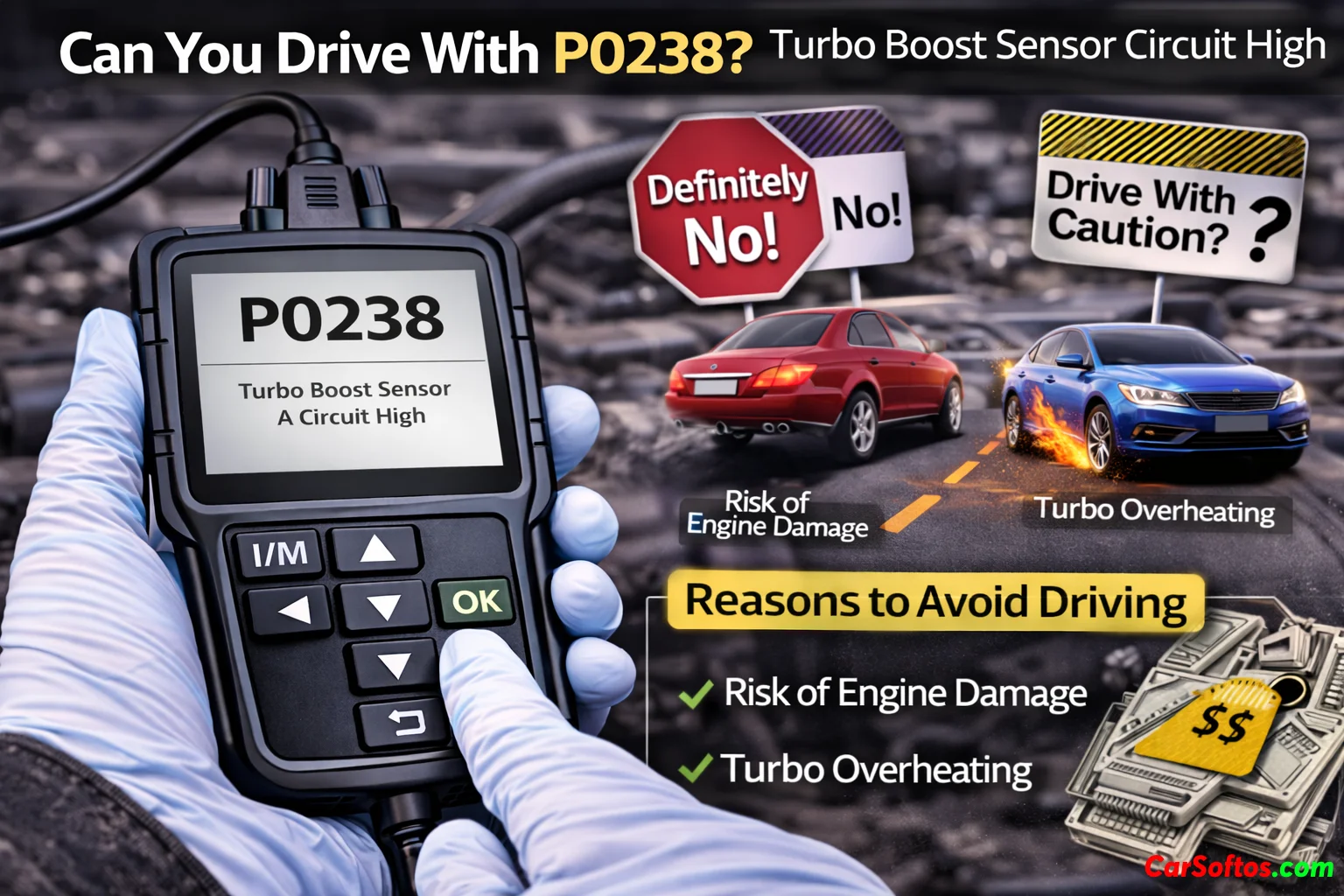
🚗 Can You Drive With P0238?
Yes, sometimes — but not for long.
If the vehicle still runs normally, short-term driving may be possible. But if power is weak, boost behavior is unstable, or the car enters limp mode, it should be diagnosed quickly. That recommendation is based on the documented role of the boost sensor in turbo control and the common drivability effects of invalid sensor input.
📌 Final Verdict
P0238 usually means the ECU is seeing a boost-sensor signal that is too high to be believable. The most common causes are a bad boost/MAP sensor, wiring shorted to voltage, connector corrosion, or a ground/reference issue. On some vehicles, broader boost-control problems can sit in the background, but the circuit itself should be checked first.

Tags:
Users of Guests are not allowed to comment this publication.