
Navigation
Top News
Statistics
Advertisement
Аrchives
Votes
| Rate the site |
P1741 Audi S tronic — Clutch Pressure Adaptation Limit Reached Explained - Causes, Symptoms, Diagnosis & Fix Guide
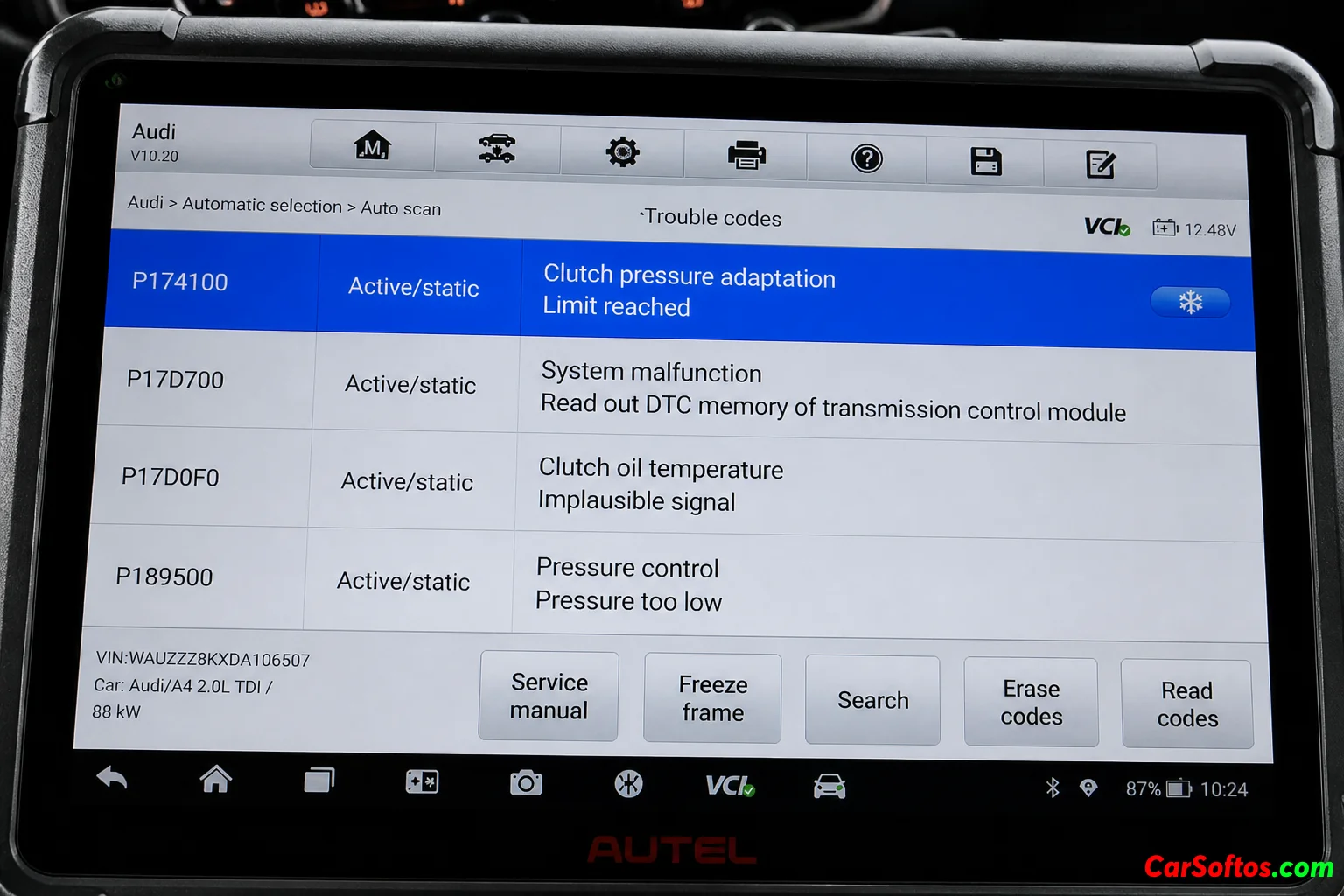
P1741 is a VAG / Audi-specific transmission fault code commonly used on DSG / S tronic gearboxes.
The common meaning is:
P1741 — Clutch Pressure Adaptation Limit Reached
Also described as: Clutch pressure adaptation at limit
In some 0B5/DL501 logs: 18769 — Clutch Pressure Adaptation, Limit Reached
In simple words, the gearbox has tried to compensate for clutch wear by adjusting clutch pressure, but the correction has reached its limit. After that, the mechatronic can no longer “hide” the wear through adaptation.
⚙️ What “Clutch Pressure Adaptation” Means
Audi DSG / S tronic gearboxes use a mechatronic unit to control clutch pressure. Over time, the clutch wears. The TCU adapts pressure and clutch engagement points to keep shifts smooth.
👉 Normal process:
- clutch wears slightly
- TCU adjusts clutch pressure
- gearbox still shifts normally
- adaptation values stay within range
🚨 P1741 happens when:
- clutch wear becomes too high
- pressure compensation reaches its limit
- adaptation can no longer correct the problem
- clutch slip, jerking or overheating begins
0B5 quick-reference data gives example clutch adaptation pressure ranges and says that if values are outside range, the clutch should be checked first; if the clutch is good, hydraulic pressure sensors on the TCU should be checked.
⚠️ How Serious Is P1741?
Severity: ⭐⭐⭐⭐⭐ Critical
P1741 is serious because it usually means the gearbox has been compensating for clutch wear for a long time and has now reached the end of its adjustment range.
🚨 Why it matters:
- clutch may already be worn
- slip can create heat
- heat damages friction plates
- dirty fluid can damage the mechatronic
- limp mode may appear
- ignoring it can lead to full clutch / gearbox repair
Specialist DSG/S tronic sources describe P1741 as a sign that the mechatronic can no longer adapt clutch pressure, often requiring clutch replacement and sometimes mechatronic repair.
🚨 Common Symptoms of P1741
Typical symptoms include:
- ⚠️ Gearbox malfunction warning
- ⚠️ PRNDS / transmission warning light
- ⚠️ jerking when pulling away
- ⚠️ shudder during acceleration
- ⚠️ harsh gear engagement
- ⚠️ delayed Drive or Reverse
- ⚠️ clutch slip under load
- ⚠️ worse behavior when hot
- ⚠️ limp mode
- ⚠️ adaptation/basic settings failure
- ⚠️ burnt clutch smell in severe cases
P1741-related specialist sources describe overheating, jerks, shift shocks, emergency mode and expensive clutch/mechatronic repair as common consequences when the code is ignored.
🔥 Real-World Pattern
| Symptom / Code combo | What it usually suggests |
|---|---|
| P1741 alone | clutch adaptation limit reached |
| P1741 + P17D0 | clutch 2 slip / clutch wear very likely |
| P1741 + P17D7 | clutch 2 pressure compensation issue |
| P1741 + P17D8 | clutch temperature / torque limitation nearby |
| P1741 + jerking from stop | clutch wear or bad adaptation |
| P1741 after repair | adaptation, fluid level, clutch setup or mechatronic issue |
Audi/VAG transmission repair references group P1741, P17D0, P17D6, P17D7 and P2873 together as clutch pressure / clutch slip faults on 0B5/DL501.
🧠 Most Common Causes of P1741
1️⃣ Worn clutch pack — most common
This is the main cause.
As clutch friction plates wear, the mechatronic increases or adjusts pressure to keep the clutch holding correctly. Eventually, the adaptation range is used up.
Signs:
- slip under acceleration
- shudder from stop
- hot driving makes it worse
- adaptation values near limits
- P17D0 / P17D7 / P17D8 nearby
- burnt smell or contaminated fluid
DSG specialists describe P1741 as a clutch pressure adaptation limit caused by clutch wear, where software compensation is no longer enough.
2️⃣ Damaged multi-plate clutch assembly
Some S tronic repair sources say P1741-type faults are often caused by damage to the multi-plate clutch assembly and the hydraulic part of the mechatronic. In these cases, the fix may require both clutch replacement and mechatronic repair.
Possible damage:
- worn friction plates
- warped steel plates
- damaged clutch basket
- piston/seal leakage
- heat damage
- incorrect clutch clearance
3️⃣ Mechatronic hydraulic problem
P1741 is not always only the clutch. If the clutch is mechanically good but pressure cannot be controlled correctly, the mechatronic may still reach its adaptation limit.
Possible mechatronic causes:
- pressure solenoid fault
- hydraulic leakage
- blocked valve body passage
- pressure sensor feedback problem
- worn valve body
- failed repair kit
- TCU/mechatronic electronics fault
Specialist sources note that these errors can also occur because of mechatronic electronic faults in some cases.
4️⃣ Wrong fluid level, wrong fluid type or degraded fluid
DSG / S tronic transmissions are very sensitive to fluid condition.
Bad fluid can cause:
- unstable hydraulic pressure
- poor clutch cooling
- clutch slip
- adaptation failure
- mechatronic valve sticking
- clutch overheating
Check for:
- low fluid
- overfilled fluid
- wrong fluid type
- incorrect fill temperature
- burnt smell
- metal or friction debris
5️⃣ Failed adaptation after repair
P1741 can appear after:
- clutch replacement
- mechatronic repair
- valve body repair
- transmission swap
- battery/voltage issue
- fluid service with incorrect level
If adaptation cannot complete, the fault may return. But adaptation alone will not fix worn clutch plates or hydraulic pressure loss.
6️⃣ Pressure sensor / TCU feedback issue
If clutch pressure feedback is wrong, the TCU may think adaptation has reached a limit even when the clutch is not the only problem.
0B5 quick-reference material says that when clutch adaptation pressure values are outside the expected range, check the clutch first; if clutch components are good, check hydraulic pressure sensors on the TCU.
7️⃣ Aggressive driving / overheating
Aggressive driving can accelerate clutch wear:
- launch control
- stop-and-go traffic
- towing
- repeated hard acceleration
- driving with existing slip
Once clutch heat rises, related faults like P17D8 can appear.
⚡ P1741 vs Related Audi DSG Codes
| Code | Meaning |
|---|---|
| P1741 | Clutch Pressure Adaptation Limit Reached |
| P17D0 | Clutch 2 Slippage Too High |
| P17D6 | Clutch 1 Pressure Too High |
| P17D7 | Clutch 2 Pressure Too High |
| P17D8 | Torque Limitation Because of Clutch Temperature |
| P2873 | Clutch 2 pressure/intervention too high |
| P0730 | Incorrect Gear Ratio / transmission slip |
👉 Simple explanation:
- P1741 = adaptation has reached its limit
- P17D0 = clutch 2 is slipping
- P17D7 = clutch 2 pressure too high
- P17D8 = clutch temperature protection
If P1741 + P17D0 + P17D8 appear together, the clutch is very likely worn or overheating.
🔧 Step-by-Step Diagnosis
1️⃣ Scan with VCDS / ODIS
Do not rely only on a generic scanner.
Record:
- full DTC: P1741 / P174100
- fault number / symptom code, for example 18769
- static or intermittent status
- freeze-frame data
- clutch pressure
- clutch temperature
- adaptation values
- related codes
- exact gearbox type
A real Audi DL501 forum case showed 18769 Clutch Pressure Adaption, P1741, Limit Reached stored many times, which is exactly the kind of detail you need from VCDS/ODIS-level diagnosis.
2️⃣ Check related codes
Look for:
- P17D0 — clutch 2 slip too high
- P17D6 / P17D7 — clutch pressure too high
- P17D8 — torque limitation due to clutch temperature
- P2873 — clutch pressure/intervention fault
- P0730 — incorrect gear ratio
- P176A–P176D — selector regulation faults
Multiple clutch/pressure codes mean the problem is likely deeper than one adaptation reset.
3️⃣ Check clutch adaptation values
This is the key step.
Review:
- K1 adaptation pressure
- K2 adaptation pressure
- upper and lower adaptation points
- clutch pressure adaptation values
- adaptation limits
- whether basic settings complete successfully
0B5 quick-reference data gives example adaptation pressure ranges: K1 upper around 7.6–7.9 bar, K1 lower around 2.55–2.95 bar, K2 upper around 7.6–7.9 bar, and K2 lower around 2.1–2.5 bar. It also warns these are quick-reference ranges, not a full diagnostic substitute.
4️⃣ Check clutch slip live data
Compare:
- clutch 1 slip
- clutch 2 slip
- requested vs actual clutch behavior
- slip under acceleration
- slip when hot
- clutch temperature
If slip rises while the clutch is commanded to hold, the adaptation limit is likely caused by real clutch wear.
5️⃣ Check fluid level and condition
Inspect:
- correct S tronic / DSG fluid
- correct fill procedure
- correct fluid temperature during level check
- burnt smell
- debris
- metal particles
- friction material contamination
If the clutch has been slipping, fluid may already be contaminated.
6️⃣ Perform basic settings only under correct conditions
Basic settings/adaptation should be done only when:
- voltage is stable
- fluid temperature is correct
- no blocking faults are present
- gearbox is correctly filled
- the proper VCDS/ODIS procedure is used
If adaptation fails or P1741 returns, do not keep repeating it endlessly.
7️⃣ Inspect clutch and mechatronic hydraulics
If P1741 returns:
- inspect clutch pack
- check friction plates and steel plates
- check clutch pistons and seals
- inspect clutch basket
- inspect mechatronic pressure control
- check hydraulic pressure sensors
- inspect valve body and solenoids
🛠️ How to Fix P1741
✔️ Correct fluid level + perform proper adaptation
If P1741 appeared after service or repair, correct fluid level and run proper adaptation.
💰 Typical cost: $150–$600
But if clutch wear is real, this will not be enough.
✔️ Replace clutch pack / clutch set
This is often the main fix when P1741 is caused by clutch wear.
💰 Typical cost: $1,200–$3,500+
Specialist sources describe clutch replacement as a common required repair when the mechatronic can no longer adapt clutch pressure.
✔️ Repair mechatronic hydraulic system
If pressure adaptation limit is caused by hydraulic control issues, repair may involve:
- pressure solenoids
- valve body
- hydraulic seals
- pressure sensors
- mechatronic repair kit
💰 Typical cost: $800–$2,000+
✔️ Replace clutch + repair mechatronic together
Often the best solution when both clutch wear and mechatronic hydraulic issues are present.
💰 Typical cost: $1,800–$4,000+
Several DSG/S tronic repair sources mention clutch replacement plus mechatronic repair together for this fault family.
✔️ Internal gearbox repair
If clutch basket, piston, seals or gearbox internals are damaged.
💰 Typical cost: $2,500–$6,000+
💰 Repair Cost Summary
| Repair | Typical cost |
|---|---|
| VCDS / ODIS diagnosis | $100–$250 |
| Fluid level correction + adaptation | $150–$600 |
| S tronic / DSG fluid service | $250–$600 |
| Mechatronic hydraulic repair | $800–$2,000+ |
| Clutch pack / clutch set replacement | $1,200–$3,500+ |
| Clutch + mechatronic repair together | $1,800–$4,000+ |
| Internal gearbox repair | $2,500–$6,000+ |
❗ Common Mistakes
❌ Resetting adaptation endlessly
P1741 means the adaptation limit was reached. Resetting it without fixing the cause can make shifting worse.
❌ Replacing only mechatronic when the clutch is worn
If the clutch friction plates are worn, mechatronic repair alone may not solve the problem.
❌ Replacing only clutch when hydraulic pressure is unstable
If mechatronic pressure control is bad, the new clutch may still adapt incorrectly.
❌ Ignoring P17D0 / P17D8
P17D0 means slip. P17D8 means clutch temperature protection. Together with P1741, they are strong signs of real clutch wear/overheat.
❌ Using generic scanner only
You need adaptation values, clutch pressure, clutch temperature and fault counters from VCDS/ODIS-level tools.
❌ Driving aggressively after the warning appears
Hard acceleration and stop-and-go abuse can overheat the clutch and spread damage.
🚗 Can You Drive With P1741?
Only short-term and gently.
If the car still drives, you may be able to move it to a workshop. But normal driving is risky.
🚨 Avoid:
- launch control
- towing
- hard acceleration
- stop-and-go abuse
- long driving after gearbox warning
- repeated adaptation resets without repair
Risks of ignoring:
- clutch overheating
- no-drive condition
- fluid contamination
- mechatronic damage
- full gearbox repair
📌 Final Verdict
P1741 usually means the DSG / S tronic transmission has reached the clutch pressure adaptation limit.
Most common real causes:
- worn clutch friction plates
- damaged multi-plate clutch assembly
- clutch overheating
- mechatronic hydraulic pressure problem
- pressure sensor feedback issue
- wrong fluid level or degraded fluid
- failed adaptation after repair
💡 Key takeaway:
- P1741 = clutch pressure adaptation limit reached
- P17D0 = clutch 2 slipping
- P17D7 = clutch 2 pressure too high
- P17D8 = clutch temperature protection

Tags:
Users of Guests are not allowed to comment this publication.