
Navigation
Top News
Statistics
Advertisement
Аrchives
Votes
| Rate the site |
P17D7 Code Explained: Clutch 2 Pressure Fault in DL501
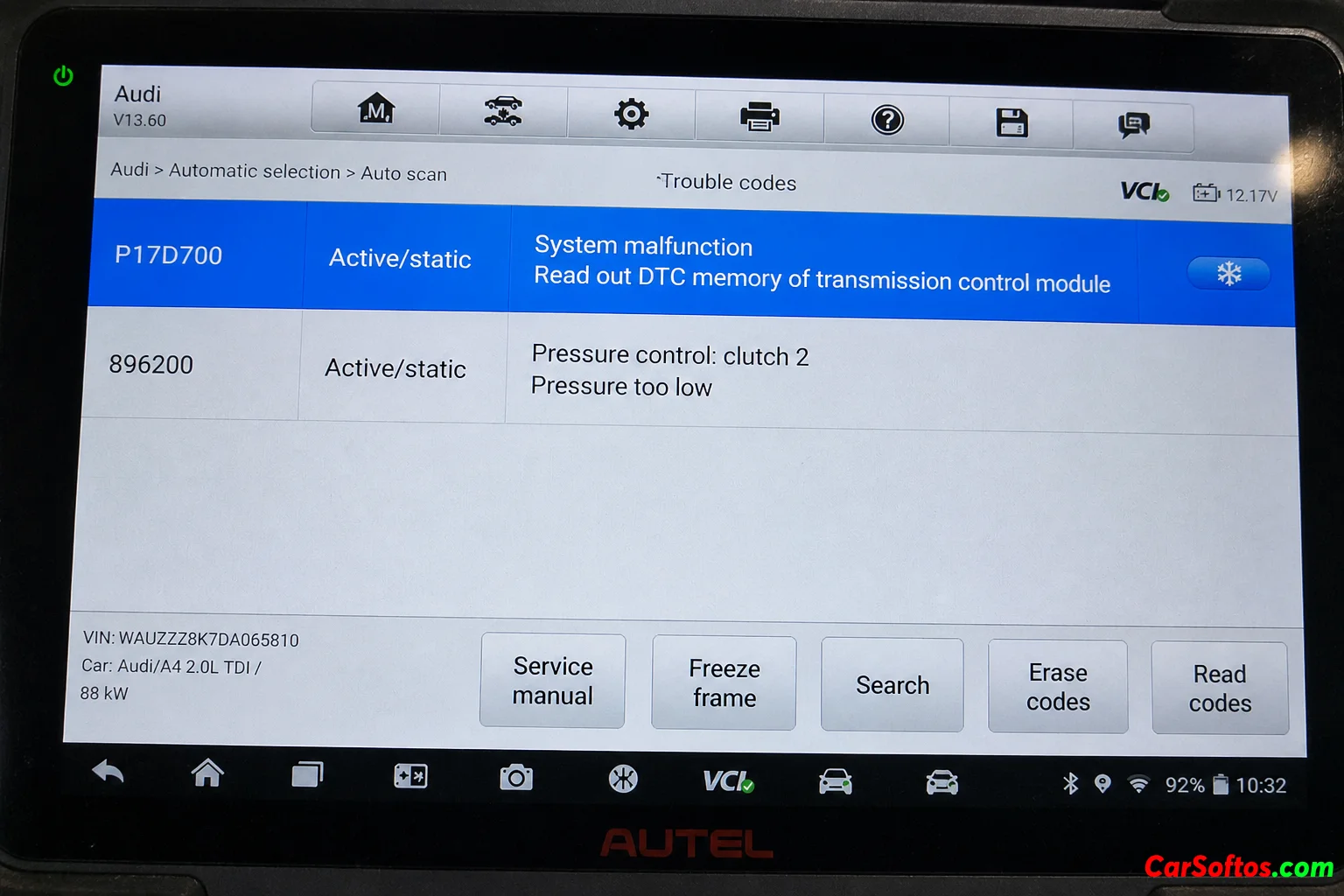
🔍 What Does P17D7 Mean?
P17D7 is a VAG / Audi-specific transmission fault code, most commonly linked to the 0B5 / DL501 7-speed S tronic gearbox.
The common meaning is:
P17D7 — Clutch 2 Pressure Too High
Common reference number: 8962
0B5 / DL501 quick-reference material lists P17D7 = Clutch 2 Pressure too High / 8962, often with a repair direction toward a mechatronic repair kit.
👉 In simple words:
The transmission control unit sees that clutch 2 hydraulic pressure is higher than expected.
That can happen because of:
- clutch 2 pressure regulation fault
- mechatronic hydraulic problem
- clutch pressure solenoid issue
- clutch pressure sensor feedback problem
- blocked hydraulic passage
- clutch 2 wear / clutch pack damage
- wrong fluid level or contaminated S tronic fluid
⚙️ What “Clutch 2 Pressure” Means
Audi 0B5 / DL501 S tronic is a wet dual-clutch gearbox. It uses two clutch circuits:
- Clutch 1 / K1
- Clutch 2 / K2
The mechatronic unit controls hydraulic pressure to each clutch. If the TCU sees clutch 2 pressure above the expected range, it may trigger P17D7, reduce torque, enter limp mode, or store related clutch-temperature faults.
Specialist 0B5 references group P17D6 / P17D7 as clutch-pressure faults that often appear with mechatronic or hydraulic malfunction.
⚠️ How Serious Is P17D7?
Severity: ⭐⭐⭐⭐⭐ Critical
P17D7 is not a small sensor fault. It is a serious S tronic clutch-pressure control fault.
🚨 Why it matters:
- excessive clutch pressure can cause harsh engagement
- wrong pressure can overheat the clutch
- mechatronic damage can spread to other faults
- clutch slip / pressure faults can lead to no-drive condition
- ignoring it can turn a repairable fault into a full gearbox job
ECU Testing and Autotronics both list P17D7 — Clutch 2 Pressure Too High among common Audi S tronic / 0B5 mechatronic failure codes.
🚨 Common Symptoms of P17D7
Typical symptoms include:
- ⚠️ Gearbox malfunction warning
- ⚠️ PRNDS / transmission warning light
- ⚠️ harsh engagement into Drive or Reverse
- ⚠️ jerking when pulling away
- ⚠️ vibration or shudder during acceleration
- ⚠️ rough shifts when hot
- ⚠️ limp mode / limited gears
- ⚠️ delayed engagement
- ⚠️ fault returns after clearing
- ⚠️ adaptation/basic settings failure
A repair Q&A for a 2012 Audi Q5 describes P17D7 as Clutch 2 pressure too high, with vibrations and jerks, and recommends checking clutch pressure sensor data, hydraulic circuits, mechatronic faults, and clutch packs.
🔥 Real-World Pattern
| Symptom | What it may suggest |
|---|---|
| Harsh takeoff / jerk | clutch 2 pressure too high or unstable |
| Worse when hot | fluid, hydraulic or mechatronic issue |
| P17D7 + P17D8 | clutch temperature / torque limitation nearby |
| P17D7 + P1741 | clutch pressure adaptation limit issue |
| P17D7 after repair | adaptation, fluid level, pressure sensor or repair-kit issue |
| P17D6 + P17D7 together | broader clutch/mechatronic pressure problem |
Some specialist sources list P17D7 together with P17D0, P1741, and P2873 as a clutch-pressure / clutch-wear group on DL501.
🧠 Most Common Causes of P17D7
1️⃣ Mechatronic clutch pressure regulation fault — very common
The mechatronic controls clutch pressure using:
- hydraulic valves
- solenoids
- pressure sensors
- internal fluid channels
- TCU logic
If pressure regulation for clutch 2 becomes unstable, P17D7 can be stored.
Possible mechatronic causes:
- pressure solenoid sticking
- valve body hydraulic fault
- pressure-control blockage
- sensor feedback error
- mechatronic repair-kit issue
- internal electrical/hydraulic fault
Eco Torque says P17D6 / P17D7 often appear in clusters confirming electrical or hydraulic malfunction inside the mechatronic unit.
2️⃣ Clutch 2 wear or clutch pack damage
A 2025 DSG specialist article describes P17D7 on DSG 0B5 / DL501 / S tronic as excessive pressure in clutch 2, often meaning clutch 2 is worn or working at its limit.
Possible signs:
- shudder from stop
- slipping under load
- harsh engagement
- adaptation values near limit
- clutch temperature codes
- P17D0 / clutch slip code nearby
If clutch 2 is worn, the gearbox may increase pressure to compensate. Eventually the pressure goes outside expected limits.
3️⃣ Clutch pressure sensor / feedback problem
Sometimes the pressure may not actually be too high — the reported pressure may be wrong.
Red flags:
- clutch 2 pressure is high with ignition on / engine off
- pressure value is unrealistic
- pressure does not change logically
- pressure reading differs heavily from clutch 1
- code returns immediately after clearing
Forum discussions around DL501/0B5 clutch pressure sensor data show that abnormal clutch pressure readings can strongly point toward pressure-sensor or mechatronic diagnosis.
4️⃣ Hydraulic blockage or stuck valve
If clutch 2 pressure cannot bleed off or regulate correctly, the TCU may see pressure too high.
Possible causes:
- debris in valve body
- varnish from old fluid
- blocked hydraulic passage
- sticking pressure-control valve
- worn valve bore
- contaminated mechatronic oil circuit
This is especially likely when the fault is worse hot or after contaminated-fluid history.
5️⃣ Wrong fluid level, wrong fluid type or contaminated fluid
The 0B5 / DL501 is sensitive to fluid condition and correct fill procedure.
Check for:
- wrong S tronic fluid
- low fluid
- overfilled fluid
- incorrect fill temperature
- burnt smell
- metal debris
- service mistakes after mechatronic removal
Fluid directly affects clutch pressure and mechatronic hydraulic control.
6️⃣ Internal leakage or seal problem
Internal hydraulic leakage can confuse the pressure-control system. The mechatronic may overcompensate or pressure feedback may become unstable.
Possible areas:
- clutch piston seals
- clutch circuit seals
- mechatronic seals
- valve body sealing surfaces
- cross-leakage between hydraulic circuits
If P17D7 appears with clutch slip or adaptation-limit codes, this becomes more likely.
7️⃣ Adaptation / basic settings problem
After:
- mechatronic repair
- clutch replacement
- fluid service
- gearbox swap
- battery/voltage problem
the gearbox may require proper basic settings/adaptation.
But adaptation alone will not fix:
- worn clutch 2
- bad pressure sensor
- blocked hydraulic circuit
- damaged mechatronic
- internal leakage
⚡ P17D7 vs Related Codes
| Code | Meaning |
|---|---|
| P17D6 | Clutch 1 Pressure Too High |
| P17D7 | Clutch 2 Pressure Too High |
| P17D8 | Torque limitation because of clutch temperature |
| P17D0 | Clutch 2 slippage too high |
| P1741 | Clutch pressure adaptation limit reached |
| P2873 | Clutch 2 intervention / pressure too high |
0B5 quick-reference material lists P17D6 = 8957 and P17D7 = 8962, both commonly repaired with a mechatronic repair kit.
👉 Simple explanation:
- P17D7 = pressure problem on clutch 2
- P17D6 = pressure problem on clutch 1
- P17D8 = clutch temperature protection
- P17D0 = clutch 2 slipping
🔧 Step-by-Step Diagnosis
1️⃣ Scan with VCDS / ODIS
Do not rely only on a generic scanner.
Record:
- full code: P17D7 / P17D700
- fault number: 8962
- static or intermittent status
- freeze-frame data
- transmission temperature
- clutch 1 and clutch 2 pressure data
- adaptation values
- related codes
- gearbox type
2️⃣ Check related codes
Look for:
- P17D6 — Clutch 1 pressure too high
- P17D8 — torque limitation due to clutch temperature
- P17D0 — clutch 2 slip too high
- P1741 — clutch pressure adaptation limit reached
- P176A–P176D — selector regulation faults
- P179C / P179D — pressure/cooling oil valve electrical faults
- P0730 — incorrect gear ratio / slip
If several are present, the issue is likely broader than one pressure value.
3️⃣ Check clutch pressure live data
Compare:
- clutch 1 pressure
- clutch 2 pressure
- requested vs actual pressure
- pressure at ignition-on
- pressure during Drive/Reverse engagement
- pressure during acceleration
- pressure during shifts
🚨 Red flag:
If clutch 2 pressure is high when clutch 2 should not be applied, suspect pressure sensor feedback, mechatronic fault, or internal hydraulic issue.
4️⃣ Check clutch adaptation values
Review:
- K1 / K2 adaptation values
- clutch pressure adaptation
- adaptation limits
- clutch wear compensation values
- whether basic settings complete successfully
If adaptation values are near limits, suspect clutch wear or pressure-control compensation.
5️⃣ Check fluid level and condition
Inspect:
- correct fluid type
- correct fill temperature
- low or overfilled level
- burnt smell
- metal debris
- contaminated oil
- service history
This is critical because the S tronic mechatronic depends heavily on clean, correct fluid.
6️⃣ Road test gently and log data
During road test, check:
- when jerking happens
- hot vs cold behavior
- clutch 2 pressure response
- clutch temperature
- torque limitation
- shift quality
- any limp mode activation
Do not drive aggressively with P17D7.
7️⃣ Inspect mechatronic and clutch circuit
If P17D7 returns, inspect:
- clutch 2 pressure solenoid
- clutch 2 pressure sensor
- hydraulic valve body
- mechatronic repair kit / circuit board
- internal seals
- clutch 2 pack condition
- piston seals
- cross-leaks or blocked passages
🛠️ How to Fix P17D7
✔️ Correct fluid level + perform adaptation
If the fault appeared after service or repair, correct the basics first.
💰 Typical cost: $150–$600
✔️ Mechatronic repair kit
0B5 quick-reference material lists P17D7 / 8962 with repair direction Repair with mechatronic repair kit.
💰 Typical cost: $800–$2,000+
✔️ Pressure solenoid / valve body repair
If pressure control hardware is faulty:
- repair clutch pressure solenoid
- clean / rebuild valve body
- repair hydraulic valve
- replace mechatronic seals
💰 Typical cost: $500–$1,800+
✔️ Pressure sensor / mechatronic repair
If live data shows impossible pressure readings, pressure sensor or mechatronic repair becomes more likely.
💰 Typical cost: $700–$2,000+
✔️ Clutch 2 pack / clutch assembly repair
If clutch 2 is worn, slipping or overheating, clutch repair may be required.
💰 Typical cost: $1,200–$3,500+
✔️ Complete mechatronic replacement
If the mechatronic is too damaged or repair is unreliable.
💰 Typical cost: $1,500–$3,500+
✔️ Internal gearbox repair
If clutch damage, internal leakage or mechanical wear is severe.
💰 Typical cost: $2,500–$6,000+
💰 Repair Cost Summary
| Repair | Typical cost |
|---|---|
| VCDS / ODIS diagnosis | $100–$250 |
| Fluid level correction + adaptation | $150–$600 |
| S tronic fluid service | $250–$600 |
| Mechatronic repair kit | $800–$2,000+ |
| Pressure solenoid / valve body repair | $500–$1,800+ |
| Pressure sensor / mechatronic repair | $700–$2,000+ |
| Clutch 2 repair / clutch pack | $1,200–$3,500+ |
| Complete mechatronic replacement | $1,500–$3,500+ |
| Internal gearbox repair | $2,500–$6,000+ |
❗ Common Mistakes
❌ Replacing clutch 2 immediately
P17D7 can be clutch-related, but it can also be pressure sensor, solenoid, hydraulic, fluid, or mechatronic-related.
❌ Ignoring live pressure data
This is one of the biggest mistakes. Pressure readings can reveal whether the fault is real hydraulic pressure or sensor/mechatronic feedback.
❌ Doing adaptation endlessly
Adaptation cannot fix worn clutches, hydraulic leakage, blocked valves, or bad pressure feedback.
❌ Using generic scanner only
You need VCDS/ODIS-level clutch pressure, temperature and adaptation data.
❌ Ignoring P17D0 / P1741
If P17D0 or P1741 appears with P17D7, clutch wear/adaptation-limit diagnosis becomes much stronger.
❌ Driving hard with P17D7
Aggressive driving can increase clutch temperature and accelerate failure.
🚗 Can You Drive With P17D7?
Only short-term and gently.
If the vehicle still drives, it may be possible to move it to a workshop. But normal driving is risky if there are:
- harsh engagement
- vibration / shudder
- limp mode
- gearbox malfunction warning
- P17D8 / clutch temperature faults
- P17D0 / clutch slip code
- repeated P17D7 after clearing
🚨 Risks of ignoring:
- clutch overheating
- no-drive condition
- mechatronic damage
- clutch pack failure
- full gearbox repair
📌 Final Verdict
P17D7 usually means Clutch 2 pressure is too high inside the Audi 0B5 / DL501 S tronic gearbox.
Most common real causes:
- clutch 2 pressure regulation fault
- mechatronic hydraulic problem
- pressure solenoid / valve body issue
- clutch pressure sensor feedback problem
- wrong fluid level or contaminated fluid
- internal leakage or blockage
- clutch 2 wear / clutch pack damage
- failed adaptation / basic settings
💡 Key takeaway:
- P17D7 = Clutch 2 Pressure Too High
- P17D6 = Clutch 1 Pressure Too High
- P17D8 = clutch temperature torque limitation
- P17D0 / P1741 = clutch slip / adaptation limit nearby

Tags:
Users of Guests are not allowed to comment this publication.