
Navigation
Top News
Statistics
Advertisement
Аrchives
Votes
| Rate the site |
Code P17D7 / 8962 Code: Audi 0B5 Mechatronic or Clutch Problem?
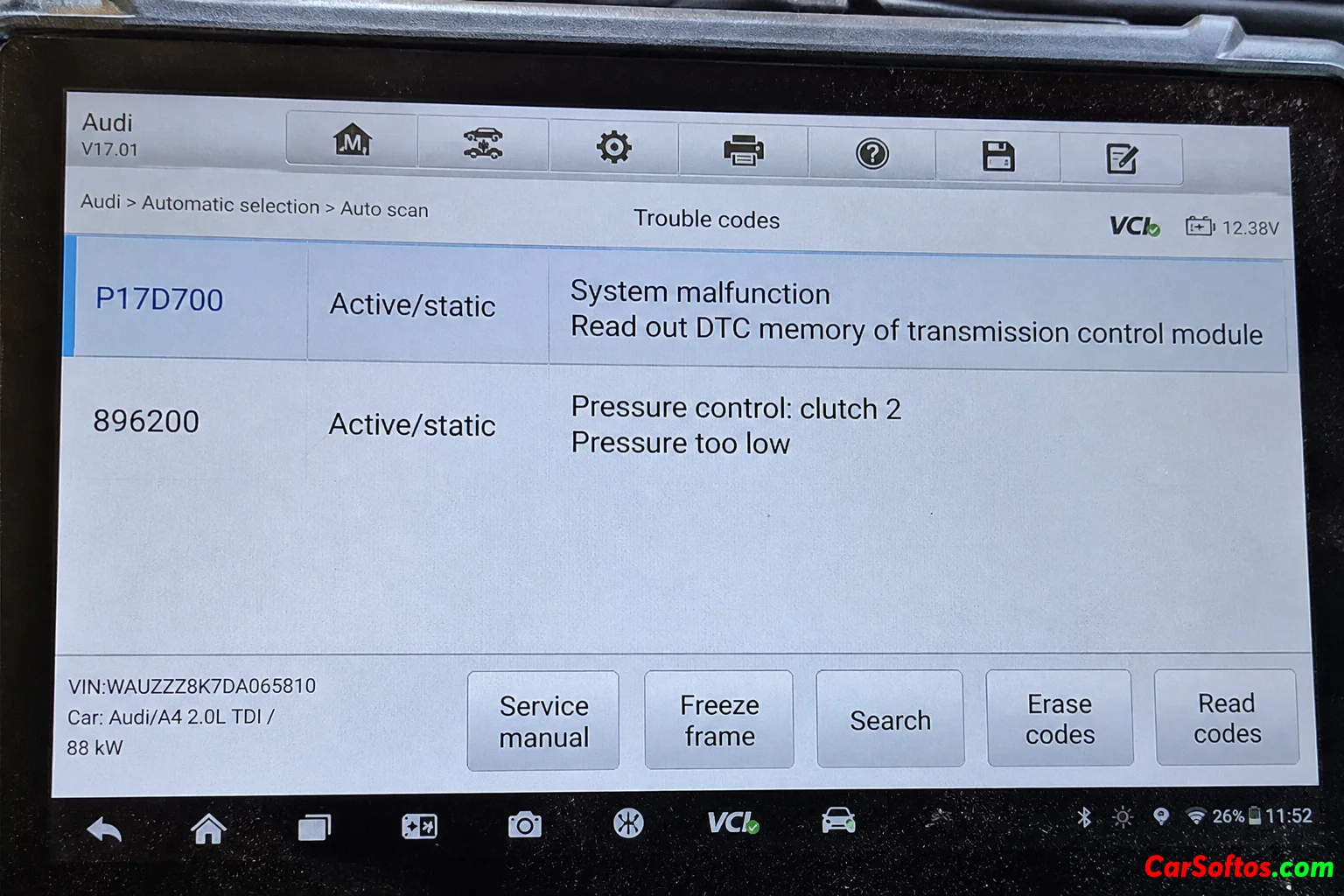
🔍 What Does P17D7 Mean?
P17D7 is a VAG / Audi-specific transmission fault code, most commonly linked to the 0B5 / DL501 7-speed S tronic gearbox.
The common meaning is:
P17D7 — Clutch 2 Pressure Too High
Common 0B5 reference number: 8962
0B5 quick-reference material lists P17D7 = Clutch 2 Pressure too High / 8962, and repair direction often points toward a mechatronic repair kit.
👉 In simple words:
The transmission control unit sees that clutch 2 pressure is higher than expected.
That usually means a problem with:
- clutch 2 pressure regulation
- mechatronic hydraulic control
- clutch pressure solenoid
- clutch pressure sensor feedback
- internal hydraulic leakage / blockage
- clutch pack wear or abnormal clutch behavior
⚙️ What “Clutch 2 Pressure” Means
The Audi 0B5 / DL501 S tronic is a wet dual-clutch gearbox. It uses two clutch circuits and a mechatronic unit to control clutch engagement and gear selection. The DL501 uses separate oil circuits, including a hydraulic/mechatronic clutch oil circuit, which is why fluid level, pressure control and mechatronic health are critical.
Simple idea:
- Clutch 1 controls one gear path
- Clutch 2 controls the other gear path
- the mechatronic regulates oil pressure to apply/release each clutch
When the TCU sees too much pressure on clutch 2, it may reduce torque, enter limp mode, or store related faults.
⚠️ How Serious Is P17D7?
Severity: ⭐⭐⭐⭐⭐ Critical
P17D7 is not a small generic OBD code. It is a premium Audi S tronic pressure-control fault.
🚨 Why it matters:
- too much clutch pressure can cause harsh engagement
- pressure regulation failure can overheat or damage clutches
- limp mode is possible
- related faults like P17D8 or P1740 may appear
- the root cause can be mechatronic, hydraulic, sensor or clutch-related
- ignoring it can turn a repairable issue into a full gearbox job
Specialist 0B5 mechatronic references list P17D7 among common DL501 mechatronic fault codes, and describe typical failure symptoms such as harsh shifting, PRNDS/gearbox warning, limp mode and no engagement when hot.
🚨 Common Symptoms of P17D7
Typical symptoms include:
- ⚠️ Gearbox malfunction warning on the dashboard
- ⚠️ PRNDS / transmission warning light
- ⚠️ harsh engagement into Drive or Reverse
- ⚠️ jerking when pulling away
- ⚠️ shudder during acceleration
- ⚠️ harsh 2–3 / 4–5 style shifts
- ⚠️ limp mode / limited gear operation
- ⚠️ fault returns after clearing
- ⚠️ worse when hot
- ⚠️ delayed engagement after stop/start
A repair case summary describes P17D7 on a 0B5 S tronic as Clutch 2 pressure too high, causing vibrations and jerks, and recommends checking clutch pressure sensor data, hydraulic circuits, mechatronic faults and clutch packs.
🔥 Real-World Pattern
| Symptom | What it may suggest |
|---|---|
| Harsh takeoff / jerk | clutch 2 pressure too high or unstable |
| Worse when hot | hydraulic leakage, fluid issue, mechatronic behavior |
| P17D7 + P17D8 | clutch temperature / torque limitation nearby |
| P17D7 + P1740 | clutch temperature monitoring issue |
| P17D7 after mechatronic repair | adaptation, fluid level, sensor or repair-kit issue |
| Pressure reading high at ignition-on | pressure sensor / mechatronic internal fault possible |
A real forum case reported clutch 2 pressure sensor data showing abnormal pressure with ignition on and engine off, which is a strong clue for sensor/mechatronic diagnosis rather than only mechanical clutch wear.
🧠 Most Common Causes of P17D7
1️⃣ Mechatronic clutch pressure regulation fault — very common
The mechatronic controls clutch pressure using hydraulic valves, solenoids and pressure feedback. If pressure regulation for clutch 2 becomes unstable, the TCU may store P17D7.
Possible mechatronic causes:
- pressure solenoid sticking
- hydraulic valve body fault
- pressure-control leak or blockage
- pressure sensor feedback issue
- internal TCU/mechatronic fault
- circuit board or solenoid control problem
Eco Torque lists P17D6/P17D7 as clutch pressure faults in the common DL501 mechatronic failure family, alongside selector regulation and solenoid faults.
2️⃣ Clutch 2 pressure sensor / feedback problem
If the TCU receives incorrect pressure data, it may think clutch 2 pressure is too high even when actual pressure is normal.
Red flags:
- pressure reading unrealistic with ignition on
- pressure value does not match engine/transmission state
- pressure does not change logically during engagement
- P17D7 returns quickly after clearing
A discussion around DL501/0B5 clutch pressure sensor data shows abnormal clutch 2 pressure reading with ignition on, highlighting why live data matters.
3️⃣ Hydraulic blockage or stuck valve
If a valve is sticking or a hydraulic passage is blocked, clutch pressure may not bleed off or regulate correctly.
Possible causes:
- debris in valve body
- varnish from degraded fluid
- worn valve bore
- blocked hydraulic channel
- sticking clutch-pressure solenoid
This is especially likely when symptoms are heat-related or fluid service history is poor.
4️⃣ Wrong fluid level, wrong fluid type or contaminated fluid
The 0B5/DL501 is sensitive to fluid level and fill procedure. Wrong fluid or incorrect level can affect clutch pressure, mechatronic behavior and adaptation.
Check for:
- wrong S tronic/DSG fluid
- incorrect fill temperature
- low fluid
- overfilled fluid
- burnt smell
- metal debris
Because the DL501 uses a dedicated hydraulic/mechatronic oil circuit, fluid problems can directly affect clutch pressure control.
5️⃣ Clutch 2 wear or clutch pack damage
P17D7 can also be related to clutch wear or clutch pack behavior. If clutch 2 is worn, slipping, overheating or mechanically damaged, the mechatronic may command unusual pressure to compensate.
Possible signs:
- shudder on takeoff
- slipping under load
- adaptation values near limits
- clutch temperature faults
- P17D8 or P1740 also present
A 2025 DSG specialist summary says P17D7 indicates excessive pressure in clutch 2 and can suggest clutch 2 is worn or working at its limit.
6️⃣ Internal leakage / seal problem
If pressure is escaping internally, the mechatronic may overcompensate or the pressure regulation logic may become unstable.
Possible areas:
- clutch piston seals
- internal hydraulic seals
- mechatronic seals
- clutch circuit cross-leakage
- valve body sealing surfaces
Specialist discussion of 0B5 faults often points toward checking both clutch and mechatronic hydraulic behavior when pressure faults appear.
7️⃣ Adaptation / basic settings problem
After repairs, clutch replacement, mechatronic replacement or fluid service, adaptation must be correct.
If adaptation is incomplete or blocked by fault codes, P17D7 may return.
But adaptation alone will not fix:
- real clutch wear
- bad pressure sensor data
- hydraulic leakage
- stuck valves
- damaged mechatronic
⚡ P17D7 vs P17D6 vs P17D8
| Code | Meaning |
|---|---|
| P17D6 | Clutch 1 Pressure Too High |
| P17D7 | Clutch 2 Pressure Too High |
| P17D8 | Torque limitation because of clutch temperature |
0B5 quick-reference material lists P17D6 = Clutch 1 Pressure too High / 8957 and P17D7 = Clutch 2 Pressure too High / 8962.
👉 Simple explanation:
- P17D6 = pressure problem on clutch 1
- P17D7 = pressure problem on clutch 2
- P17D8 = clutch temperature/torque limitation problem
If P17D7 appears with P17D8 or P1740, suspect a more serious clutch pressure/temperature issue.
🔧 Step-by-Step Diagnosis
1️⃣ Scan with VCDS / ODIS
Do not rely only on a generic scanner.
Record:
- full DTC: P17D7 / P17D700
- fault number: 8962
- static or intermittent status
- freeze-frame data
- transmission temperature
- clutch pressure data
- clutch temperature data
- related codes
- gearbox type
For 0B5/DL501, P17D7 is commonly listed as Clutch 2 Pressure too High / 8962.
2️⃣ Check related codes
Look for:
- P17D6 — Clutch 1 pressure too high
- P17D8 — torque limitation due to clutch temperature
- P1740 — clutch temperature monitoring
- P176A/B/C/D — selector regulation faults
- P179C / P179D — pressure/cooling oil valve electrical faults
- P174A/E/B/F — valve electrical faults
- P0730 — incorrect gear ratio / slip
Multiple codes mean the issue is likely broader than one single clutch pressure reading.
3️⃣ Check clutch pressure live data
Compare:
- clutch 1 pressure
- clutch 2 pressure
- requested vs actual pressure
- pressure at ignition-on
- pressure during D/R engagement
- pressure during shifts
🚨 Red flag:
If clutch 2 pressure is high when the engine is not running or when clutch 2 should not be applied, suspect pressure sensor, mechatronic or internal hydraulic fault.
4️⃣ Check fluid level and condition
Inspect:
- correct fluid type
- correct fill temperature
- low or overfilled fluid
- burnt smell
- metal debris
- previous service history
This step is critical because fluid directly affects hydraulic pressure control in the 0B5 clutch/mechatronic circuit.
5️⃣ Check battery voltage and adaptation conditions
Before basic settings:
- battery must be strong
- voltage stable
- charger support recommended
- no blocking DTCs
- correct gearbox temperature
- correct VCDS/ODIS procedure
Weak voltage or failed adaptation can create misleading diagnosis.
6️⃣ Perform basic settings only if conditions are correct
Basic settings can help after repair or fluid service, but it will not fix:
- worn clutch 2
- faulty pressure sensor
- hydraulic leakage
- blocked valve body
- bad mechatronic
If P17D7 returns after correct adaptation, deeper repair is needed.
7️⃣ Inspect mechatronic / clutch hydraulic system
If the fault remains, inspect:
- clutch 2 pressure solenoid
- clutch 2 pressure sensor
- hydraulic valve body
- mechatronic seals
- internal leakage
- clutch 2 pack condition
- clutch basket / piston seals
Some specialists recommend checking clutch circuits for cross-leaks or hydraulic pressure loss when pressure faults appear.
🛠️ How to Fix P17D7
✔️ Correct fluid level + perform adaptation
If the fault appeared after fluid service, clutch work or mechatronic repair, correct the basics first.
💰 Typical cost: $150–$600
✔️ Mechatronic repair kit
0B5 quick-reference material lists P17D7 / 8962 with repair direction Repair with mechatronic repair kit.
💰 Typical cost: $800–$2,000+
✔️ Pressure solenoid / valve body repair
If pressure control hardware is faulty, repair may involve:
- clutch pressure solenoid
- valve body cleaning/rebuild
- hydraulic valve repair
- mechatronic seal repair
💰 Typical cost: $500–$1,800+
✔️ Pressure sensor / mechatronic repair
If live data shows unrealistic pressure readings, sensor/mechatronic repair becomes more likely.
💰 Typical cost: $700–$2,000+
✔️ Clutch 2 pack / clutch assembly repair
If clutch 2 is worn, slipping or overheating, clutch repair may be required.
💰 Typical cost: $1,200–$3,500+
✔️ Complete mechatronic replacement
If the unit is too damaged or repair is not reliable.
💰 Typical cost: $1,500–$3,500+
✔️ Internal gearbox repair
If clutch damage, internal leakage or mechanical wear is severe.
💰 Typical cost: $2,500–$6,000+
💰 Repair Cost Summary
| Repair | Typical cost |
|---|---|
| VCDS / ODIS diagnosis | $100–$250 |
| Fluid level correction + adaptation | $150–$600 |
| S tronic fluid service | $250–$600 |
| Mechatronic repair kit | $800–$2,000+ |
| Pressure solenoid / valve body repair | $500–$1,800+ |
| Pressure sensor / mechatronic repair | $700–$2,000+ |
| Clutch 2 repair / clutch pack | $1,200–$3,500+ |
| Complete mechatronic replacement | $1,500–$3,500+ |
| Internal gearbox repair | $2,500–$6,000+ |
❗ Common Mistakes
❌ Replacing the clutch immediately
P17D7 can be clutch-related, but it can also be pressure sensor, solenoid, hydraulic or mechatronic-related.
❌ Ignoring live clutch pressure data
This is one of the biggest mistakes. If pressure readings are impossible, the sensor/mechatronic path may be the real issue.
❌ Doing adaptation endlessly
Adaptation cannot fix real hydraulic leakage, clutch wear or a bad pressure solenoid.
❌ Using generic scanner only
You need VCDS/ODIS-level clutch pressure and adaptation data.
❌ Ignoring P17D8 / P1740 if present
If temperature-related clutch codes appear, the issue may already be damaging the clutch.
❌ Driving hard with P17D7
Aggressive driving can increase clutch temperature and worsen pressure-control damage.
🚗 Can You Drive With P17D7?
Only short-term and gently.
If the vehicle still drives, it may be possible to move it to a workshop. But normal driving is risky if there are:
- harsh engagement
- shudder
- limp mode
- gearbox malfunction warning
- P17D8 / clutch temperature faults
- repeated P17D7 after clearing
🚨 Risks of ignoring:
- clutch overheating
- no-drive condition
- mechatronic damage
- clutch pack failure
- full gearbox repair
📌 Final Verdict
P17D7 usually means Clutch 2 pressure is too high inside the Audi 0B5 / DL501 S tronic gearbox.
Most common real causes:
- clutch 2 pressure regulation fault
- mechatronic hydraulic problem
- clutch pressure solenoid issue
- pressure sensor feedback problem
- wrong fluid level or contaminated fluid
- internal leakage or blockage
- clutch 2 wear / clutch pack damage
💡 Key takeaway:
- P17D7 = Clutch 2 Pressure Too High
- P17D6 = Clutch 1 Pressure Too High
- P17D8 = Clutch temperature torque limitation
- P176A–D = selector regulation faults nearby

Tags:
Users of Guests are not allowed to comment this publication.