
Navigation
Top News
Statistics
Advertisement
Аrchives
Votes
| Rate the site |
P2563 Code — Turbocharger Boost Control Position Sensor Range/Performance (Causes, Symptoms & Fix)
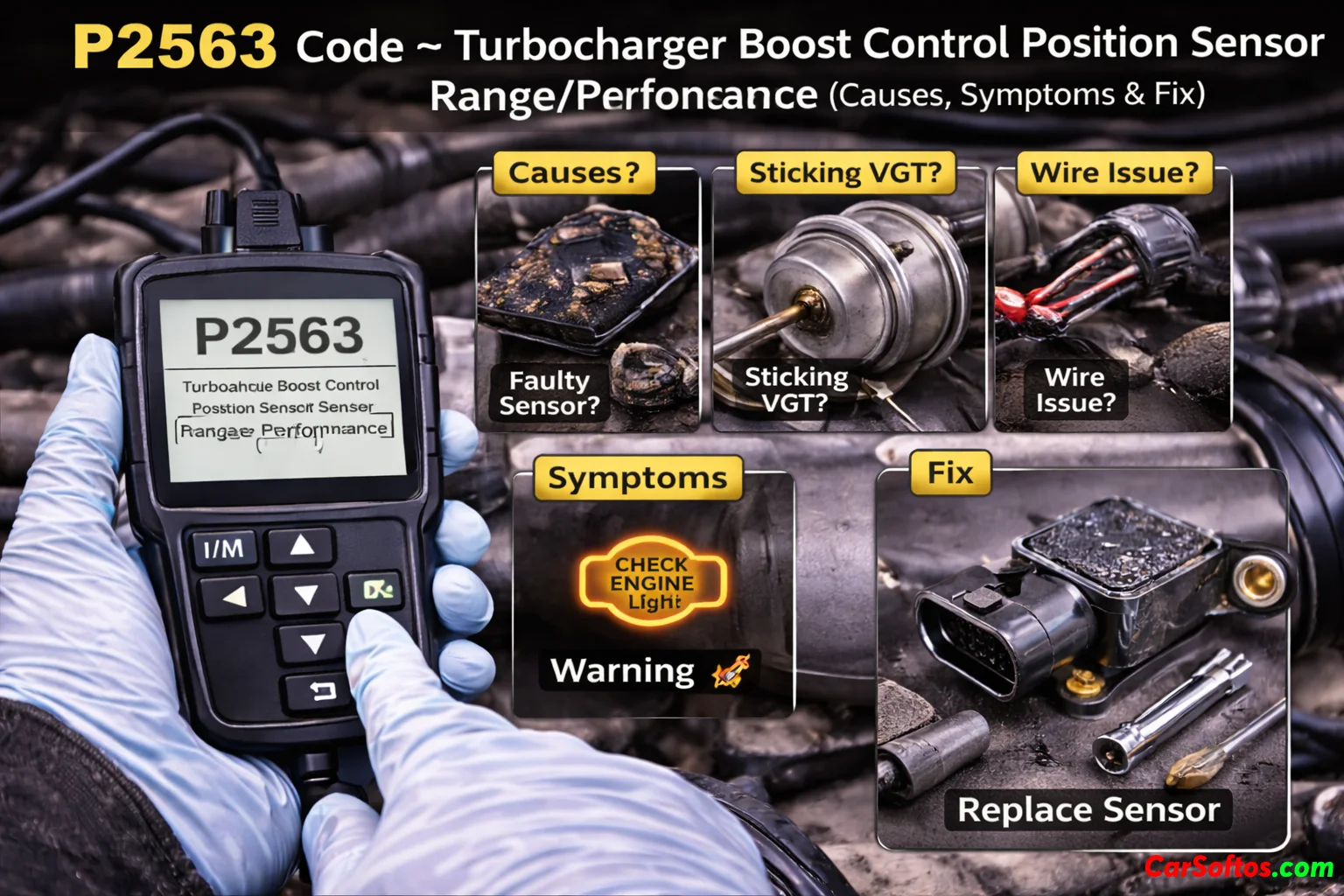
🔍 What Does P2563 Mean?
P2563 means the ECU/PCM has detected that the turbocharger boost control position sensor circuit is out of range or not performing as expected. On many turbo engines, this usually points to the vane position sensor / turbo actuator position feedback, especially on variable-geometry turbo systems. Ross-Tech, CarParts, and KBB all describe P2563 as a turbo boost control position sensor range/performance fault, often tied to the turbo vane position system rather than a simple boost leak alone.
In simple terms, the engine computer commands the turbo control mechanism to move, but the feedback signal says the position is wrong, slow, unstable, or outside the expected range. That is why P2563 often shows up with power loss, poor acceleration, and limp mode.
⚙️ How This System Works
On many modern turbo engines, especially diesels with VGT/VNT turbos, the turbo uses movable vanes or an electronically controlled actuator to regulate boost. The position sensor reports where the turbo control mechanism actually is, and the ECU compares that feedback to the commanded position. If commanded position and actual position do not match closely enough, P2563 can set.
That is why this code is usually more about actuator movement, vane sticking, sensor feedback, or wiring problems than about a simple pressure reading alone. Recent diagnostic writeups also note that soot buildup and sticking VGT vanes are common triggers.
⚠️ How Serious Is P2563?
Severity: Medium to High ⚠️⚠️⚠️⚠️☆
You can sometimes still drive with P2563, but it should not be ignored. Typical consequences include reduced power, limp mode, poor drivability, and higher fuel consumption. Ross-Tech lists MIL on and power loss as common symptoms, while KBB and CarParts also connect the code to acceleration problems and turbo performance issues.
If the root cause is sticking vanes, a failing actuator, or damaged wiring, the problem can get worse and may eventually lead to more serious turbo control faults or repeated limp-mode events. That is an inference based on how the system works and on the common causes listed in multiple repair references.
🚨 Common Symptoms of P2563
Typical symptoms include:
- ✅ Check Engine Light
- ✅ Noticeable loss of power
- ✅ Weak acceleration
- ✅ Turbo not responding normally
- ✅ Limp mode
- ✅ Hesitation or stumbling
- ✅ Poor fuel economy
- ✅ Sometimes inconsistent boost behavior
🧠 Most Common Causes of P2563
1️⃣ Sticking VGT vanes / carbon buildup
One of the most common real-world causes is soot or carbon buildup inside the turbo mechanism, which can make the vanes stick or move sluggishly. Recent iCarsoft guidance specifically highlights sticking VGT vanes due to soot buildup as a common cause.
2️⃣ Faulty turbo actuator
A failing electronic or vacuum turbo actuator can command the vanes incorrectly or fail to move them through the proper range. Multiple sources tie P2563 to actuator faults or boost control position problems.
3️⃣ Bad vane position sensor / boost control position sensor
If the sensor feedback is incorrect, noisy, or out of range, the ECU sees a position error and stores P2563. Ross-Tech and CarParts both point directly to vane/position sensor issues as common causes.
4️⃣ Wiring or connector problems
Damaged wiring, corroded pins, poor grounds, and weak connections can all distort the feedback signal. Ross-Tech explicitly lists faulty wiring/connections as a possible cause.
5️⃣ Vacuum leak or boost-control plumbing problem
On vacuum-operated systems, leaks in vacuum lines or faults in the control solenoid can prevent the actuator from moving correctly. Ross-Tech specifically mentions vacuum leaks to/from the turbo actuator and boost control solenoid.
6️⃣ Turbocharger mechanical wear
Excessive wear, damaged internals, or sticking hardware inside the turbo can also cause position-control problems and trigger P2563. That is reflected in Defy Diagnostics and CarParts summaries.
🔧 Step-by-Step Diagnosis
1️⃣ Scan all stored codes
First, check whether P2563 appears by itself or together with related turbo faults such as P0299, P00AF, boost sensor codes, or actuator relearn/position codes. Related faults can help separate a sensor-feedback issue from a broader turbo control problem. This is consistent with Ross-Tech and model-specific repair discussions.
2️⃣ Check live data
Look at:
- commanded actuator position
- actual actuator/vane position
- boost pressure / MAP
- desired vs actual boost
If commanded and actual position do not track each other properly, that strongly supports an actuator, sensor, wiring, or sticking-vane problem. Recent iCarsoft guidance specifically recommends live data graphing for this code.
3️⃣ Inspect the connector and wiring
Check for:
- green corrosion
- loose connector fit
- broken insulation
- oil contamination
- bent pins
This step matters because wiring faults are one of the most commonly cited P2563 causes.
4️⃣ Test actuator movement
If your scan tool supports actuator tests, command the turbo actuator through its range. Sluggish or incomplete movement points toward sticking vanes or a failing actuator. That matches recent guidance that actuator testing is key for P2563-type faults.
5️⃣ Inspect the turbo mechanism
If the actuator and wiring seem okay, inspect for:
- carbon buildup
- sticking vane mechanism
- linkage problems
- internal turbo wear
This is especially important on diesel engines with variable-geometry turbos.
6️⃣ Check vacuum lines and control solenoid
On vacuum-controlled systems, cracked hoses or a bad control solenoid can make the actuator position inaccurate or unstable.
🛠️ How to Fix P2563
The correct repair depends on the cause, but the most common fixes are:
✔️ Clean sticking turbo vanes / address soot buildup
If the vane mechanism is sticking from soot or carbon, cleaning or turbo service may be needed. Recent P2563 writeups call this one of the most common solutions.
✔️ Replace the turbo actuator
A bad actuator is a frequent cause when the turbo hardware itself is still usable.
✔️ Repair wiring or connectors
If the circuit is unstable, wiring repair can solve the code without replacing major parts.
✔️ Replace the position sensor
On some vehicles the sensor is separate; on others it is integrated into the actuator or turbo assembly. That varies by platform, so vehicle-specific service info matters. This is an inference supported by the range of parts described in repair sources.
✔️ Replace or rebuild the turbocharger
If the turbo mechanism is badly worn or seized, full turbo replacement may be necessary.
💰 Typical Repair Cost
Real cost depends heavily on the engine and whether the sensor/actuator is sold separately, but a practical range looks like this:
- Wiring repair: $20–$150
- Sensor replacement: $60–$250
- Actuator replacement: $200–$1,100
- Turbo cleaning/service: varies widely
- Turbocharger replacement: often the expensive worst case
Those ranges are a practical estimate based on the types of repairs commonly associated with P2563 in repair references; exact prices are vehicle-specific and not standardized across sources.
❗ Common Mistakes
❌ Replacing the turbo too early
A lot of P2563 cases come from wiring, actuator, sensor, or sticking vane issues rather than a fully failed turbo.
❌ Ignoring live data
This code is much easier to diagnose when you compare commanded vs actual position and desired vs actual boost.
❌ Missing vacuum leaks
On vacuum-controlled systems, a small leak can send diagnosis in the wrong direction.
❌ Replacing parts without checking the connector
Corrosion and poor electrical contact are simple but common causes.
⚖️ P2563 vs Similar Turbo Codes
P2563
Turbo boost control position sensor range/performance fault. Usually points to actuator position feedback, vane movement, or control mismatch.
P0299
Underboost. More focused on low boost pressure itself. It can share the same root causes, but P2563 is more position/control-oriented. This distinction is an inference from the code definitions and common cause lists.
P2262
Boost pressure not detected. Often overlaps with leaks, actuator faults, or turbo control failures, but P2563 is more directly tied to the turbo control position feedback side.
🚗 Can You Drive With P2563?
Yes, sometimes — but it is not a good idea for long.
Many vehicles with P2563 still run, but often with limited boost, weak acceleration, and limp mode risk. If power is badly reduced, the safest choice is to diagnose it soon instead of continuing to drive it hard. That conclusion is supported by the common symptom lists and severity implied across repair references.
📌 Final Verdict
P2563 usually means the turbo control mechanism is not reaching or reporting the position the ECU expects. The most common causes are sticking VGT vanes, a bad turbo actuator, a faulty position sensor, wiring problems, or vacuum/control faults. Recent references especially emphasize soot buildup and live-data diagnosis as key parts of solving this code correctly.

Tags:
Users of Guests are not allowed to comment this publication.