
Navigation
Top News
Statistics
Advertisement
Аrchives
Votes
| Rate the site |
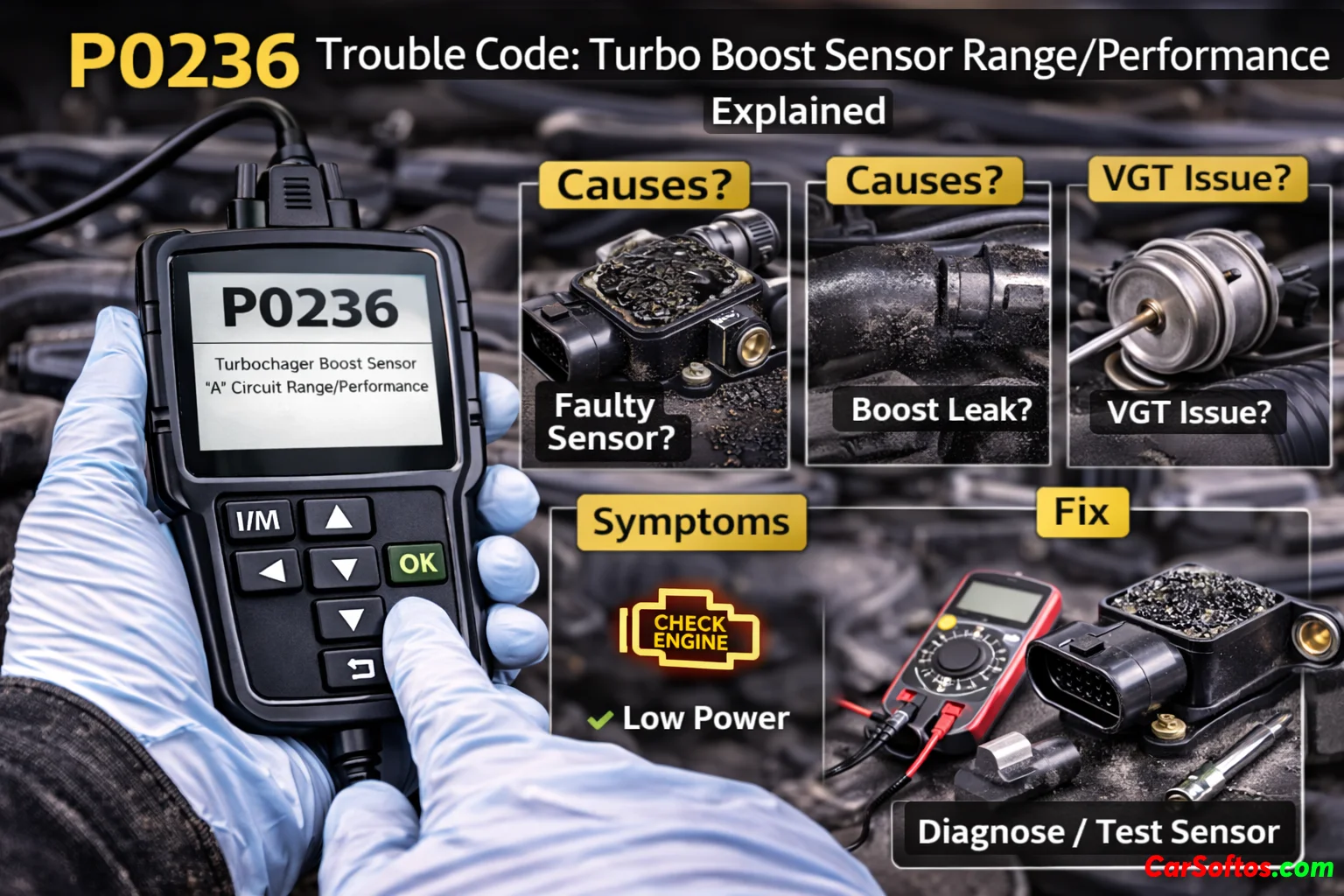
P0236 Trouble Code: Turbo Boost Sensor Range / Performance Explained
🔍 What Does P0236 Mean?
P0236 is the generic OBD-II definition for Turbocharger/Supercharger Boost Sensor “A” Circuit Range/Performance. Ford lists that definition in its OBD code documentation, and Ross-Tech describes the fault as an implausible signal from the manifold pressure / boost sensor.
In simple terms, the ECU is seeing a boost sensor reading that does not make sense compared with expected operating conditions or with other pressure-related signals. On Ford systems, the monitor can involve correlation checks between BARO, MAP, and the turbo/boost sensor, which is why P0236 is often more than “just a bad sensor.”
⚙️ What This Code Usually Means in Real Life
P0236 usually appears when one of these happens:
- the boost/MAP sensor signal is inaccurate
- the wiring or connector is unstable
- there is a boost leak in hoses, pipes, or the intercooler
- the actuator / charge air pressure control is not behaving correctly
Lists boost hose/intercooler leaks, loose clamps, wiring issues, a faulty boost sensor, and a faulty charge air pressure actuator among the common causes.
⚠️ How Serious Is P0236?
Severity: Medium to High
P0236 usually will not destroy the engine instantly, but it can cause reduced engine performance, poor acceleration, and improper boost control. Ross-Tech lists reduced performance, poor acceleration, and boost not building properly as typical symptoms.
If the root cause is a real boost-control problem rather than only a sensor issue, the car may go into limp mode or continue to run with weak boost, which can make overtaking and uphill driving unsafe. That is an inference based on the documented symptoms and how turbo control systems work.
🚨 Common Symptoms of P0236
Typical symptoms include:
- ✅ Check Engine Light
- ✅ Reduced engine performance
- ✅ Poor acceleration
- ✅ Boost pressure not building properly
- ✅ Weak response under load
- ✅ Sometimes limp mode
- ✅ Sometimes inconsistent turbo behavior
🧠 Most Common Causes of P0236
1️⃣ Faulty boost pressure sensor / MAP sensor
One of the most direct causes is a bad boost sensor sending an implausible signal. Both Ford and Ross-Tech describe P0236 as a boost sensor range/performance problem, and Ross-Tech specifically lists a faulty manifold pressure / boost sensor as a cause.
2️⃣ Wiring or connector problems
Damaged wiring, poor connections, shorts, opens, or corroded pins can distort the sensor signal. Ross-Tech explicitly lists electrical wiring issues as a common cause.
3️⃣ Boost leak in hoses, pipes, or intercooler
This is a very important one. If boost escapes through a split hose, cracked charge pipe, leaking intercooler, or loose clamp, the sensor signal can look implausible for the commanded operating condition. Ross-Tech lists leaks or damage in boost hoses, pipes, or intercooler plus loose hose clamps among the causes.
4️⃣ Faulty charge air pressure actuator / boost control hardware
Ross-Tech also lists a faulty charge air pressure actuator as a possible cause, which is why P0236 can overlap with actuator-related faults like P2563 and low-boost faults like P0299.
5️⃣ Sensor correlation problem, not just one bad part
Ford’s OBD documentation shows P0236 can be part of correlation checks involving BARO, MAP, and turbo/boost sensor values. So sometimes the issue is not only one failed sensor, but a signal that does not agree with the rest of the pressure model.
🔧 Step-by-Step Diagnosis
1️⃣ Scan all codes first
Check whether P0236 appears alone or with related turbo codes such as:
- P0237 — Boost Sensor Low
- P0238 — Boost Sensor High
- P0299 — Underboost
- P2563 — Turbo Boost Control Position Sensor Range/Performance
- P2262 — Boost Pressure Not Detected
Ford lists P0236 together with nearby turbo/boost-sensor codes, and Ross-Tech’s cause list shows why these codes often overlap diagnostically.
2️⃣ Check live data
Look at:
- boost pressure / MAP
- desired boost
- actual boost
- BARO if available
Ford documents that P0236 can involve pressure-sensor correlation logic, so live data is one of the fastest ways to see whether the sensor value is believable.
3️⃣ Inspect the sensor and connector
Check for:
- oil contamination
- bent pins
- water intrusion
- loose fit
- damaged insulation
This is a high-value step because Ross-Tech explicitly lists wiring and sensor faults among the main causes.
4️⃣ Inspect hoses, charge pipes, and intercooler
Look for:
- split hoses
- popped-off pipes
- cracked plastic charge pipes
- loose clamps
- oily residue around a leak
5️⃣ Check actuator / boost-control operation
If the sensor and plumbing look good, the next suspect is the boost-control side. Ross-Tech includes a faulty charge air pressure actuator in the P0236 cause list.
6️⃣ Compare P0236 with P0237/P0238 behavior
If the signal is completely too low or too high, you may see P0237 or P0238 instead. GM documents very low and very high boost-sensor voltage thresholds for those adjacent codes, which helps show where P0236 fits: it is often a plausibility/range-performance fault rather than a simple hard-low or hard-high circuit fault.
🛠️ How to Fix P0236
The repair depends on the real cause, but the most common fixes are:
✔️ Replace the boost/MAP sensor
A failed or drifting sensor is one of the most direct causes.
✔️ Repair wiring or clean the connector
If the signal is unstable because of wiring damage or corrosion, repairing the circuit can solve the fault without replacing major hardware.
✔️ Fix boost leaks
Replace split hoses, tighten clamps, or repair cracked charge pipes / intercooler leaks. Ross-Tech explicitly points to these as common causes.
✔️ Repair the actuator / charge pressure control side
If the boost-control hardware is not responding properly, the sensor reading can become implausible even when the sensor itself is fine.
💰 Typical Repair Cost
A practical article-friendly estimate:
- Boost/MAP sensor: $60–$250
- Wiring repair: $20–$150
- Hose / clamp / small boost leak: $20–$150
- Charge pipe / intercooler repair: $80–$400
- Actuator-related repair: $200–$1,100
These are practical market-style ranges rather than a single official schedule; exact cost varies a lot by engine layout and whether the actuator/sensor is sold separately.
❗ Common Mistakes
❌ Replacing the sensor too early
P0236 sounds like a sensor code, but Ross-Tech’s cause list shows it can also be caused by boost leaks, loose clamps, wiring faults, or actuator issues.
❌ Ignoring charge-air leaks
A leaking intercooler pipe can make the sensor reading look wrong even when the sensor is healthy.
❌ Skipping live-data checks
Since Ford uses pressure correlation logic for this family of faults, live data is critical.
❌ Confusing P0236 with P2563
P0236 is mainly about boost sensor range/performance, while P2563 is more about turbo control position feedback / actuator-vane position performance.
⚖️ P0236 vs P2563
P0236
Boost sensor “A” circuit range/performance. Usually points to an implausible or out-of-range boost-pressure signal, often involving the sensor, wiring, leaks, or charge-pressure control hardware.
P2563
Turbo boost control position sensor range/performance. This usually points more toward the actuator / vane position feedback side of the turbo control system. That distinction is based on the code definitions themselves.
👉 Simple way to explain it:
- P0236 = boost signal looks wrong
- P2563 = turbo control position looks wrong
🚗 Can You Drive With P0236?
Yes, sometimes — but it should not be ignored.
Because P0236 is commonly associated with reduced performance and poor acceleration, short-term driving may be possible, but long-term driving is a bad idea until you know whether the cause is a sensor issue, a leak, or a real boost-control problem.
If the vehicle has severe power loss, limp mode, or obvious boost leak symptoms, treat it as urgent. That is an inference based on the documented symptom profile.
📌 Final Verdict
P0236 usually means the ECU is receiving a boost-pressure signal that does not fit reality. The most common causes are a faulty boost/MAP sensor, wiring or connector issues, boost leaks in hoses or the intercooler, loose clamps, or a charge-pressure actuator problem.

Tags:
Users of Guests are not allowed to comment this publication.