
Navigation
Top News
Statistics
Advertisement
Аrchives
Votes
| Rate the site |
P0341 Trouble Code: Camshaft Position Sensor Range/Performance Explained
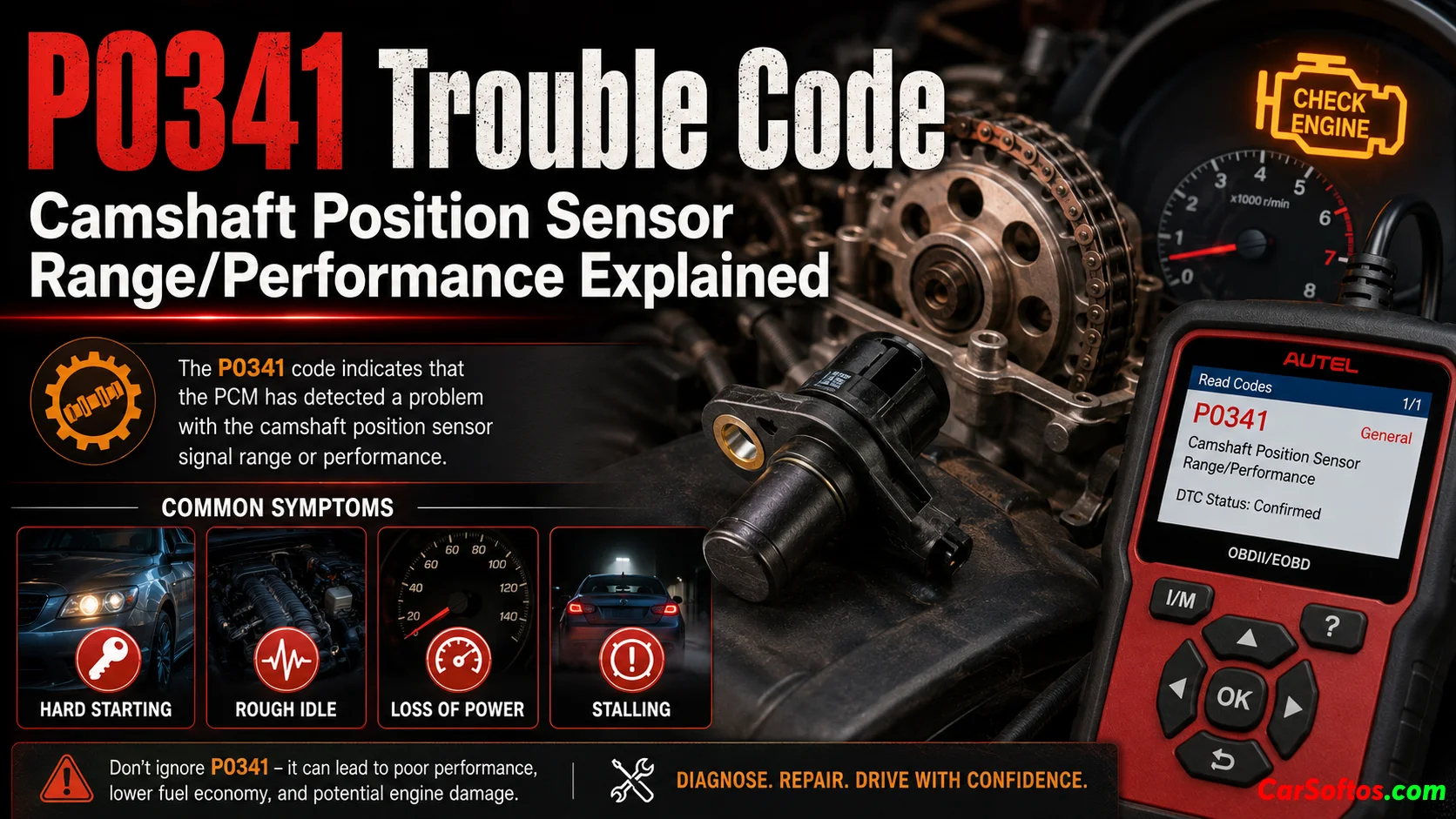
🔍 What Does P0341 Mean?
P0341 means:
Camshaft Position Sensor “A” Circuit Range/Performance — Bank 1 or Single Sensor
In simple terms, the engine computer sees that the camshaft position sensor signal is not believable. The signal may be out of range, missing expected pulses, showing the wrong pulse count, out of sync with the crankshaft sensor, or not matching the ECU’s expected camshaft timing. AutoZone describes P0341 as a fault where camshaft position sensor readings do not correspond to PCM specifications, often involving the number of pulses detected during a certain number of engine revolutions.
👉 Simple explanation
The ECU is saying:
- the camshaft sensor signal exists, but it does not look correct;
- the camshaft signal may not match the crankshaft signal;
- the cam timing may be mechanically wrong;
- the sensor, wiring, timing chain/belt, VVT system or reluctor wheel may be faulty.
This is why P0341 is not always just a bad sensor. A stretched timing chain, jumped timing belt, VVT actuator issue, low oil pressure, wiring fault or damaged camshaft tone wheel can also trigger it. Ross-Tech’s VAG-specific P0341 page lists possible causes including faulty wiring to the camshaft sensor, faulty sensor, misaligned timing, low oil level and low oil pressure.
⚙️ What the Camshaft Position Sensor Does
The camshaft position sensor, often called the CMP sensor, tells the ECU where the camshaft is in its rotation.
The ECU uses this signal for:
- sequential fuel injection;
- ignition timing strategy;
- variable valve timing control;
- cam/crank synchronization;
- misfire detection;
- start-up synchronization;
- cylinder identification.
The crankshaft sensor tells the ECU where the crankshaft is. The camshaft sensor tells the ECU which stroke the engine is on and whether camshaft timing matches the expected position. That is why P0341 often overlaps with crank/cam correlation codes such as P0016 or P0017.
⚠️ How Serious Is P0341?
Severity: ⭐⭐⭐⭐☆ to ⭐⭐⭐⭐⭐ — Medium-High to Critical
P0341 can be mild if it is only an intermittent connector issue, but it can be serious if it is caused by timing-chain stretch, jumped timing, VVT actuator failure or low oil pressure.
🚨 Why it matters
- the engine may start hard or not start;
- fuel injection timing may be incorrect;
- ignition timing strategy may be affected;
- VVT control may become unreliable;
- fuel economy may drop;
- engine power may be reduced;
- severe timing problems can cause engine damage on interference engines.
Edmunds notes that a malfunctioning camshaft sensor can disrupt fuel delivery and ignition timing, causing poor performance and potential engine damage if ignored.
🚨 Common Symptoms of P0341
Typical symptoms include:
- ⚠️ Check Engine Light;
- ⚠️ hard starting;
- ⚠️ extended cranking;
- ⚠️ crank-no-start;
- ⚠️ rough idle;
- ⚠️ hesitation during acceleration;
- ⚠️ poor fuel economy;
- ⚠️ reduced engine power;
- ⚠️ stalling;
- ⚠️ misfires;
- ⚠️ rattling noise from timing chain area;
- ⚠️ limp mode on some vehicles;
- ⚠️ related codes like P0016, P0011, P0340, P0344.
Samarins lists hard starting, lack of power and rattling noise as possible signs when P0341 is related to a stretched timing chain.
🔥 Real-World P0341 Patterns
| Pattern | Most likely diagnostic direction |
|---|---|
| P0341 only, engine runs fine | sensor signal issue, connector, early intermittent fault |
| P0341 + hard start | CMP sensor, crank/cam sync, timing issue |
| P0341 + rattling at startup | stretched timing chain or weak tensioner |
| P0341 + P0016/P0017 | cam/crank correlation or mechanical timing issue |
| P0341 + P0011/P0010 | VVT actuator, oil control valve, oil pressure, cam phaser |
| P0341 after timing work | timing off by one tooth, wrong sensor plate alignment |
| P0341 after sensor replacement | wiring, wrong sensor, reluctor, timing, relearn/adaptation |
| P0341 only when hot | sensor heat failure, connector expansion, wiring fault |
| P0341 with low oil pressure | VVT/cam timing control issue |
| P0341 after engine repair | connector unplugged, harness pinched, cam target damaged |
A JLR technical bulletin shows P0341 appearing with VVT-related codes such as P0010, P0011 and P052A, and the stated cause was loose retaining bolts for the inlet VCT actuator. That is a good example of P0341 being caused by a cam timing/VVT mechanical issue rather than only a failed sensor.
🧠 Most Common Causes of P0341
1️⃣ Faulty camshaft position sensor
A failing CMP sensor can produce an incorrect waveform, missing pulses, weak signal or an implausible signal.
Common sensor failure clues
- code returns quickly after clearing;
- signal drops out on oscilloscope;
- engine starts poorly;
- sensor fails when hot;
- live data shows cam signal loss;
- known-good sensor fixes the issue.
P0341 diagnostic references commonly describe the fault as the CMP signal being outside the expected range or not correctly synchronized with the crankshaft signal.
2️⃣ Wiring or connector problem 🔌
This is one of the most common and cheapest-to-miss causes.
Check for:
- broken connector lock;
- loose terminals;
- bent pins;
- green corrosion;
- oil contamination;
- wiring rubbed through;
- harness damage near valve cover;
- pinched wires after engine work;
- damaged shielding;
- poor ground or missing reference voltage.
Samarins specifically recommends checking the camshaft position sensor connector and wiring for damage, poor connection or corrosion, and checking 5V reference and ground on a three-wire sensor.
3️⃣ Stretched timing chain or jumped timing belt ⛓️
This is a major cause of P0341, especially when the code appears with rattling, hard start, loss of power or crank/cam correlation codes.
A stretched chain or jumped belt changes the relationship between crankshaft position and camshaft position. The sensor may be working perfectly, but the camshaft is no longer where the ECU expects it to be.
Signs of timing issue
- rattling noise on cold start;
- poor acceleration;
- hard starting;
- P0341 + P0016/P0017;
- P0341 + P0011/P0012;
- timing marks do not line up;
- cam/crank waveform correlation is shifted.
Samarins states that a jumped timing belt/chain or stretched timing chain can cause P0341.
4️⃣ VVT / cam phaser problem
On engines with variable valve timing, the camshaft position changes dynamically. If the cam phaser, VVT actuator or oil control valve cannot move the camshaft correctly, the ECU may see the camshaft signal as implausible.
Possible VVT-related causes:
- stuck oil control valve;
- clogged VVT solenoid screen;
- low oil level;
- low oil pressure;
- dirty oil;
- cam phaser stuck advanced or retarded;
- loose VCT actuator bolt;
- failed camshaft actuator.
low oil level or low oil pressure as possible P0341 causes on VAG vehicles, and the JLR bulletin shows P0341 with VVT actuator-related faults caused by loose VCT actuator retaining bolts.
5️⃣ Damaged camshaft reluctor / tone wheel ⚙️
The camshaft sensor reads a target wheel, reluctor, trigger plate or sensor disc. If that target is damaged, the sensor waveform becomes wrong even when the sensor is good.
Possible problems:
- bent trigger tab;
- cracked tone wheel;
- loose reluctor;
- damaged cam gear;
- wrong camshaft gear installed;
- excessive camshaft endplay;
- debris on sensor target;
- incorrect sensor plate after repair.
Some diagnostic references list target wheel damage, electrical noise, poor connection and ECM issues as possible P0341 causes.
6️⃣ Incorrect sensor installation or wrong part
P0341 can appear after sensor replacement if the new part is not correct.
Possible issues:
- wrong aftermarket sensor;
- sensor not fully seated;
- damaged O-ring;
- wrong sensor length;
- poor connector fit;
- incorrect air gap;
- sensor installed on wrong bank;
- Bank 1 and Bank 2 sensors swapped incorrectly.
Mitsubishi service information for P0341 includes checking whether the camshaft position sensor is correctly installed as an early diagnostic step.
7️⃣ Low oil level, dirty oil or oil pressure problem 🛢️
On VVT engines, oil pressure controls camshaft timing. If the oil is low, dirty or too thick, the cam phaser may not respond correctly.
Check:
- oil level;
- oil pressure;
- oil condition;
- correct viscosity;
- clogged VVT screens;
- sludge;
- overdue oil service.
This is especially important if P0341 appears together with VVT codes such as P0010, P0011, P0012, P0014 or P052A.
8️⃣ Electrical noise / signal interference 📡
The CMP signal can be distorted by electrical noise.
Possible causes:
- damaged shielding;
- poor ground;
- ignition coil interference;
- alternator ripple;
- harness routed near high-current wiring;
- bad repair splices;
- aftermarket remote start/alarm wiring.
An oscilloscope is the best way to catch this because a multimeter may show normal voltage while the waveform contains noise or missing pulses.
9️⃣ ECU/PCM fault — rare
An ECU input fault is possible but uncommon.
Only suspect the ECU after confirming:
- sensor is good;
- power and ground are correct;
- wiring continuity is good;
- signal waveform reaches the ECU;
- timing is correct;
- VVT system works;
- relevant TSB/software issues are checked.
⚡ P0341 vs Related Codes
| Code | Meaning | Simple explanation |
|---|---|---|
| P0340 | Camshaft Position Sensor Circuit | General CMP circuit fault |
| P0341 | Camshaft Position Sensor Range/Performance | CMP signal is implausible or out of sync |
| P0342 | Camshaft Position Sensor Low Input | CMP signal too low |
| P0343 | Camshaft Position Sensor High Input | CMP signal too high |
| P0344 | Camshaft Position Sensor Intermittent | CMP signal drops in and out |
| P0016 | Crank/Cam Correlation | Crankshaft and camshaft timing do not agree |
| P0011 | Camshaft Timing Over-Advanced | VVT/cam timing too advanced |
👉 Practical difference
- P0340 usually points more toward circuit failure.
- P0341 points toward signal quality, pulse count, range/performance or crank/cam synchronization.
- P0344 points toward intermittent signal dropout.
- P0016/P0017 point more strongly toward mechanical timing correlation.
Mechanic describes P0341 as a code where the ECM detects the camshaft sensor circuit is not within specifications and the sensor pulses do not correlate to crankshaft sensor pulses.
🔧 Professional Step-by-Step Diagnosis
1️⃣ Scan all codes and save freeze-frame data
Do not clear the code before saving data.
Look for:
- P0340–P0344;
- P0010/P0011/P0012/P0014;
- P0016/P0017/P0018/P0019;
- P0335–P0339;
- misfire codes P0300–P0308;
- low oil pressure codes;
- low-voltage codes.
Freeze-frame data helps identify whether the fault happened during:
- cold start;
- hot idle;
- acceleration;
- extended cranking;
- high RPM;
- deceleration;
- VVT activation.
2️⃣ Confirm Bank 1 and Sensor A
Before replacing parts, identify the correct sensor.
Terms matter
- Bank 1 = side of the engine with cylinder 1.
- Sensor A often means intake camshaft sensor on many engines, but naming varies by manufacturer.
- On inline engines, Bank 1 or single sensor may refer to the only cam sensor or the intake cam sensor.
Replacing the wrong cam sensor is a very common mistake on V6/V8 engines.
3️⃣ Inspect the connector and wiring first
Check:
- connector fully seated;
- broken tab;
- oil inside connector;
- corrosion;
- terminals pushed back;
- harness rubbed through;
- wiring near valve cover;
- wiring near exhaust;
- pinched loom after timing or valve cover work.
This should be done before buying a sensor.
4️⃣ Check power, ground and signal
Use a wiring diagram.
For a typical three-wire Hall-effect CMP sensor, check:
- 5V or 12V supply;
- sensor ground;
- signal wire;
- voltage drop on ground;
- continuity to ECU;
- short to ground;
- short to power.
If power or ground is missing, replacing the sensor will not fix P0341.
5️⃣ Check live data
Use a scan tool that can show camshaft data.
Look for:
- cam/crank sync status;
- camshaft actual angle;
- camshaft desired angle;
- VVT duty command;
- sensor activity;
- fault counter;
- start-up synchronization.
Red flags
- camshaft actual angle does not follow desired angle;
- cam sync switches between yes/no;
- cam angle jumps suddenly;
- no signal from one cam sensor;
- Bank 1 behaves differently from Bank 2;
- code appears when VVT is commanded.
6️⃣ Use an oscilloscope if possible
P0341 is a range/performance code, so waveform testing is very valuable.
Compare:
- CMP signal;
- CKP signal;
- Bank 1 vs Bank 2 cam signals if available;
- waveform shape;
- pulse count;
- synchronization point.
The oscilloscope images above show how a camshaft sensor signal may look normal, drop out, or show irregular pulses. This is exactly the type of evidence needed for P0341 diagnosis.
7️⃣ Check mechanical timing
If wiring and signal are plausible, verify mechanical timing.
Check:
- timing belt/chain marks;
- chain stretch;
- tensioner condition;
- guide condition;
- cam sprocket alignment;
- crank pulley/reluctor alignment;
- VVT actuator position;
- camshaft phaser lock position.
If the cam/crank waveform is shifted, the sensor may be reporting correctly but the engine timing may be wrong.
8️⃣ Check VVT system and oil condition
If the engine has VVT, check:
- oil level;
- oil pressure;
- oil viscosity;
- oil control valve;
- cam phaser;
- VVT actuator;
- clogged screens;
- sludge;
- related P0010/P0011/P0012/P052A codes.
A P0341 code with VVT codes should not be treated as a sensor-only problem.
9️⃣ Inspect the camshaft target wheel
If P0341 returns after sensor replacement and timing checks:
- inspect reluctor/tone wheel;
- check cam gear trigger tabs;
- look for broken or bent targets;
- verify correct cam gear;
- check for loose phaser components;
- inspect for debris near sensor.
🔟 Check TSBs and software
Some vehicle-specific P0341 cases involve known timing, VVT actuator or software issues. The JLR bulletin is a strong example where P0341 appeared in a group of VVT-related DTCs due to VCT actuator retaining bolt problems.
🛠️ How to Fix P0341
✔️ Repair connector or wiring
If the connector is loose, corroded or damaged.
Typical cost: $50–$300
✔️ Replace camshaft position sensor
If the sensor signal is faulty and wiring/timing are good.
Typical cost: $120–$450 installed
✔️ Correct oil level / oil pressure / oil quality
If VVT operation is affected by oil problems.
Typical cost: $50–$250+
✔️ Clean or replace VVT oil control valve
If cam timing response is slow or incorrect.
Typical cost: $150–$500
✔️ Replace cam phaser / VVT actuator
If the camshaft actuator is stuck, loose or mechanically failed.
Typical cost: $500–$2,000+
✔️ Repair timing chain or timing belt
If timing is misaligned, stretched or jumped.
Typical cost: $600–$3,500+
✔️ Repair camshaft reluctor / target wheel
If the sensor target is damaged.
Typical cost: $300–$2,000+
✔️ ECU repair / update
Rare, only after complete diagnosis.
Typical cost: $100–$350 for update, $600–$2,000+ for ECU replacement.
💰 Repair Cost Summary
| Repair | Typical cost |
|---|---|
| Diagnostic scan / live data | $80–$200 |
| Oscilloscope diagnosis | $120–$350 |
| Connector or wiring repair | $50–$300+ |
| Camshaft position sensor replacement | $120–$450 |
| Oil service / oil-level correction | $50–$250+ |
| VVT solenoid / oil control valve | $150–$500 |
| Cam phaser / VVT actuator repair | $500–$2,000+ |
| Timing chain / timing belt repair | $600–$3,500+ |
| Reluctor / target wheel repair | $300–$2,000+ |
| ECU software update | $100–$350 |
| ECU replacement | $600–$2,000+ |
❗ Common Mistakes
❌ Replacing the cam sensor immediately
P0341 can be caused by timing chain stretch, VVT failure, oil pressure issues, wiring faults or target wheel damage.
❌ Ignoring timing-chain noise
A rattling chain plus P0341 is a major warning sign. Do not treat it as only an electrical sensor fault.
❌ Replacing the wrong sensor
Bank 1 / Sensor A must be identified correctly before parts are replaced.
❌ Not checking oil level and pressure
On VVT engines, oil problems can create cam timing faults that look like sensor range/performance codes.
❌ Ignoring P0016/P0017
P0341 with crank/cam correlation codes often points to mechanical timing, not just the CMP sensor.
❌ Using only a generic scanner
For a proper diagnosis, you need cam desired/actual angle, sync status, VVT command and sometimes oscilloscope waveforms.
🚗 Can You Drive With P0341?
Short-term only if the engine runs normally.
You may drive gently to a repair shop if:
- engine starts normally;
- no rattling timing noise;
- no stalling;
- no severe misfire;
- no major loss of power;
- Check Engine Light is steady, not flashing.
Do not keep driving if:
- engine rattles on startup;
- engine is hard to start;
- car stalls;
- power is reduced;
- Check Engine Light flashes;
- P0016/P0017 or oil pressure codes are also present;
- timing chain noise is obvious.
🚨 Risks of ignoring P0341
- no-start condition;
- poor fuel economy;
- rough running;
- failed emissions test;
- catalytic converter damage from misfires;
- timing-chain failure;
- engine damage on interference engines.
❓ FAQ
Is P0341 always a bad camshaft position sensor?
No. It can be the sensor, but it can also be wiring, connector damage, timing misalignment, stretched chain, VVT problem, low oil pressure or a damaged camshaft target wheel. Ross-Tech lists wiring, sensor, timing, oil level and oil pressure as possible causes.
What is the difference between P0340 and P0341?
P0340 is usually a more general camshaft sensor circuit fault. P0341 means the signal is out of expected range, has the wrong performance, or does not correlate correctly with crankshaft position.
Can a stretched timing chain cause P0341?
Yes. A stretched chain changes cam timing relative to crank timing, and that can trigger P0341. Samarins specifically notes that a stretched timing chain can cause P0341.
Can low oil cause P0341?
Yes, especially on VVT engines. Low oil level or low oil pressure can affect cam timing control. Ross-Tech lists low oil level or low oil pressure as possible causes for VAG P0341.
Can P0341 cause no start?
Yes. If the ECU cannot identify camshaft position or cam/crank synchronization, some engines may crank longer, start poorly or not start.
📌 Final Verdict
P0341 means the ECU sees the camshaft position sensor “A” signal as out of range, implausible or not correctly synchronized with crankshaft position.
Most common real causes:
- faulty camshaft position sensor;
- damaged wiring or connector;
- stretched timing chain;
- jumped timing belt;
- VVT solenoid or cam phaser problem;
- low oil level or low oil pressure;
- damaged camshaft reluctor / target wheel;
- incorrect sensor installation;
- electrical noise or rare ECU fault.
💡 Key takeaway
- P0341 is not always just a sensor.
- Check wiring and connector first.
- Look for timing-chain noise and VVT codes.
- Check oil level and oil pressure on VVT engines.
- Use cam/crank waveform comparison when diagnosis is unclear.
- P0341 + P0016/P0017 strongly points toward timing correlation.

Tags:
Users of Guests are not allowed to comment this publication.