
Navigation
Top News
Statistics
Advertisement
Аrchives
Votes
| Rate the site |
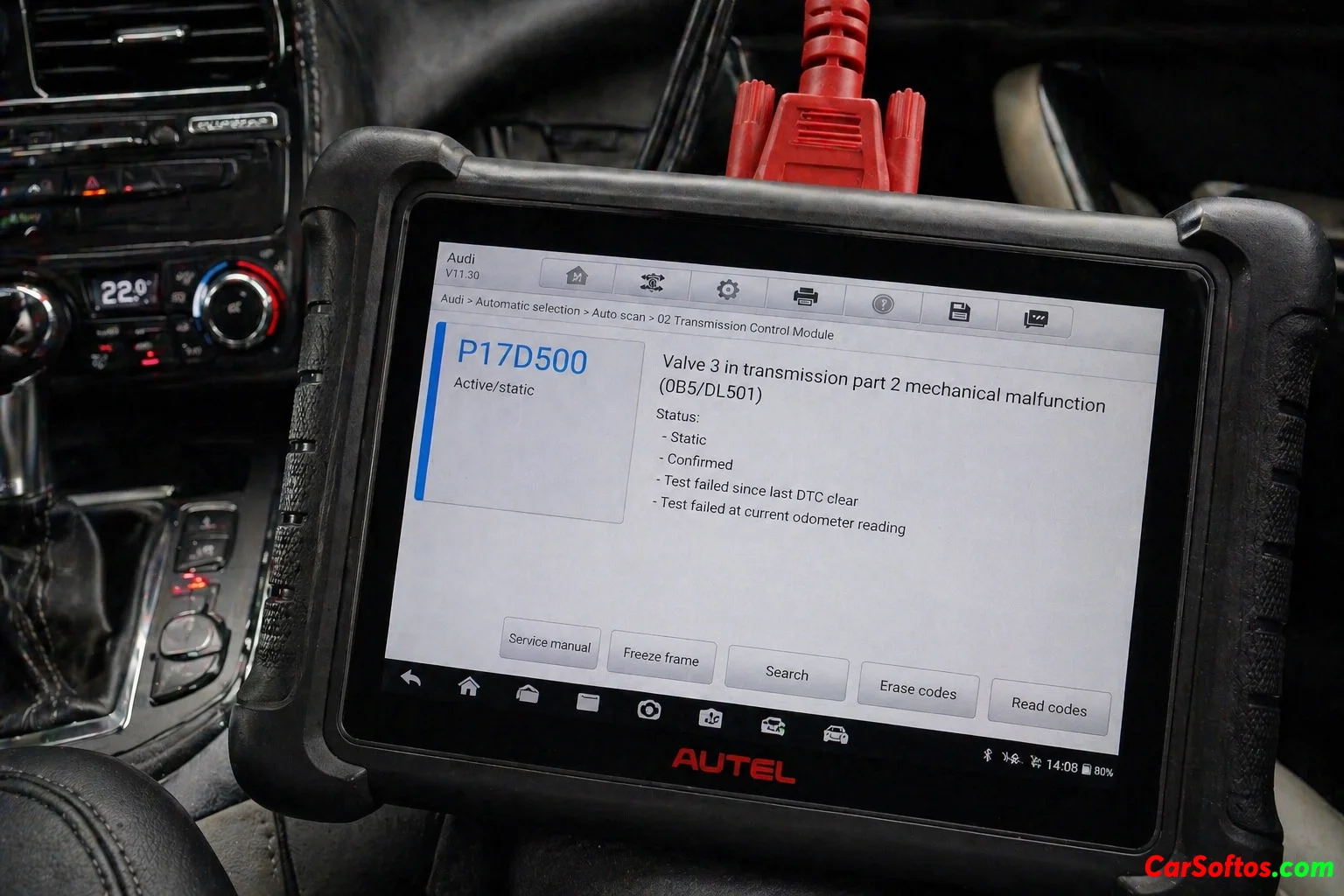
P17D5 Code — Valve 3 in Transmission Part 2 Mechanical Malfunction (Audi S tronic 0B5 / DL501 Guide)
🔍 What Does P17D5 Mean?
P17D5 is a VAG / Audi-specific transmission fault code most commonly linked to the Audi 0B5 / DL501 7-speed S tronic gearbox.
The common VCDS wording is:
8960 — Valve 3 in Transmission Part 2
P17D5 00 — Mechanical Malfunction
Specialist 0B5 references list P17D5 as “Valve 3 in Transmission Part 2” with DFCC/symptom code 18766, and describe it as a fault that can often be repaired with a mechatronic repair kit, although some cases require the entire mechatronic unit.
👉 In simple words:
The transmission control unit sees that Valve 3 in sub-gearbox / transmission part 2 is not mechanically behaving correctly.
That usually points to:
- sticking Valve 3
- hydraulic valve-body issue
- mechatronic solenoid / valve fault
- dirty or degraded S tronic fluid
- unstable clutch/gear pressure control
- sometimes broader mechatronic failure
⚙️ What “Transmission Part 2” Means on Audi 0B5
The 0B5 / DL501 S tronic is a dual-clutch gearbox. Internally it works like two partial gearboxes inside one unit:
- Transmission Part 1 / Sub-gearbox 1
- Transmission Part 2 / Sub-gearbox 2
Each side has its own hydraulic control logic through the mechatronic unit. That is why Audi/VAG fault descriptions separate codes like:
- P17D4 — Valve 3 in Transmission Part 1
- P17D5 — Valve 3 in Transmission Part 2
Quick-reference 0B5 material lists P17D4 = Valve 3 in Transmission Part 1 / 18765 and P17D5 = Valve 3 in Transmission Part 2 / 18766.
⚠️ How Serious Is P17D5?
Severity: ⭐⭐⭐⭐⭐ High / Critical
This is not a small generic OBD code. P17D5 is usually a mechatronic / hydraulic control fault inside the Audi S tronic transmission.
🚨 Why it matters:
- can trigger Gearbox malfunction warning
- may cause harsh shifts or delayed engagement
- can become worse when hot
- may lead to limp mode
- can damage clutches if pressure control is unstable
- can become expensive if ignored
0B5 mechatronic specialists list P17D5 among common S tronic mechatronic failure codes, together with P17D4, P17D8, P1740, P174B/P174F, P179C/P179D and related faults.
🚨 Common Symptoms of P17D5
Typical symptoms include:
- ⚠️ Gearbox malfunction message on the dashboard
- ⚠️ harsh or jerky shifting
- ⚠️ delayed engagement into Drive or Reverse
- ⚠️ shudder when moving from a stop
- ⚠️ rough downshifts
- ⚠️ limp mode / limited gears
- ⚠️ fault returns after clearing
- ⚠️ warning appears more often when hot
🔥 Real-world pattern:
| Symptom | What it may suggest |
|---|---|
| Harsh shift after warm-up | hydraulic valve / fluid / mechatronic issue |
| Delayed D/R engagement | pressure control instability |
| P17D5 alone | Valve 3 part 2 issue likely |
| P17D4 + P17D5 together | broader Valve 3 / mechatronic issue |
| P17D5 + P174E | mechanical + electrical Valve 3 side 2 issue |
| P17D5 + P17D8/P1740 | clutch temperature / pressure problem nearby |
Real owner reports show P17D5 / Valve 3 in Transmission Part 2 appearing with S tronic gearbox malfunction complaints, sometimes even after mechatronic-related work.
🧠 Most Common Causes of P17D5
1️⃣ Valve 3 mechanical sticking — most direct cause
The code description says mechanical malfunction, so the first target is not a simple open/short circuit.
Possible mechanical/hydraulic causes:
- Valve 3 sticking
- solenoid spool binding
- varnish or debris in valve body
- worn valve bore
- hydraulic flow restriction
- pressure response too slow or unstable
Specialist references list P17D5 as a Valve 3 in sub-gearbox 2 mechanical malfunction, which supports treating it as a valve/mechatronic hydraulic fault first.
2️⃣ Mechatronic unit failure
The mechatronic controls clutch pressure, gear selection and hydraulic valve operation. If it cannot move or regulate Valve 3 correctly in transmission part 2, P17D5 can be stored.
0B5 repair references group P17D5 with common mechatronic failure codes, not with generic engine or sensor faults.
3️⃣ Dirty, wrong or degraded S tronic fluid
Bad fluid can make mechanical valve faults worse.
Possible fluid-related issues:
- wrong DSG/S tronic fluid
- incorrect fluid level
- old fluid with degraded friction properties
- metal/debris contamination
- burnt smell after overheating or clutch slip
In forums discussion around 0B5 symptom codes notes that wrong or incorrect fluid level can be relevant when solenoid/valve faults are present.
4️⃣ Internal hydraulic pressure instability
Because Valve 3 belongs to the mechatronic hydraulic control system, pressure problems can trigger or worsen P17D5.
Possible sources:
- internal leakage
- worn seals
- valve-body wear
- pump pressure instability
- solenoid response delay
- clutch pressure instability
This is a diagnostic inference based on the 0B5 mechatronic architecture and the way P17D5 is grouped with mechatronic and pressure-related faults.
5️⃣ Mechatronic repair kit or solenoid issue
0B5 quick-reference material says P17D5 can normally be fixed with a mechatronic repair kit, but some situations require full mechatronic replacement.
That means the repair often focuses on:
- mechatronic repair kit
- Valve 3 / related solenoid repair
- valve body repair
- complete mechatronic replacement if repair is not enough
6️⃣ Electrical sister fault nearby: P174E
P17D5 is the mechanical Valve 3 fault for transmission part 2.
The related electrical code is:
- P174E — Valve 3 in sub-gearbox 2, electrical fault
0B5 quick-reference material lists P174E = Valve 3 in sub-gearbox 2 electrical fault / 8940, usually tied to circuit board repair.
👉 Simple difference:
- P17D5 = Valve 3 part 2 mechanical/hydraulic problem
- P174E = Valve 3 part 2 electrical/circuit problem
⚡ P17D5 vs P17D4 — Important Difference
P17D4
Valve 3 in Transmission Part 1 — mechanical malfunction.
P17D5
Valve 3 in Transmission Part 2 — mechanical malfunction.
👉 Simple explanation:
- P17D4 = same Valve 3 fault, but on gearbox half 1
- P17D5 = same Valve 3 fault, but on gearbox half 2
🔧 Step-by-Step Diagnosis
1️⃣ Scan with VCDS / ODIS, not only a generic scanner
For Audi S tronic faults, generic scanners often miss important context.
Record:
- full code
- VAG number
- symptom/DFCC code
- static or intermittent status
- freeze-frame data
- fluid temperature
- mileage
- related DTCs
Typical wording may show:
- 8960 — Valve 3 in Transmission Part 2
- P17D5 00 — Mechanical Malfunction
Real-world VCDS logs show P17D5 in this format.
2️⃣ Check whether P17D5 appears alone or with related codes
Look for:
- P17D4 — Valve 3 part 1 mechanical
- P174E — Valve 3 part 2 electrical
- P174A — Valve 3 part 1 electrical
- P174B / P174F — Valve 4 electrical faults
- P179C / P179D — pressure/cooling oil valve faults
- P17D8 — torque limitation because of clutch temperature
- P1740 — clutch temperature monitoring
- P0726 — RPM signal implausible
If several of these are present, the issue is more likely a broader 0B5 mechatronic failure cluster, not just one isolated valve.
3️⃣ Road test and note when symptoms appear
During a careful road test, note:
- cold vs hot behavior
- Drive/Reverse engagement delay
- harsh upshifts or downshifts
- shudder from a stop
- whether manual mode behaves differently
- whether the warning appears after warm-up
If the fault appears mostly hot, fluid, pressure and valve sticking become more suspicious.
4️⃣ Check fluid service history and fluid level
This is very important on 0B5.
Check:
- correct S tronic fluid type
- correct fill procedure
- fluid temperature during level check
- service interval history
- signs of contamination or burnt smell
Incorrect fluid or level can make valve and mechatronic behavior worse, and expert forum comments on 0B5 valve faults specifically warn about wrong/incorrect fluid level as a possibility.
5️⃣ Do not rely on adaptation as a “magic fix”
Basic settings/adaptation may be needed after repairs, but it will not fix a mechanically sticking valve.
If P17D5 returns after adaptation, suspect:
- Valve 3 sticking
- mechatronic fault
- hydraulic leakage
- repair kit/solenoid issue
- deeper gearbox fault
6️⃣ Inspect / repair the mechatronic
If P17D5 is confirmed and returns, the core inspection usually moves toward:
- mechatronic valve body
- Valve 3 function
- solenoid behavior
- hydraulic passages
- circuit board / internal mechatronic condition
- repair kit suitability
Specialist references say P17D5 is commonly handled as a mechatronic-related repair, though full replacement may be required in some cases.
🛠️ How to Fix P17D5
✔️ DSG/S tronic fluid service
This may help if the issue is early or fluid-related, but it is not a guaranteed fix.
💰 Typical cost: $250–$600
Best when:
- fluid is old
- fluid level is wrong
- symptoms are mild
- no major mechatronic fault cluster is present
✔️ Mechatronic repair kit
For many P17D5 cases, 0B5 quick-reference material says the fault can normally be fixed with a mechatronic repair kit, although not always.
💰 Typical cost: $800–$1,800+
Good when:
- Valve 3 issue is confirmed
- gearbox internals still seem healthy
- no severe clutch slip/no-drive symptoms
- repair kit matches the exact mechatronic version
✔️ Valve 3 / solenoid-side repair
If diagnosis confirms the specific valve/solenoid side, targeted repair may be possible depending on parts availability and workshop skill.
💰 Typical cost: $500–$1,500+
In forum discussions show that solenoid-specific repair gets discussed often, but serviceability depends heavily on the exact 0B5 unit and available parts.
✔️ Complete mechatronic replacement
If the repair kit does not solve the issue, the unit is too worn, or multiple mechatronic faults are present, complete replacement may be required.
💰 Typical cost: $1,500–$3,500+
Quick-reference material specifically notes that some P17D5 situations require replacing the entire mechatronic.
✔️ Clutch / internal gearbox repair
If P17D5 appears with:
- slipping
- no drive
- clutch temperature faults
- metal contamination
- severe harsh engagement
then deeper internal work may be required.
💰 Typical cost: $2,500–$6,000+
💰 Repair Cost Summary
| Repair | Typical cost |
|---|---|
| VCDS/ODIS diagnosis | $100–$250 |
| DSG/S tronic fluid service | $250–$600 |
| Mechatronic repair kit | $800–$1,800+ |
| Valve / solenoid repair | $500–$1,500+ |
| Complete mechatronic replacement | $1,500–$3,500+ |
| Clutch / internal transmission repair | $2,500–$6,000+ |
These are broad market-style estimates. Exact cost depends on country, labor rate, parts availability, mechatronic version, and whether the clutch/transmission internals are still healthy.
❗ Common Mistakes
❌ Treating P17D5 like a generic OBD code
This is a VAG-specific S tronic fault, not a universal engine code. It needs VCDS/ODIS context.
❌ Replacing clutches first without checking the mechatronic
P17D5 points first to Valve 3 / transmission part 2 / mechatronic hydraulic control, not directly to clutch wear.
❌ Repeating adaptation endlessly
If Valve 3 is mechanically sticking, adaptation will not fix the root cause.
❌ Ignoring P174E if present
If P174E is also present, the issue may include the electrical side of Valve 3 in sub-gearbox 2. That changes the diagnosis toward circuit board/electrical repair.
❌ Using wrong fluid or wrong fill procedure
The 0B5 gearbox is sensitive to fluid type, level and fill temperature. Incorrect service can worsen symptoms.
⚖️ P17D5 vs Related Audi Codes
| Code | Meaning |
|---|---|
| P17D5 | Valve 3 in Transmission Part 2 — mechanical malfunction |
| P17D4 | Valve 3 in Transmission Part 1 — mechanical malfunction |
| P174E | Valve 3 in Sub-Gearbox 2 — electrical fault |
| P174A | Valve 3 in Sub-Gearbox 1 — electrical fault |
| P174F | Valve 4 in Sub-Gearbox 2 — electrical fault |
| P174B | Valve 4 in Sub-Gearbox 1 — electrical fault |
| P17D8 | Torque limitation because of clutch temperature |
| P1740 | Clutch temperature monitoring |
| P179C | Main pressure valve electrical fault |
| P179D | Cooling oil valve electrical fault |
🚗 Can You Drive With P17D5?
Only carefully and short-term.
If the vehicle still drives, you may be able to move it gently to a workshop. But normal driving is risky if there are:
- harsh shifts
- delayed Drive/Reverse
- slipping
- repeated gearbox warnings
- limp mode
- P17D5 together with other mechatronic codes
🚨 Main risks:
- clutch overheating
- mechatronic damage
- no-drive condition
- full gearbox repair
- higher repair cost
📌 Final Verdict
P17D5 usually means Valve 3 in transmission part 2 is mechanically malfunctioning inside the Audi 0B5 / DL501 S tronic mechatronic system.
Most common real causes:
- Valve 3 sticking
- mechatronic hydraulic fault
- dirty or wrong S tronic fluid
- valve body wear
- internal pressure instability
- mechatronic repair kit failure
- sometimes full mechatronic failure
💡 Key takeaway:
- P17D5 = mechanical/hydraulic Valve 3 fault on gearbox half 2
- P17D4 = same mechanical fault on gearbox half 1
- P174E = electrical Valve 3 fault on gearbox half 2

Tags:
Users of Guests are not allowed to comment this publication.