
Navigation
Top News
Statistics
Advertisement
Аrchives
Votes
| Rate the site |
P0100 Trouble Code: MAF Circuit Malfunction Explained
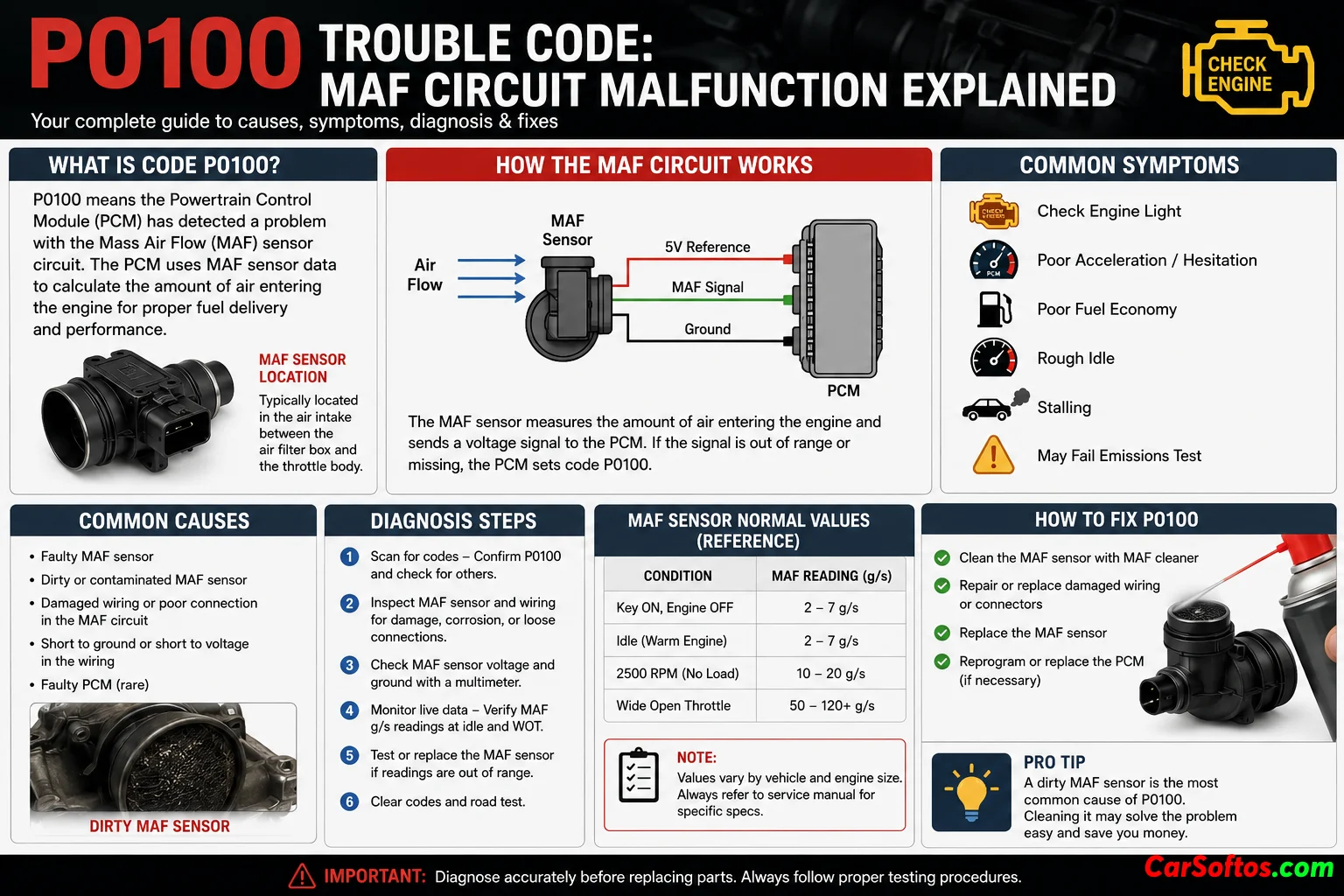
🔍 What Does P0100 Mean?
P0100 is the generic OBD-II code for Mass or Volume Air Flow “A” Circuit Malfunction.
In simple terms, the engine computer sees a problem with the MAF sensor circuit. The MAF sensor measures how much air enters the engine, and the ECM/PCM uses that information to calculate fuel injection, ignition strategy, load, idle control and emissions behavior. If the signal is missing, shorted, out of expected range, or not believable, the ECU can set P0100. Toyota service information explains that if the MAF meter has a defect, open circuit or short circuit, the signal voltage can deviate from normal range and the ECM interprets that as a malfunction.
👉 Simple explanation:
- the engine needs to know how much air is entering
- the MAF sensor reports that airflow to the ECU
- the signal is missing, wrong, shorted or unstable
- ECU sets P0100
⚙️ What the MAF Sensor Does
The Mass Air Flow sensor is usually mounted in the intake duct between the air filter box and the throttle body. Many modern vehicles use a hot-wire or hot-film MAF sensor. The sensor measures incoming air and sends a voltage or frequency signal to the ECU. Some MAF sensors also include an Intake Air Temperature sensor.
The ECU uses MAF data for:
- fuel injection quantity
- air-fuel ratio correction
- engine load calculation
- automatic transmission shift strategy on some cars
- turbo boost/load control on some engines
- emissions monitoring
- idle stability
💡 Why this matters:
If the MAF signal is wrong, the ECU may inject too much or too little fuel. That can cause rough idle, hesitation, stalling, poor fuel economy, black smoke, lean codes, rich codes, misfires or limp mode.
⚠️ How Serious Is P0100?
Severity: ⭐⭐⭐☆☆ to ⭐⭐⭐⭐☆ — Medium to Medium-High
P0100 is usually not as immediately dangerous as an active misfire or overheating code, but it should not be ignored. A bad MAF signal can make the engine run too lean or too rich. Over time, that can damage spark plugs, oxygen sensors, catalytic converters and even turbo/DPF-related systems on some vehicles.
16484/P0100/000256 lists possible symptoms such as loss of power and possible causes such as wiring/connections or defective MAF sensor.
🚨 Higher-risk situations:
- engine stalls at idle
- car hesitates badly when accelerating
- strong fuel smell
- black smoke
- lean codes appear with P0100
- turbo engine loses boost or enters limp mode
- Check Engine Light flashes because misfires also occur
🚨 Common Symptoms of P0100
Typical symptoms include:
- ⚠️ Check Engine Light
- ⚠️ loss of power
- ⚠️ hesitation when accelerating
- ⚠️ rough idle
- ⚠️ stalling
- ⚠️ hard starting or extended crank
- ⚠️ poor fuel economy
- ⚠️ black smoke from exhaust if running rich
- ⚠️ lean or rich fuel-trim codes
- ⚠️ limp mode on some vehicles
- ⚠️ unstable idle after air filter or intake work
Generic P0100 references list symptoms such as MIL illumination, rough idle, hesitation, stalling, reduced power, limp-home mode, poor fuel economy, hard starting and increased emissions.
🔥 Real-World Pattern
| Symptom / pattern | Most likely direction |
|---|---|
| P0100 after air filter replacement | MAF connector unplugged, intake duct loose |
| P0100 + rough idle | MAF signal wrong, intake leak, dirty sensor |
| P0100 + hesitation under load | weak MAF signal, wiring issue, air leak |
| P0100 + P0171/P0174 | unmetered air leak or under-reporting MAF |
| P0100 + black smoke / rich smell | over-reporting MAF, wiring/sensor fault |
| MAF reading 0 g/s | open circuit, dead sensor, no power/ground |
| MAF reading extremely high | short circuit, signal fault, bad sensor |
| Code appears only when hot | heat-sensitive wiring, connector or sensor failure |
| Code appears after engine work | connector not seated, intake boot leak, harness pinched |
Toyota diagnostic-style information gives useful clues: if airflow is 0.0 g/s, that can suggest an open circuit or completely failed MAF sensor; if airflow is extremely high, it can suggest a short circuit or faulty sensor.
🧠 Most Common Causes of P0100
1️⃣ Faulty MAF sensor — common
The MAF sensor itself can fail internally. Hot-wire/hot-film elements can become contaminated, damaged or electrically faulty.
Signs of a bad MAF:
- MAF live data is impossible
- sensor has power and ground but no valid signal
- airflow does not change with throttle
- signal drops out when tapping sensor
- replacement with known-good sensor fixes the code
Generic references list a faulty MAF sensor as one of the main causes of P0100.
2️⃣ MAF wiring open or short circuit 🔌
Because P0100 is a circuit malfunction, wiring must be checked before replacing parts.
Possible wiring issues:
- open signal wire
- short to ground
- short to power
- damaged sensor ground
- missing 5V/reference or 12V feed, depending on design
- rubbed-through harness
- wiring damaged by heat or oil
- harness pinched after air filter/intake work
Toyota service information states that an open or short circuit in the MAF meter can cause the voltage level to deviate from normal range and set the DTC.
3️⃣ Loose, corroded or unplugged MAF connector 🧩
This is very common after:
- air filter replacement
- intake boot removal
- throttle body cleaning
- engine bay detailing
- turbo/intercooler work
- battery or harness repairs
Check for:
- connector not fully clicked in
- broken lock tab
- bent pins
- green corrosion
- oil contamination
- spread terminals
- water intrusion
VAG P0100 include checking wiring and connections before replacing the MAF.
4️⃣ Dirty or contaminated MAF element 🧼
MAF sensors are sensitive. Oil, dust, silicone, water, or debris can contaminate the sensing element.
Common causes:
- over-oiled aftermarket air filter
- dirty air filter
- broken airbox
- intake leak before the sensor
- poor-quality filter
- engine oil mist through PCV system
- cleaning with the wrong chemical
A contaminated MAF may not always trigger a pure P0100 by itself, but it can make the signal implausible or unstable enough to create MAF-related faults.
Important:
Use only MAF sensor cleaner. Do not use brake cleaner, carb cleaner or compressed air directly on the sensing element.
5️⃣ Intake air leak after the MAF 🌬️
An air leak after the MAF lets unmetered air enter the engine. The MAF may report one airflow value while the engine actually receives more air.
Common leak points:
- cracked intake boot
- loose clamp
- PCV hose leak
- brake booster hose leak
- vacuum hose leak
- turbo inlet pipe leak
- intercooler/charge pipe leak on turbo engines
- intake manifold gasket leak
This often creates lean codes like P0171/P0174 together with MAF-related complaints.
Pattern clue:
If the MAF sensor tests good but fuel trims are very positive, smoke-test the intake.
6️⃣ Dirty or blocked air filter
A severely restricted air filter can distort airflow and reduce engine power. Lists check intake air filter as a possible solution for related VAG MAF performance code P0101, and in real diagnostics it is also a sensible check when MAF data looks wrong.
Check:
- clogged air filter
- collapsed filter
- debris in airbox
- snow/water restriction
- damaged air filter seal
- incorrect filter installation
7️⃣ Blown fuse or missing sensor power
Some MAF sensors need a power supply and ground. If the fuse, relay or shared sensor feed fails, the MAF signal may disappear.
Generic P0100 references list a blown sensor reference or ignition-switched fuse among possible causes.
Check:
- MAF power feed
- sensor ground
- ECU sensor reference
- related fuses
- engine control relay
- shared power with other sensors
8️⃣ Bad engine ground or ECU/PCM fault
This is less common, but possible.
Suspect ECU/PCM only after:
- sensor is known good
- connector is good
- wiring continuity is good
- power and ground are correct
- signal still not interpreted correctly
Generic P0100 references include PCM/ECM internal fault as a possible cause, but it should be diagnosed last.
⚡ P0100 vs P0101 vs P0102 vs P0103 vs P0104
| Code | Meaning | Simple explanation |
|---|---|---|
| P0100 | MAF Circuit Malfunction | General circuit fault |
| P0101 | MAF Range/Performance | Signal exists but does not match expected airflow |
| P0102 | MAF Circuit Low Input | Signal too low |
| P0103 | MAF Circuit High Input | Signal too high |
| P0104 | MAF Circuit Intermittent | Signal cuts in/out or is erratic |
CarParts notes that P0100 and P0104 are similar, but differ by the consistency of the malfunction: P0104 is intermittent/erratic, while P0100 is the broader MAF circuit issue.
👉 Simple takeaway:
- P0100 = MAF circuit problem
- P0101 = MAF reading does not make sense
- P0102 = MAF signal too low
- P0103 = MAF signal too high
- P0104 = MAF signal intermittent
🔧 Step-by-Step Diagnosis
1️⃣ Scan all codes and freeze-frame data
Do not diagnose P0100 alone. Check for related codes:
- P0101 / P0102 / P0103 / P0104
- P0171 / P0174 lean codes
- P0172 / P0175 rich codes
- misfire codes P0300–P0308
- throttle body codes
- IAT codes if built into the MAF
- turbo/boost codes on forced-induction engines
Freeze-frame data tells you when the fault happened:
- idle
- acceleration
- cold start
- hot engine
- highway cruise
- high load
2️⃣ Inspect the MAF connector and intake duct first
Before replacing the sensor, check the simple things:
- connector fully seated
- pins clean and tight
- no broken lock tab
- intake boot not cracked
- clamps tight
- air filter box sealed
- no unplugged vacuum hoses
- no loose PCV hose
This is especially important if P0100 appeared after recent maintenance.
3️⃣ Check live MAF data
Use a scan tool and look at MAF airflow in g/s or calculated load.
At idle, airflow should usually be relatively low and stable. When you rev the engine, airflow should rise smoothly. Exact numbers depend on engine size, but impossible values are the key clue.
🚨 Red flags:
- 0.0 g/s with engine running
- extremely high value at idle
- value does not change with throttle
- signal drops to zero intermittently
- airflow does not match engine size/load
- MAF value spikes when harness is moved
Toyota-style diagnostic guidance says 0.0 g/s can point toward open circuit or failed sensor, while extremely high airflow can point toward short circuit or faulty sensor.
4️⃣ Check power, ground and signal
Use wiring diagrams for the exact vehicle.
Typical checks:
- battery/ignition feed to MAF
- 5V/reference feed if used
- sensor ground
- signal voltage or frequency
- voltage drop on ground
- continuity from MAF to ECU
- short to ground
- short to power
Toyota service information gives an example where sensor output below 0.2 V or above 4.9 V for more than 3 seconds can set a MAF DTC on that application.
5️⃣ Wiggle-test the harness
Some P0100 faults are intermittent.
With engine running or key on:
- move the MAF connector
- move the harness near the airbox
- move the harness near engine mounts
- watch live MAF data
- watch for stalls or signal dropouts
If MAF data jumps or the engine stumbles, repair the connector/harness before replacing the sensor.
6️⃣ Smoke-test the intake system
If MAF signal is plausible but fuel trims are lean, smoke-test the intake.
Check for leaks after the MAF:
- intake boot
- PCV hose
- vacuum lines
- brake booster hose
- intake manifold gasket
- turbo inlet/charge pipe
- intercooler piping
Unmetered air can make the ECU think the MAF system is wrong even when the sensor is not dead.
7️⃣ Inspect air filter and airbox
Check:
- clogged filter
- wrong filter
- filter not seated
- broken airbox tabs
- leaves/debris in airbox
- aftermarket oiled filter contamination
Do not skip this step. Airflow problems can mimic sensor problems.
8️⃣ Clean the MAF sensor only if contamination is likely
Use MAF-specific cleaner.
Do not:
- touch the sensing wire/film
- use brake cleaner
- use carb cleaner
- blast it with compressed air
- scrape the sensor
Let it dry completely before reinstalling.
Important:
Cleaning helps only if the sensor is contaminated. It will not fix an open circuit, broken wire or failed internal electronics.
9️⃣ Substitute a known-good or OEM-quality sensor
If wiring, power, ground, connector, air leaks and air filter are all good, then the MAF sensor itself becomes more likely.
For many vehicles, cheap aftermarket MAF sensors can cause poor readings. On VAG cars, specifically notes that MAF diagnosis can be problematic and that MAF failures are common on many 2000+ VW/Audi vehicles.
1️⃣0️⃣ Confirm repair with fuel trims and road test
After repair:
- clear codes
- check idle MAF reading
- check fuel trims
- road test under load
- recheck pending codes
- confirm no lean/rich/misfire codes return
Do not call it fixed just because the light is off.
🛠️ How to Fix P0100
✔️ Reconnect or repair MAF connector
If connector is loose, corroded or damaged.
💰 Typical cost: $20–$150
✔️ Repair MAF wiring
If signal, power or ground wiring is open/shorted.
💰 Typical cost: $80–$400+
✔️ Clean dirty MAF sensor
If contamination is visible or suspected.
💰 Typical cost: $10–$40
✔️ Replace MAF sensor
If sensor fails testing.
💰 Typical cost: $120–$500 installed
✔️ Replace air filter / repair airbox
If airflow restriction or bad sealing caused bad readings.
💰 Typical cost: $20–$150
✔️ Repair intake/vacuum leak
If unmetered air is entering after the MAF.
💰 Typical cost: $80–$700+
✔️ Repair ECU/PCM issue
Rare, only after circuit and sensor testing.
💰 Typical cost: $500–$1,500+
💰 Repair Cost Summary
| Repair | Typical cost |
|---|---|
| Diagnostic scan / live data check | $80–$200 |
| MAF cleaner | $10–$40 |
| Air filter replacement | $20–$80 |
| Connector repair | $20–$150 |
| Wiring repair | $80–$400+ |
| MAF sensor replacement | $120–$500 |
| Intake/vacuum leak repair | $80–$700+ |
| ECU/PCM repair or replacement | $500–$1,500+ |
❗ Common Mistakes
❌ Replacing the MAF sensor immediately
P0100 is a circuit code. Wiring, connector, power and ground must be checked.
❌ Cleaning the MAF with the wrong chemical
Brake cleaner or carb cleaner can damage the sensing element.
❌ Ignoring intake leaks
A cracked intake boot after the MAF can make the engine run lean and make MAF data look wrong.
❌ Using cheap low-quality MAF sensors
Some engines are very sensitive to MAF signal quality. OEM or high-quality brand sensors are safer.
❌ Forgetting the air filter and airbox
A blocked filter or unsealed airbox can create airflow problems.
❌ Not checking live data
P0100 diagnosis is much easier when you compare MAF g/s, fuel trims and throttle/load behavior.
🚗 Can You Drive With P0100?
Usually short-term, yes — but not as a long-term fix.
You may drive carefully if:
- engine runs smoothly
- no stalling
- no heavy hesitation
- no flashing Check Engine Light
- no strong fuel smell
- no severe lean/rich symptoms
Avoid long or hard driving if:
- car stalls
- power is very low
- engine hesitates badly
- turbo car goes into limp mode
- misfire codes appear
- catalytic converter smell/heat appears
🚨 Risks of ignoring P0100:
- poor fuel economy
- rough running
- misfires
- catalyst damage from rich/lean running
- oxygen sensor contamination
- turbo/DPF-related problems on some vehicles
- failed emissions test
📌 Final Verdict
P0100 means the ECU detected a Mass Air Flow sensor circuit malfunction. It can be caused by a bad MAF sensor, but the real cause is often wiring, connector damage, missing power/ground, contamination, or an intake air leak.
Most common real causes:
- faulty MAF sensor
- open or shorted MAF wiring
- loose/corroded connector
- missing sensor power or ground
- dirty/contaminated MAF element
- cracked intake boot or vacuum leak
- clogged air filter
- rarely ECU/PCM fault
💡 Key takeaway:
- P0100 = MAF circuit malfunction
- Do not replace the sensor before checking wiring and connector
- MAF live data is critical
- 0 g/s often points to open/dead sensor
- extremely high reading can point to short/faulty sensor
- intake leaks can mimic MAF problems

Tags:
Users of Guests are not allowed to comment this publication.