
Navigation
Top News
Statistics
Advertisement
Аrchives
Votes
| Rate the site |
P0305 – P0308 Codes — Cylinder 5, 6, 7 & 8 Misfire Detected (Causes, Symptoms & Fix Guide)
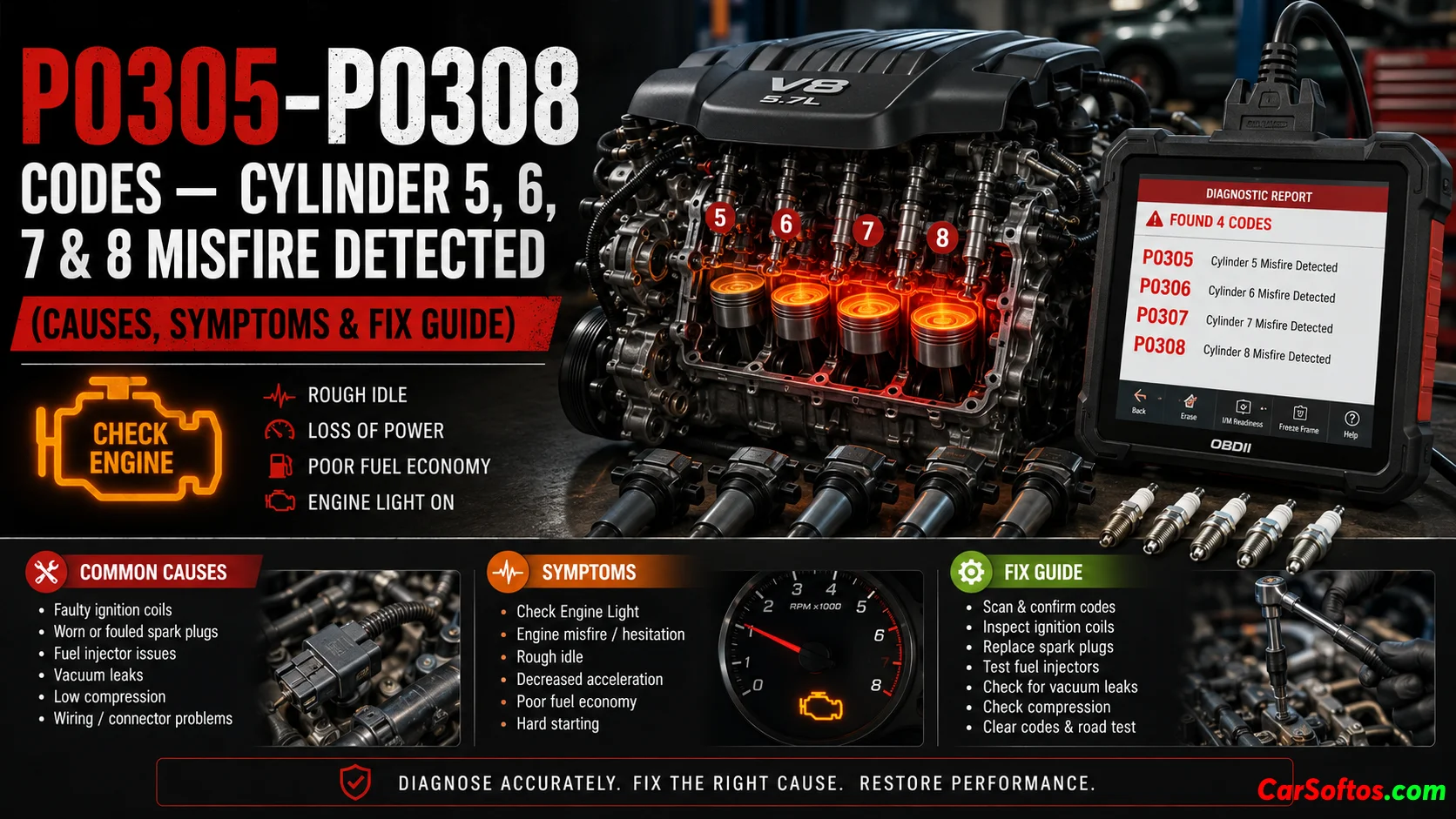
🔍 What Do P0305, P0306, P0307 and P0308 Mean?
P0305, P0306, P0307 and P0308 are cylinder-specific misfire codes. They mean the engine computer has detected a combustion problem in one exact cylinder:
| Code | Meaning |
|---|---|
| P0305 | Cylinder 5 Misfire Detected |
| P0306 | Cylinder 6 Misfire Detected |
| P0307 | Cylinder 7 Misfire Detected |
| P0308 | Cylinder 8 Misfire Detected |
A cylinder-specific misfire means the air-fuel mixture in that cylinder is not burning correctly, or sometimes not burning at all. General OBD references describe these codes as the PCM/ECM detecting enough misfire events on that numbered cylinder to store the fault.
👉 Simple explanation:
- P0305 = cylinder 5 is misfiring
- P0306 = cylinder 6 is misfiring
- P0307 = cylinder 7 is misfiring
- P0308 = cylinder 8 is misfiring
These codes are especially common on larger engines because cylinders 5–8 usually exist on:
- V6 engines
- V8 engines
- V10 engines
- V12 engines
On a 4-cylinder engine, you normally will not see P0305–P0308 because those cylinders do not exist.
⚙️ How the ECU Detects a Misfire
The ECU does not usually “see combustion” directly. It watches crankshaft speed. When a cylinder fires normally, it slightly accelerates the crankshaft. When a cylinder misfires, the crankshaft does not accelerate as expected.
Factory-style Toyota diagnostic information explains that the crankshaft position sensor is used to measure crankshaft rotation-speed variations, while the camshaft position sensor helps identify which cylinder is misfiring.
In simple words:
- good combustion = smooth crankshaft acceleration
- misfire = tiny crankshaft speed drop
- ECU matches the event to a cylinder
- code P0305–P0308 is stored
This is why a misfire can be detected even before the driver feels a major shake.
⚠️ How Serious Are P0305–P0308?
Severity: ⭐⭐⭐⭐☆ to ⭐⭐⭐⭐⭐ — Medium-High to Critical
A light occasional misfire at idle is not the same as a flashing Check Engine Light under load. But misfires should never be ignored for long.
🚨 Why misfires matter:
- unburned fuel can overheat and damage the catalytic converter
- the engine can run rough and lose power
- fuel economy drops
- ignition coils and plugs can be damaged further
- raw fuel can wash cylinder walls
- severe misfire can damage the engine internally
Edmunds warns that driving with an active P0308 misfire can cause serious harm to the engine and sensitive emissions components.
🚫 Flashing Check Engine Light = stop driving hard
If the Check Engine Light is flashing, that usually means an active misfire severe enough to risk catalytic converter damage. Reduce load immediately and diagnose the problem.
🚨 Common Symptoms of P0305–P0308
Typical symptoms include:
- ⚠️ Check Engine Light
- ⚠️ flashing Check Engine Light under load
- ⚠️ rough idle
- ⚠️ engine shaking
- ⚠️ hesitation during acceleration
- ⚠️ reduced engine power
- ⚠️ poor fuel economy
- ⚠️ fuel smell from exhaust
- ⚠️ hard starting
- ⚠️ vibration at idle or highway speed
- ⚠️ limp mode on some vehicles
P0305 and P0308 repair references commonly list rough idle, hesitation, jerking during acceleration, reduced power, poor fuel economy and fuel smell as possible symptoms.
🔥 Real-World Misfire Patterns
| Pattern | Most likely direction |
|---|---|
| One cylinder only: P0305 | coil, plug, injector, compression on cylinder 5 |
| One cylinder only: P0308 | coil, plug, injector, compression on cylinder 8 |
| P0305 + P0306 together | same bank problem, intake leak, fuel issue, bank-specific timing |
| P0305–P0308 together | bank 2 issue on many V8s, wiring, fuel rail, vacuum/intake leak, timing |
| Misfire only cold | injector leak, carbon buildup, weak plug/coil, compression issue |
| Misfire only hot | coil breakdown, injector fault, valve issue, wiring heat failure |
| Misfire under load | weak ignition coil, worn plug, lean condition, fuel delivery |
| Misfire at idle only | vacuum leak, carbon buildup, compression, injector spray issue |
| Misfire after plugs/coils replaced | injector, wiring, compression, intake leak, timing or ECU driver |
A cylinder-specific code is valuable because it tells you where to start. But the code does not automatically prove the coil or spark plug is bad.
🧠 Most Common Causes of P0305–P0308
1️⃣ Bad ignition coil — very common ⚡
Modern V6 and V8 engines often use one coil per cylinder. A weak coil can fail only when hot or only under load.
Signs of a bad coil:
- misfire follows the coil when swapped
- worse under acceleration
- flashing Check Engine Light under load
- rough idle after warm-up
- code returns quickly after clearing
For P0308, common causes include bad spark plug wires and failed ignition coils, and P0305 references also list weak or failed ignition coils as a common cause.
Pro diagnostic trick:
Swap the coil from cylinder 5 to another cylinder. If the code moves from P0305 to P0302, the coil is probably bad.
2️⃣ Worn or fouled spark plug 🔥
A worn spark plug needs more voltage to fire. Under load, it may fail and cause a misfire.
Common plug-related causes:
- worn electrode
- wrong gap
- oil fouling
- fuel fouling
- cracked ceramic
- wrong heat range
- incorrect plug type
P0305 and P0308 references commonly list spark plugs among the top causes.
Important:
On larger engines, cylinders 5–8 may be harder to access. Sometimes plugs on the rear bank are ignored for too long, especially on V6/V8 engines.
3️⃣ Bad fuel injector 💧
A cylinder-specific misfire can be caused by a clogged, leaking, or electrically failed injector.
Injector fault signs:
- misfire stays on same cylinder after coil swap
- spark plug looks wet or unusually clean
- fuel trim is abnormal
- rough idle
- fuel smell
- misfire after hot soak
- cylinder balance test shows weak contribution
Generic P0305 diagnostic references list clogged, stuck, or electrically failed fuel injector as a possible cause.
Diagnostic trick:
Swap injector 5 with injector 3 if access allows. If P0305 becomes P0303, the injector is the likely cause.
4️⃣ Vacuum leak / intake manifold leak near one bank 🌬️
On V6 and V8 engines, an intake leak can affect one cylinder or one bank more than the others.
Common leak areas:
- intake manifold gasket
- PCV system
- brake booster hose
- vacuum lines
- runner flap shaft seals
- injector O-rings
- cracked intake boot
A P0305 reference lists vacuum or intake manifold leak near cylinder 5 as a possible cause.
Pattern clue:
If you see P0305 + P0306 + P0307 + P0308, suspect a bank-specific problem rather than four coils dying at the same time.
5️⃣ Low compression / mechanical engine problem 🧱
If ignition and fuel checks pass, compression must be tested.
Mechanical causes:
- burnt valve
- bent valve
- worn piston rings
- damaged piston
- head gasket leak
- camshaft/lifter problem
- valve spring problem
- timing chain/cam timing issue
A misfire that does not follow the coil, plug or injector can be mechanical. Multiple repair references recommend compression testing when normal ignition/fuel checks do not solve cylinder-specific misfires.
6️⃣ Carbon buildup on intake valves 🟤
Direct-injection engines can develop intake valve deposits. This is especially common on many modern European V6/V8 engines, including Audi/VW TFSI platforms.
Carbon buildup symptoms:
- cold-start misfire
- rough idle
- misfire on one or more cylinders
- better after warm-up
- no obvious bad coil
- fuel trims may look lean
Why this matters:
If P0305–P0308 appear on a direct-injection V6/V8, especially at cold start, carbon buildup should be considered after ignition checks.
7️⃣ Fuel pressure or fuel delivery problem ⛽
A weak fuel pump, fuel-pressure regulator issue, clogged filter, or high-pressure fuel system issue can create lean misfires.
Pattern clue:
- multiple cylinders misfire
- misfires happen under load
- lean codes may appear
- fuel trims are high positive
- power drops at high RPM
Generic P0305 references include low fuel pressure or fuel pump/fuel pressure regulator issues as possible causes.
8️⃣ Wiring, connector or ECU driver issue 🔌
Sometimes the part is good, but the control circuit is not.
Check:
- coil connector pins
- injector connector pins
- wiring rubbed through
- harness heat damage
- oil contamination in connector
- ECU coil/injector driver fault
This becomes more likely if:
- misfire does not move after swapping parts
- voltage supply is missing
- injector pulse is missing
- coil trigger is missing
9️⃣ Exhaust restriction or catalytic converter damage 🧨
Misfires can damage catalytic converters. But a restricted catalytic converter can also worsen misfires by creating excessive backpressure.
Pattern clue:
- poor high-RPM power
- multiple misfires on one bank
- glowing catalytic converter
- sulfur smell
- exhaust backpressure high
This is especially important if the misfire has been ignored for a long time.
🧭 Cylinder 5–8 Location: Why It Matters
The biggest mistake with P0305–P0308 is replacing parts on the wrong cylinder.
Cylinder numbering depends on the manufacturer.
Examples:
- Many V8 engines split cylinders across two banks
- Cylinder 5 may be the first cylinder on the opposite bank
- Audi, BMW, Mercedes, Ford, GM, Toyota and Chrysler can use different layouts
- Transverse and longitudinal engines may make access confusing
👉 Always check the firing order and cylinder layout for your exact engine.
For example:
| Code | You must identify |
|---|---|
| P0305 | exact location of cylinder 5 |
| P0306 | exact location of cylinder 6 |
| P0307 | exact location of cylinder 7 |
| P0308 | exact location of cylinder 8 |
Never assume cylinder 5 is simply “the fifth coil from the front.”
🔧 Step-by-Step Diagnosis
1️⃣ Scan all codes and freeze-frame data
Check for:
- P0300 — random/multiple misfire
- P0305–P0308 — cylinder-specific misfires
- lean codes like P0171 / P0174
- fuel pressure codes
- cam/crank correlation codes
- injector circuit codes
- oxygen sensor / catalyst codes
Freeze-frame data tells you when the misfire happened:
- cold start
- idle
- cruise
- high load
- high RPM
- hot engine
This is critical because a cold idle misfire and a high-load misfire often have different causes.
2️⃣ Identify the correct cylinder
Before touching parts, confirm cylinder layout.
Use:
- factory service info
- repair manual
- engine bay diagram
- firing order
- scan tool misfire counter
Example:
If the code is P0307, you need to know exactly where cylinder 7 is before swapping coils.
3️⃣ Check misfire counters
Many scan tools show live misfire counters.
Look for:
- cylinder 5 counting misfires
- cylinder 6 only at idle
- cylinder 8 only under load
- several cylinders on one bank
- misfire counts after cold start
This helps separate one-cylinder faults from bank-wide faults.
4️⃣ Inspect spark plug and ignition coil
Start with the easiest and most common causes.
Check:
- coil boot cracks
- oil inside spark plug well
- water intrusion
- plug gap
- plug fouling
- coil connector damage
- carbon tracking
Fast test:
Move coil and plug to another cylinder.
| Result | Meaning |
|---|---|
| Misfire follows coil | bad coil |
| Misfire follows plug | bad plug |
| Misfire stays on same cylinder | injector, wiring, compression or mechanical issue |
5️⃣ Check injector operation
If ignition checks pass, check fuel delivery to that cylinder.
Tests:
- listen with stethoscope for injector clicking
- check injector resistance
- perform injector balance test
- inspect injector connector
- swap injector if practical
- check for leaking injector after shutdown
Important:
A leaking injector can cause a cold-start misfire. A clogged injector can cause a lean misfire under load.
6️⃣ Smoke test for vacuum leaks
If multiple cylinders on one bank misfire, smoke test the intake.
Look for:
- intake gasket leak
- PCV leak
- vacuum hose leak
- brake booster leak
- injector O-ring leak
- cracked intake boot
Pattern:
P0305–P0308 together on a V8 often suggests a bank-side issue, not four separate bad coils.
7️⃣ Check compression and leak-down
If spark and fuel are good, test mechanical condition.
Do:
- compression test
- leak-down test
- relative compression test
- borescope inspection
What it can reveal:
- burnt valve
- ring damage
- head gasket issue
- piston damage
- valve sealing problem
If one cylinder has low compression, parts swapping will not fix the misfire.
8️⃣ Check cam timing / VVT if multiple cylinders on one bank misfire
If cylinders 5–8 all misfire on one bank, consider:
- cam timing issue
- stretched timing chain
- VVT actuator issue
- camshaft position sensor issue
- oil control valve problem
- bank-specific timing fault
This is especially important on large V6/V8 engines where one bank can develop a timing or air/fuel problem.
9️⃣ Confirm the repair with a road test
After repair:
- clear codes
- monitor misfire counters
- test cold start
- test idle
- test acceleration
- check fuel trims
- recheck pending codes
Do not call it fixed just because the Check Engine Light is off. Misfire counters are more useful.
🛠️ How to Fix P0305–P0308
✔️ Replace spark plugs
If plug wear, fouling or incorrect gap is found.
💰 Typical cost: $80–$400
Higher on V6/V8 engines if access is difficult.
✔️ Replace ignition coil
If the misfire follows the coil during swap testing.
💰 Typical cost: $80–$300 per coil installed
✔️ Repair coil/injector wiring
If power, ground, trigger or connector problems are found.
💰 Typical cost: $50–$350+
✔️ Clean or replace fuel injector
If injector flow or electrical testing fails.
💰 Typical cost: $150–$600 per injector installed
✔️ Repair vacuum or intake leak
If smoke test reveals a leak.
💰 Typical cost: $100–$700+
✔️ Clean intake valves on direct-injection engines
If carbon buildup causes cold-start or idle misfires.
💰 Typical cost: $400–$1,200
✔️ Repair mechanical engine problem
If compression/leak-down fails.
💰 Typical cost: $800–$4,000+
✔️ Replace catalytic converter if damaged by long-term misfire
Only after misfire cause is fixed.
💰 Typical cost: $700–$2,500+
💰 Repair Cost Summary
| Repair | Typical cost |
|---|---|
| Diagnosis / scan / misfire testing | $80–$200 |
| Spark plugs | $80–$400 |
| One ignition coil | $80–$300 |
| Coil / injector connector repair | $50–$350+ |
| Fuel injector repair/replacement | $150–$600 each |
| Vacuum leak / intake gasket repair | $100–$700+ |
| Carbon cleaning on DI engine | $400–$1,200 |
| Compression/mechanical repair | $800–$4,000+ |
| Catalytic converter if damaged | $700–$2,500+ |
❗ Common Mistakes
❌ Replacing all coils without testing
Sometimes it works, but it can waste money. Swap-test the coil first.
❌ Not checking cylinder numbering
This is extremely common on V6/V8 engines. Always confirm cylinder layout.
❌ Ignoring injector problems
If a new coil and plug do not fix the code, the injector is a major suspect.
❌ Skipping compression test
A burnt valve or low compression will not be fixed by spark plugs.
❌ Driving with a flashing Check Engine Light
This can destroy the catalytic converter.
❌ Assuming P0305–P0308 all mean separate bad coils
If several rear-bank cylinders misfire together, look for a bank-wide issue.
⚖️ P0305–P0308 vs Related Codes
| Code | Meaning |
|---|---|
| P0300 | Random / multiple cylinder misfire |
| P0301–P0304 | Misfires on cylinders 1–4 |
| P0305 | Cylinder 5 misfire |
| P0306 | Cylinder 6 misfire |
| P0307 | Cylinder 7 misfire |
| P0308 | Cylinder 8 misfire |
| P0171 / P0174 | Lean condition, often related to vacuum/fuel problems |
| P0205–P0208 | Injector circuit faults for cylinders 5–8 |
| P0355–P0358 | Ignition coil circuit faults for cylinders 5–8 |
| P0420 / P0430 | Catalyst efficiency codes that can appear after long misfire damage |
👉 Simple explanation:
- P0305–P0308 = combustion problem
- P0205–P0208 = injector circuit problem
- P0355–P0358 = ignition coil circuit problem
- P0171/P0174 = lean air-fuel problem
- P0420/P0430 = possible catalyst damage after misfire
🚗 Can You Drive With P0305–P0308?
Short distance only, and gently — if the Check Engine Light is not flashing.
If the engine is shaking badly or the Check Engine Light is flashing, avoid driving. A flashing light usually means active misfire severe enough to damage the catalytic converter.
Safe short-term conditions:
- light is steady, not flashing
- engine runs mostly smooth
- no strong fuel smell
- no heavy shaking
- no loss of power
Stop driving if:
- Check Engine Light flashes
- engine shakes heavily
- strong raw fuel smell
- catalytic converter smell / heat
- car loses power
- misfire worsens under load
📌 Final Verdict
P0305–P0308 mean the ECU has detected a misfire on cylinder 5, 6, 7 or 8. These codes are especially important on larger V6, V8, V10 and V12 engines because they can point to one exact cylinder — or sometimes to a whole bank problem.
Most common real causes:
- worn spark plug
- weak ignition coil
- bad injector
- vacuum/intake leak
- low compression
- carbon buildup on direct-injection engines
- wiring or connector fault
- fuel pressure problem
- bank-specific timing/VVT issue
💡 Key takeaway:
- One cylinder misfire → start with plug, coil, injector, compression
- Several cylinders 5–8 misfiring → think bank-wide problem
- Flashing Check Engine Light → stop driving hard immediately
- Misfire after new plugs/coils → check injector, wiring, compression and intake leaks

Tags:
Users of Guests are not allowed to comment this publication.