
Navigation
Top News
Statistics
Advertisement
Аrchives
Votes
| Rate the site |
Audi Code P2279 Explained — Why Unmetered Air Causes Rough Idle and Power Loss
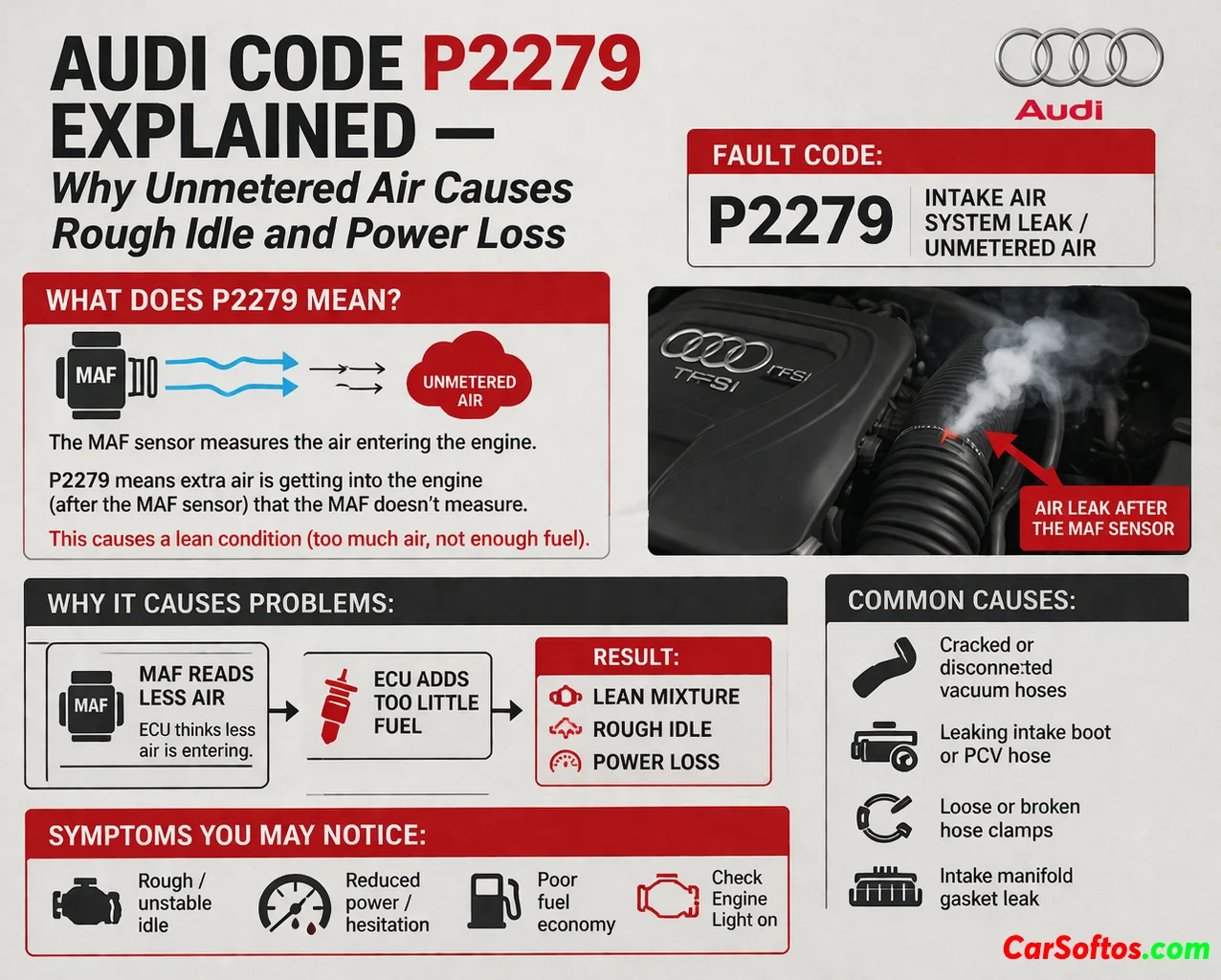
⚠️ What does Audi code P2279 mean?
On Audi/VW applications, P2279 / 008825 means “Leak in Air Intake System.” Ross-Tech describes the common symptoms as the MIL being active, and lists likely causes including a vacuum leak, intake manifold runner position out of specification, and a faulty PCV system or heating element (N79).
In simple terms, the ECU has detected that air is entering the engine somewhere it should not. That extra air is unmetered because it bypasses the normal calculation path, which can throw off the air-fuel mixture, especially at idle and light load. Ross-Tech’s fault description directly points to intake-system leakage and PCV issues as the most likely starting points.
🧠 Why this code is so common on Audi / VW engines
P2279 is especially common on Audi and VW TFSI/TSI engines because these engines are very sensitive to vacuum leaks, PCV faults, and intake sealing problems. Ross-Tech specifically calls out the PCV system as a common cause, and Audi-focused repair discussions repeatedly identify the PCV diaphragm, intake manifold gasket area, and vacuum hoses as the first things to inspect when P2279 appears.
That is why this code often shows up with symptoms owners describe as “the car still runs, but idle is rough,” “fuel trims are off,” or “it feels weak when pulling away.” It is not always a catastrophic fault, but it is one of the most important air-leak codes because it can quietly affect fuel economy, drivability, and emissions if ignored.
🔍 What an intake air leak actually is
Normal airflow path
Under normal conditions, intake air should follow this path:
- air filter
- MAF / airflow measurement path if equipped
- intake piping
- throttle body
- intake manifold
- cylinders
What goes wrong with P2279
With P2279, air is entering after the normal measurement point or through a leaking part of the intake/vacuum system. That means the ECU thinks the engine is getting one amount of air, while the engine is actually getting more. Ross-Tech’s wording and common Audi diagnostics both point to this as a classic vacuum / intake leak situation.
🚨 Common symptoms of Audi P2279
Typical real-world symptoms
- Check Engine Light
- rough idle
- idle too high on some cars
- hesitation when accelerating
- reduced fuel economy
- lean-running symptoms
- sometimes misfires or companion mixture faults
Ross-Tech confirms the MIL as the standard symptom, while Audi/VW diagnostics sources note that this code can also affect performance and fuel economy because the extra air changes the air-fuel mixture.
A very common real-world pairing is P2279 with lean-at-idle or mixture-control faults, especially when the leak is large enough to affect idle stability more than high-load operation. One recent Audi owner case specifically mentioned P2279 with P2187, which is a classic clue pointing toward a vacuum-style intake leak rather than a random electrical fault.
🔧 Most common causes of P2279 on Audi
1️⃣ Faulty PCV valve or PCV diaphragm
This is one of the most important causes on Audi/VW turbo engines. Ross-Tech directly lists the PCV system as a likely cause, and Audi-specific troubleshooting frequently points to a torn PCV diaphragm as a major source of intake leakage and rough idle.
When the PCV valve fails, it can create a vacuum leak into the intake system, often causing:
- rough idle
- lean fuel trims
- suction noises
- oil-related vacuum imbalance
2️⃣ Vacuum hose leak or disconnected intake hose
Ross-Tech lists vacuum leak as a primary cause. General intake-leak diagnostics also identify cracked, disconnected, or loose hoses as one of the most common reasons this code appears.
Typical leak points include:
- small vacuum lines
- brake booster hose
- PCV hose connections
- intake boots
- plastic turbo inlet connections on some engines
3️⃣ Intake manifold gasket leak
Audi-specific diagnostics often point toward the intake manifold gasket area or runner-area seals when P2279 persists after obvious hoses have been checked. Intake manifold leakage is especially likely if the code appears with rough idle, lean trim, and no visible external hose damage.
4️⃣ Intake manifold runner / flap issue
Ross-Tech lists “intake manifold runner position out of specification” as one of the likely causes. That is important because on some Audi/VW engines, the intake manifold flap system or its seals can become part of the leak path, not just a pure actuator problem.
This means P2279 can sometimes overlap with:
- manifold flap faults
- runner-position faults
- manifold internal wear
5️⃣ Throttle body seal or post-throttle leak
A leak near the throttle body seal or the intake path after the throttle plate can also trigger this code, especially if the leak is large enough to affect idle stability. Audi/VW troubleshooting communities commonly include the throttle-body sealing area in smoke-test inspections for P2279.
6️⃣ Damaged intake piping between MAF and manifold
Fixter’s summary of common P2279 causes includes air leaks between the MAF sensor and intake manifold, which is critical because those leaks can distort airflow calculation even if the engine still runs fairly well.
7️⃣ Sensor or connector issue that mimics a leak
P2279 is primarily a leak code, but some cases become confusing if there are also sensor or adaptation issues. Intake air temperature sealing problems, throttle-body adaptation issues after cleaning, and related sensor inputs can complicate diagnosis. Fixter specifically mentions IAT-related leakage possibilities and the importance of considering throttle-body relearn issues after service.
📉 Why P2279 is often worse at idle
This is one of the most useful things to explain to readers.
At idle, the engine is pulling high manifold vacuum and using a relatively small amount of airflow. That means even a moderate vacuum leak can have a big effect on mixture and idle quality. At higher load, the same leak may feel less dramatic because total airflow is much larger. This is why Audi/VW owners with P2279 often complain first аbout:
- rough idle
- lean-at-idle codes
- unstable cold starts
- weak low-speed response
🔎 P2279 vs P0171 — very important
These two codes often appear together or get confused.
| Code | Meaning |
|---|---|
| P2279 | Intake air system leak detected |
| P0171 | System too lean |
The difference
- P2279 points more directly to extra air entering the system
- P0171 points to the resulting lean condition
So:
- P2279 = likely cause category
- P0171 = likely mixture consequence
That is why many Audi/VW cars with P2279 also end up showing lean-trim or lean-at-idle faults if the leak is not fixed.
🛠️ How to diagnose Audi P2279 properly
Step 1: Confirm the exact code and check companion faults
Start by confirming P2279 / 008825, then check for related faults like:
- P2187
- P0171
- misfire codes
- intake-runner or throttle adaptation issues
A companion lean-at-idle code makes a vacuum-style leak much more likely.
Step 2: Inspect the PCV system first
Because Ross-Tech explicitly lists the PCV system as a likely cause, the PCV valve and diaphragm should be one of the first checks on an Audi/VW turbo engine. Audi-specific discussions repeatedly call this one of the most common root causes.
Step 3: Check all vacuum and intake hoses
Look for:
- cracked hoses
- disconnected pipes
- brittle plastic fittings
- loose clamps
- brake booster line leaks
Ross-Tech and general diagnostics both identify these as prime suspects.
Step 4: Perform a smoke test
A smoke test is one of the best ways to find hidden intake leaks. Audi owners with persistent P2279 often end up confirming the problem this way when the leak is too small to see visually. The recent Audi Q5 discussion shows how even when the code pattern strongly suggests a leak, finding the exact source may require more than just looking around.
Step 5: Check the intake manifold and runner area
Since Ross-Tech includes intake manifold runner position out of specification, inspect the manifold flap area, seals, and linkage if obvious hose leaks are not found.
Step 6: Recheck throttle-body and adaptation-related work
If the throttle body was recently cleaned or intake work was done, review seals, connectors, and whether adaptation/relearn procedures were completed correctly. This is a lesser cause, but it can complicate diagnosis.
⚠️ Most common mistakes
❌ Replacing sensors too early
P2279 is usually a real air leak, not just a random sensor fault. Replacing parts before checking hoses and the PCV system wastes time.
❌ Ignoring the PCV valve
On Audi/VW engines, this is one of the most important failure points. Ross-Tech and Audi-specific cases both support this.
❌ Skipping a smoke test
Small leaks can be hard to find visually.
❌ Assuming the car is “fine” because it still drives
Even if drivability is only mildly affected now, long-term mixture correction can hurt fuel economy and emissions performance.
💰 Typical repair cost range
Repair cost depends on the real cause:
- vacuum hose repair: low
- PCV valve replacement: low to moderate
- throttle-body or intake seal repair: low to moderate
- intake manifold gasket / manifold work: moderate
- manifold runner-related repair: moderate to higher
This is one reason P2279 is such a strong article topic: it often causes obvious symptoms, but the fix can range from a simple hose or PCV repair to more involved intake-manifold work. The source material consistently supports that cause hierarchy.
🚗 Can you drive with P2279?
Sometimes yes, but it is not smart to ignore it for long.
If the leak is small, the car may still drive reasonably well. But continued driving can lead to:
- rougher idle
- worse fuel economy
- mixture-related faults
- misfires in more severe cases
Audi/VW diagnostics sources note that the code can negatively affect both performance and fuel efficiency, especially when the leak changes the air-fuel mixture enough for the ECU to struggle with corrections.
✅ Final verdict
Audi P2279 means the ECU has detected a leak in the intake air system. On Audi/VW engines, the most common real causes are:
- faulty PCV valve / diaphragm
- vacuum hose leak
- intake manifold gasket or manifold leak
- runner/flap system issue
- throttle-body or intake-pipe sealing problem
The single best takeaway for readers is:
Do not replace random sensors first. Check the PCV system, vacuum hoses, and do a smoke test before anything else. That advice is the most consistent with Ross-Tech guidance and common Audi/VW repair experience.

Tags:
Users of Guests are not allowed to comment this publication.