
Navigation
Top News
Statistics
Advertisement
Аrchives
Votes
| Rate the site |
P0339 Code — Crankshaft Position Sensor “A” Circuit Intermittent (Causes, Symptoms & Fix Guide)
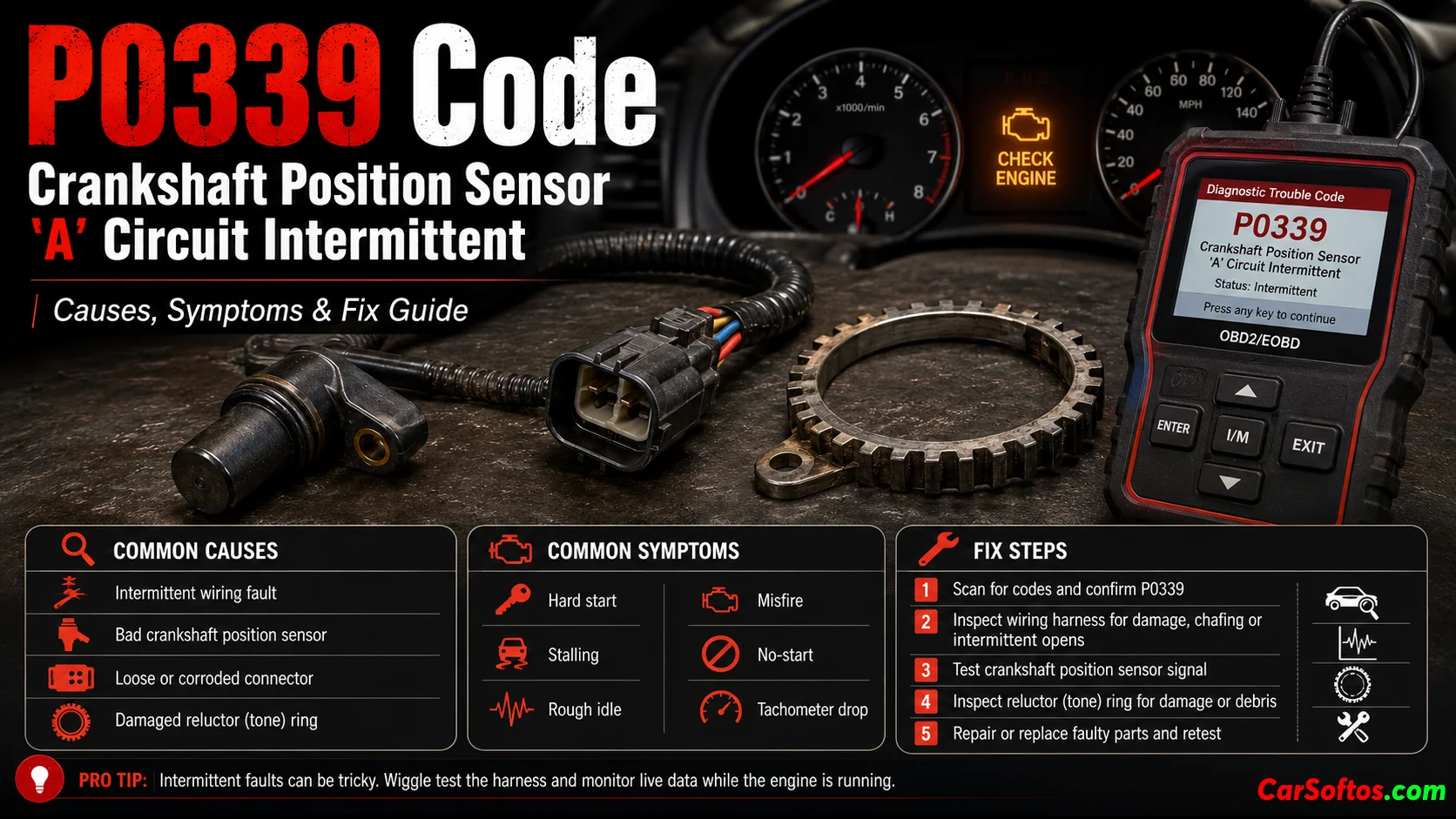
P0339 is the generic OBD-II code for:
Crankshaft Position Sensor “A” Circuit Intermittent
The engine control module has detected that the signal from crankshaft position sensor A temporarily disappeared, dropped out, became erratic or stopped matching the expected crankshaft pulse pattern.
Unlike a permanent open-circuit fault, the CKP sensor may work normally most of the time and fail only:
- when the engine is hot;
- during cranking;
- over bumps or vibration;
- at a particular engine speed;
- while accelerating;
- during start-stop operation;
- when the wiring harness moves.
The intermittent nature is what makes P0339 difficult to diagnose. The engine may run perfectly during inspection and then unexpectedly stall several hours or days later.
👉 Simple explanation
The ECU is effectively saying:
- “I was receiving a crankshaft signal.”
- “The signal suddenly disappeared or became irregular.”
- “Then it returned.”
- “I can no longer reliably determine engine speed and crankshaft position.”
⚙️ What the Crankshaft Position Sensor Does
The crankshaft position sensor—usually abbreviated CKP—provides the ECU with critical information аbout:
- crankshaft position;
- engine speed;
- piston position;
- ignition timing;
- fuel-injection timing;
- camshaft/crankshaft synchronization;
- misfire detection.
The sensor reads a toothed target commonly called a:
- reluctor wheel;
- trigger wheel;
- tone ring;
- sensor plate;
- flywheel or flexplate target.
As the teeth pass the sensor, they create an electrical pulse pattern. The ECU counts those pulses and uses the missing-tooth or reference section to identify crankshaft position. Toyota service information describes the CKP system as a sensor and toothed sensor plate whose signal allows the ECM to calculate crankshaft position and speed.
If that pulse train disappears even briefly, the ECU may temporarily lose synchronization. Depending on the vehicle, it may then:
- cut injector operation;
- interrupt spark;
- shut the engine down;
- extend cranking time;
- use a limited fallback strategy;
- disable some misfire-monitoring functions.
A 2023 calibration bulletin notes that pending P0335 or P0339 faults can disable the major misfire monitor and other diagnostics on the affected application.
⚠️ How Serious Is P0339?
Severity: ⭐⭐⭐⭐⭐ High / Critical
P0339 should be treated more seriously than many ordinary Check Engine codes because an intermittent CKP signal can stop the engine without much warning.
Possible consequences include:
- sudden engine stall while driving;
- crank-no-start condition;
- intermittent hot-start failure;
- temporary loss of injector pulse or ignition control;
- rough running or false misfire detection;
- unreliable start-stop operation;
- being stranded when the fault becomes permanent.
Manufacturer bulletins document P0339 complaints that include crank-no-start behavior, and other OEM cases connect P0339 with crank/cam synchronization or mechanical trigger-wheel problems.
🚫 Stop driving when:
- the engine stalls in traffic;
- the engine is difficult to restart;
- RPM suddenly falls to zero while the engine is still turning;
- the tachometer jumps erratically;
- the Check Engine Light flashes;
- severe misfires occur;
- the fault repeatedly appears during start-stop events;
- the car shuts down after warming up.
🚨 Common Symptoms of P0339
P0339 symptoms may be constant, but they are often unpredictable.
Typical complaints include:
- ⚠️ Check Engine Light;
- ⚠️ engine randomly stalls;
- ⚠️ crank-no-start;
- ⚠️ long cranking before the engine starts;
- ⚠️ hot engine will not restart until it cools;
- ⚠️ rough idle;
- ⚠️ hesitation during acceleration;
- ⚠️ intermittent loss of power;
- ⚠️ tachometer drops to zero;
- ⚠️ RPM reading disappears or jumps on the scan tool;
- ⚠️ engine starts normally on the second attempt;
- ⚠️ start-stop system fails to restart the engine;
- ⚠️ related P0335, P0336 or cam/crank correlation codes.
Specialist diagnostic descriptions of P0339 commonly mention sporadic stalling, hesitation, unpredictable idle and intermittent sensor-signal loss. Manufacturer bulletins also document no-start and cold-start roughness on certain vehicles where P0339 was addressed through updated control-module software.
🔥 Common Real-World P0339 Patterns
| Pattern | Most likely diagnostic direction |
|---|---|
| Stalls hot and restarts after cooling | Heat-sensitive CKP sensor or connector |
| No RPM while cranking | Missing CKP signal, wiring open, dead sensor |
| RPM briefly drops to zero while driving | Signal dropout, harness or sensor fault |
| P0339 appears after transmission work | CKP wiring, flexplate or reluctor damage |
| P0339 appears after timing work | Sensor plate, timing alignment or connector issue |
| Fault occurs over bumps | Loose terminal, broken wire inside insulation |
| Fault occurs only at high RPM | Reluctor vibration, weak mounting, electrical noise |
| P0339 plus P0016/P0017 | Timing or crank/cam correlation problem |
| P0339 after sensor replacement | Harness, wrong sensor, air gap, reluctor or software |
| P0339 during low-battery cranking | Low voltage, slow crank speed or calibration sensitivity |
| P0339 with start-stop complaints | CKP dropout or applicable PCM software issue |
A Volkswagen bulletin for the Routan specifically instructs technicians to inspect for a warped flexplate when P0339 occurs with a recorded unlock event above a specified RPM threshold, showing that an intermittent CKP code is not always caused by the sensor itself.
🧠 Most Common Causes of P0339
1️⃣ Heat-sensitive crankshaft position sensor
This is one of the most common P0339 patterns.
Internal sensor electronics or windings can fail as temperature rises. The sensor may operate normally when cold, stop producing a clean signal after the engine warms up and begin working again after cooling.
Typical clues
- engine starts normally when cold;
- stalls after 20–60 minutes;
- refuses to restart while hot;
- starts again after sitting;
- waveform disappears as sensor temperature increases;
- fault cannot be reproduced on a cold engine.
A resistance test performed only when cold may miss this failure. The sensor should be tested during the conditions that trigger the fault, ideally while monitoring its waveform.
2️⃣ Loose or corroded CKP connector
A connector can look connected but still lose contact because of vibration or thermal expansion.
Check for:
- broken locking tab;
- terminals pushed backward;
- spread female terminals;
- green corrosion;
- oil contamination;
- water intrusion;
- loose terminal tension;
- wire strands broken at the connector;
- damaged connector seal.
A loose terminal may pass a stationary continuity test but open momentarily when the engine moves.
3️⃣ Broken wire inside intact insulation
The outside of the wire may look normal while the conductor inside is partially broken.
This often occurs near:
- the connector;
- a sharp harness bend;
- the starter motor;
- an engine mount;
- the transmission bellhousing;
- the crank pulley;
- exhaust components;
- previous repair splices.
Typical pattern
The engine cuts out when:
- the harness is moved;
- the engine rocks under acceleration;
- the vehicle passes over a bump;
- heat expands the damaged conductor.
This is why a wiggle test while monitoring the waveform or RPM PID is more useful than a basic visual inspection.
4️⃣ Intermittent short to ground or power
A damaged CKP wire may periodically contact:
- the engine block;
- an exhaust shield;
- a powered wire;
- the 5-volt reference circuit;
- battery voltage;
- another sensor signal wire.
The exact resulting code can vary. The same vehicle may store P0337, P0338 or P0339 at different times depending on how the wire fails.
5️⃣ Poor sensor power or ground
A three-wire Hall-effect CKP sensor normally requires:
- a power or reference supply;
- a ground;
- a signal circuit.
An intermittent loss of either power or ground will make the output disappear even if the sensor itself is good.
Possible causes include:
- poor engine ground;
- corroded ECU ground;
- loose splice;
- damaged shared sensor-reference circuit;
- intermittent relay or fuse contact;
- excessive voltage drop during cranking.
The abnormal Hall-sensor waveform shown in the image carousel demonstrates how an intermittent supply connection can create erratic low-amplitude pulses and noise rather than a clean square-wave signal.
6️⃣ Incorrect sensor air gap or loose mounting
The CKP sensor must sit at the correct distance from the trigger wheel.
An excessive or changing air gap can produce intermittent signal loss, particularly:
- during cranking;
- at low RPM;
- when the engine or transmission moves;
- when the reluctor wheel has runout;
- when the mounting bracket is loose.
Possible causes include:
- sensor not fully seated;
- rust below the sensor flange;
- incorrect replacement sensor length;
- missing shim or spacer;
- damaged mounting bracket;
- loose retaining bolt;
- worn crankshaft or flexplate allowing movement.
7️⃣ Damaged, cracked or shifted reluctor wheel
The ECU may lose synchronization if the reluctor does not produce a consistent pulse pattern.
Possible problems include:
- cracked tone ring;
- shifted reluctor;
- bent or damaged teeth;
- excessive rust;
- loose sensor plate;
- damaged flywheel or flexplate;
- excessive crankshaft endplay;
- foreign material on the target wheel;
- incorrect flywheel installed during repair.
A manufacturer bulletin for P0339 directs inspection toward a warped flexplate under specific captured fault conditions. Mitsubishi diagnostic information also lists a loose timing chain or abnormal sensor disc as possible causes of abnormal crank/cam waveforms.
8️⃣ Metal debris on the sensor tip
Magnetic CKP sensors can collect metallic particles.
This contamination can:
- change the effective sensor gap;
- weaken the signal;
- distort individual pulses;
- create noise;
- cause intermittent synchronization loss.
Metal debris should never be dismissed without investigating where it came from. It may indicate:
- clutch or flywheel wear;
- timing-system wear;
- reluctor contact;
- internal engine contamination.
9️⃣ Low battery voltage or slow cranking
P0339 may occur during starting when cranking voltage or speed is too low for the ECU to interpret the CKP signal correctly.
Check:
- battery state of charge;
- cranking voltage;
- starter current draw;
- engine ground voltage drop;
- ECU power supply during cranking;
- actual cranking RPM.
An older Honda bulletin associated P0339 and accompanying misfire codes with incorrect CKP-position judgment during low-battery cranking; the repair involved updated control software and a crank-pattern relearn rather than automatic sensor replacement.
🔟 Electrical interference or poor shielding
The CKP signal can be corrupted by electromagnetic interference.
Potential sources include:
- damaged shielded cable;
- alternator ripple;
- ignition-coil interference;
- poor engine grounds;
- starter cable routed beside the CKP harness;
- aftermarket alarm or remote-start wiring;
- non-OEM engine wiring;
- welding damage;
- poor repair splices.
A brief noise spike can be interpreted as an extra tooth, while a severe disturbance may make the ECU temporarily lose crank synchronization.
1️⃣1️⃣ Camshaft/crankshaft synchronization or mechanical timing problem
P0339 primarily describes an intermittent CKP circuit signal, but the ECU may also reject the crank signal when it conflicts with camshaft position.
Possible causes include:
- stretched timing chain;
- loose timing chain;
- jumped timing belt;
- damaged cam or crank trigger wheel;
- incorrect mechanical timing;
- failing camshaft position sensor;
- VVT actuator fault;
- excessive timing-chain movement.
Honda documentation has linked P0339 with P0017 on specific engines affected by a manufacturing-related engine condition, while Mitsubishi waveform guidance identifies loose timing chains and abnormal sensor discs as causes of abnormal crank/cam patterns.
1️⃣2️⃣ ECU software or calibration issue
Not every P0339 requires hardware replacement.
Some manufacturer bulletins correct P0339 through:
- PCM software updates;
- revised CKP signal filtering;
- improved start-stop logic;
- crank-pattern clear and relearn;
- altered fault-monitor sensitivity.
Multiple Stellantis bulletins list P0339 among codes addressed by PCM software updates, including applications with no-start or driveability complaints.
This is why vehicle-specific technical service bulletins should be checked before replacing expensive components.
1️⃣3️⃣ Rare ECU input-circuit failure
An internal ECU fault is possible, but it should be considered only after confirming:
- sensor output is correct;
- waveform reaches the ECU;
- wiring remains intact under load;
- power and grounds are correct;
- reluctor pattern is mechanically sound;
- applicable software updates are installed.
Replacing the ECU before these tests risks an expensive misdiagnosis.
⚡ P0339 vs P0335, P0336, P0337 and P0338
| Code | Definition | Main diagnostic direction |
|---|---|---|
| P0335 | CKP Sensor “A” Circuit | General circuit/no-signal fault |
| P0336 | CKP Sensor “A” Range/Performance | Implausible pulse pattern or timing |
| P0337 | CKP Sensor “A” Circuit Low Input | Signal too low or short to ground |
| P0338 | CKP Sensor “A” Circuit High Input | Signal too high or short to voltage |
| P0339 | CKP Sensor “A” Circuit Intermittent | Signal temporarily disappears or becomes erratic |
👉 The practical distinction
- P0335: the CKP circuit has a general failure.
- P0336: the signal exists but its pattern does not make sense.
- P0337: voltage is too low.
- P0338: voltage is too high.
- P0339: the signal works and then unpredictably drops out.
🔧 Professional Step-by-Step Diagnosis
1️⃣ Scan every module and save freeze-frame data
Do not clear P0339 before saving:
- fault status;
- pending and confirmed codes;
- engine RPM at failure;
- coolant temperature;
- battery voltage;
- vehicle speed;
- engine load;
- starter status;
- cam/crank synchronization status.
Related codes may include:
- P0335–P0338;
- P0340/P0341/P0344;
- P0016–P0019;
- P0300–P0308;
- low-voltage codes;
- starter or charging-system codes.
The exact combination can separate an electrical dropout from a timing or mechanical trigger-wheel problem.
2️⃣ Check RPM while cranking
Watch the scan-tool engine-speed PID.
| Observation | Diagnostic implication |
|---|---|
| Stable cranking RPM | CKP signal is currently reaching the ECU |
| 0 RPM | CKP signal absent, circuit open or ECU not recognizing it |
| RPM appears and disappears | Intermittent sensor, wiring, connector or reluctor issue |
| Impossible RPM spikes | Noise, short, reluctor defect or signal corruption |
Toyota repair information states that a tester remaining at 0 RPM while cranking can indicate an open or short in the CKP circuit.
Important limitation
A normal RPM reading during one test does not clear P0339. The fault may only occur hot or under vibration.
3️⃣ Identify the sensor type
Hall-effect CKP sensor
Usually has three wires:
- power;
- ground;
- digital signal.
Expected output is generally a square-wave switching pattern.
Magnetic or variable-reluctance sensor
Usually has two wires and generates an AC waveform whose amplitude increases with speed.
This distinction changes the test method:
- a Hall sensor requires power and ground checks;
- a magnetic sensor must be checked for AC amplitude, resistance where specified and air gap;
- resistance testing alone cannot reliably prove a sensor is good.
4️⃣ Inspect the connector and harness under realistic conditions
Inspect the entire accessible circuit, especially near hot and moving parts.
Then perform:
- terminal-drag test;
- harness wiggle test;
- heat-gun test used carefully;
- cold-spray test;
- voltage-drop testing;
- continuity testing while flexing the harness.
A static continuity reading may look perfect even when only a few wire strands remain connected.
5️⃣ Test sensor power and ground under load
For a Hall sensor, confirm:
- correct supply voltage;
- stable ground;
- low ground voltage drop;
- stable supply while cranking;
- no intermittent loss when the harness moves.
Do not rely only on an unloaded multimeter reading. A corroded connection can display normal voltage until the circuit is loaded.
6️⃣ Capture the CKP waveform with an oscilloscope
An oscilloscope is the best diagnostic tool for P0339.
Look for:
- brief flatline;
- missing pulse groups;
- irregular amplitude;
- extra pulses;
- signal noise;
- loss of signal as the engine heats;
- one repeated disturbance per crank revolution;
- waveform interruption when the harness is moved.
In guided test shows the expected repeating inductive pattern and the reference gap created by the missing-tooth section. Comparing a clean waveform with a recorded fault event is far more reliable than replacing parts based only on the code.
Best practice
Use a long time-base or recording scope so the signal can be captured during:
- cold start;
- warm-up;
- road test;
- stall event;
- hot restart;
- start-stop restart.
A failure lasting only a few milliseconds may be invisible on a multimeter.
7️⃣ Capture CKP and CMP together
A dual-trace scope test can reveal whether:
- the crank signal disappears;
- the cam signal disappears;
- synchronization shifts;
- the reluctor pattern becomes distorted;
- mechanical timing moves.
The comparison waveform in the image carousel demonstrates how crank and cam traces can be viewed simultaneously to assess synchronization.
8️⃣ Inspect sensor mounting and air gap
Remove the CKP sensor when access allows.
Check for:
- rust beneath the mounting flange;
- incorrect sensor part number;
- loose bolt;
- cracked bracket;
- damaged O-ring;
- incorrect spacer;
- rub marks;
- metal contamination;
- excessive sensor-to-reluctor gap.
A sensor that has touched the reluctor indicates a mechanical clearance problem that must be fixed before installing another sensor.
9️⃣ Inspect the reluctor, flexplate and flywheel
This step is especially important when:
- a new sensor did not fix P0339;
- the fault began after transmission removal;
- the waveform has one recurring disturbance;
- cam/crank synchronization unlock events are stored;
- metallic knocking or flexplate noise exists.
Inspect for:
- cracks;
- warping;
- shifted trigger ring;
- missing or damaged teeth;
- loose bolts;
- excessive runout;
- incorrect replacement parts;
- crankshaft or flywheel movement.
The Volkswagen Routan bulletin’s warped-flexplate diagnostic path is a strong example of why P0339 should not automatically be treated as a sensor-only code.
🔟 Test battery, starter and ground voltage drops
Measure:
- battery voltage before cranking;
- minimum voltage while cranking;
- starter current draw;
- engine-ground voltage drop;
- ECU-ground voltage drop;
- cranking RPM;
- alternator AC ripple.
A low-voltage starting event can distort the CKP signal or trigger an incorrect synchronization judgment on sensitive applications.
1️⃣1️⃣ Check mechanical timing and correlation
When P0339 appears with P0016–P0019 or camshaft codes:
- verify chain or belt timing;
- inspect chain slack;
- check tensioner operation;
- inspect camshaft reluctors;
- compare CKP and CMP waveforms;
- verify VVT actuator position.
Do not replace the crank sensor until the mechanical relationship has been verified.
1️⃣2️⃣ Check manufacturer bulletins and software level
Search by:
- VIN;
- model year;
- engine code;
- ECU software number;
- exact P0339 symptom.
OEM bulletins show that some P0339 cases require:
- software update;
- CKP pattern relearn;
- engine inspection;
- flexplate inspection;
- specific fault-data analysis.
1️⃣3️⃣ Perform crankshaft variation relearn when required
Depending on the manufacturer, a CKP relearn may be required after:
- CKP sensor replacement;
- crankshaft replacement;
- flywheel/flexplate replacement;
- timing-system repair;
- engine replacement;
- PCM replacement or reprogramming;
- certain low-voltage or synchronization events.
A relearn should not be used to hide a real signal dropout. The electrical and mechanical problem must be corrected first.
🛠️ How to Fix P0339
✔️ Repair the CKP connector
Replace or repair terminals when the connector is loose, corroded or heat damaged.
Typical cost: $50–$250
✔️ Repair the CKP wiring harness
Repair open circuits, intermittent shorts, damaged shielding and broken conductors.
Typical cost: $80–$600+
Complex harness damage near the transmission or inside a shared engine loom may cost more.
✔️ Replace the crankshaft position sensor
Replace the sensor only when testing confirms:
- signal dropout;
- heat-related internal failure;
- incorrect output;
- intermittent open circuit;
- physical damage.
Typical cost: $120–$450 installed
Labor varies greatly because some sensors are easy to reach while others require removal of shields, starters, intake components or transmission-related parts.
✔️ Correct sensor mounting or air gap
Clean the mounting surface, repair the bracket or install the correct sensor.
Typical cost: $50–$300
✔️ Clean the sensor tip and inspect the source of debris
Typical cost: $50–$200
Cleaning alone is insufficient when metal contamination indicates deeper mechanical wear.
✔️ Repair or replace the reluctor wheel
Depending on engine design, this may require crankshaft, flywheel, flexplate or transmission removal.
Typical cost: $300–$2,000+
✔️ Replace a warped or damaged flexplate
Typical cost: $700–$2,500+
Most of the cost comes from transmission removal and installation.
✔️ Repair battery, starter or ground faults
Typical cost: $80–$800+
The range depends on whether the repair is a ground strap, battery, starter or charging-system problem.
✔️ Correct mechanical timing
Repair may involve a timing belt, timing chain, tensioner, guides or cam phaser.
Typical cost: $600–$3,500+
✔️ Update ECU software and perform relearn
Typical cost: $100–$350
The exact repair depends on the manufacturer bulletin and required programming equipment.
✔️ Repair or replace the ECU
This is uncommon and should be the final diagnostic step.
Typical cost: $600–$2,000+
Programming and immobilizer adaptation may be required.
💰 P0339 Repair Cost Summary
| Repair | Typical cost |
|---|---|
| Diagnostic scan and live-data test | $80–$250 |
| Oscilloscope diagnosis | $120–$350 |
| CKP connector repair | $50–$250 |
| Wiring-harness repair | $80–$600+ |
| CKP sensor replacement | $120–$450 |
| Sensor mounting/air-gap correction | $50–$300 |
| Battery, starter or ground repair | $80–$800+ |
| CKP relearn/software update | $100–$350 |
| Reluctor or trigger-wheel repair | $300–$2,000+ |
| Flexplate replacement | $700–$2,500+ |
| Timing-system repair | $600–$3,500+ |
| ECU repair or replacement | $600–$2,000+ |
These are broad US-dollar estimates. Vehicle design, labor rates, sensor accessibility and whether transmission removal is required can change the final cost substantially.
❗ Common Diagnostic Mistakes
❌ Replacing the CKP sensor immediately
P0339 may be caused by:
- connector contact loss;
- broken wiring;
- poor power or ground;
- warped flexplate;
- damaged reluctor;
- low cranking voltage;
- software calibration.
A new sensor will not repair any of those faults.
❌ Testing only when the engine is cold
A sensor that fails only at operating temperature can test perfectly when cold.
Reproduce the original conditions:
- engine hot;
- after heat soak;
- under load;
- during restart;
- with start-stop active.
❌ Clearing freeze-frame data before saving it
The captured temperature, RPM and voltage can reveal whether the failure occurred:
- during cranking;
- at highway speed;
- during a hot restart;
- at low system voltage;
- during an engine synchronization unlock.
❌ Relying only on resistance testing
A CKP sensor can pass a basic resistance test and still fail dynamically when:
- hot;
- vibrating;
- spinning quickly;
- subjected to a changing air gap.
Waveform testing is substantially more useful for an intermittent code.
❌ Ignoring the flexplate or reluctor
Mechanical trigger-wheel faults are easy to overlook and can repeatedly destroy diagnostic confidence after several unnecessary sensor replacements.
❌ Skipping voltage-drop tests
A circuit can show continuity and still fail under load because of corrosion or damaged wire strands.
❌ Ignoring related cam/crank codes
P0339 combined with P0016, P0017, P0340 or P0341 can point toward timing or synchronization rather than an isolated CKP sensor failure.
❌ Replacing the ECU too early
The ECU is one of the least common causes. Confirm the sensor waveform at the ECU connector before condemning the module.
🚗 Can You Drive With P0339?
Driving is not recommended until the cause is identified.
The vehicle may run normally now and stall without warning later. That unpredictability is the main danger.
A very short trip may be possible when:
- the engine starts immediately;
- no stalling has occurred;
- RPM is stable;
- no severe misfire exists;
- the Check Engine Light is steady;
- the repair facility is nearby.
Stop driving and arrange recovery when:
- the engine has stalled while moving;
- the engine will not restart hot;
- scan-tool RPM disappears;
- the tachometer drops suddenly;
- the Check Engine Light flashes;
- the vehicle loses power in traffic;
- P0339 returns immediately after clearing.
Risks of continuing to drive
- sudden engine shutdown;
- no-start condition;
- loss of power steering or brake assistance after a stall;
- catalytic-converter damage from misfires;
- damage caused by an unrecognized flexplate or timing fault;
- being stranded.
❓ Frequently Asked Questions
Can a weak battery cause P0339?
Yes, on some vehicles. Low cranking voltage or slow starter speed can weaken or distort the CKP signal. Manufacturer documentation has also shown cases in which low-battery cranking contributed to incorrect CKP-position judgment and required software updating plus a relearn procedure.
Can P0339 appear even when the engine runs normally?
Yes. Because the fault is intermittent, the signal may have failed only once. The car can run normally when inspected, but the stored freeze-frame data and fault status may reveal the conditions of the dropout.
Can a bad starter cause P0339?
Indirectly, yes. A failing starter can produce:
- slow cranking;
- excessive voltage drop;
- electrical noise;
- unstable ground voltage.
These conditions may prevent the ECU from receiving a clean CKP signal during starting.
Can a damaged flexplate cause P0339?
Yes. A warped or damaged flexplate can alter the sensor-target gap or disturb the pulse pattern. Volkswagen issued a diagnostic instruction for certain P0339 cases that directs inspection for a warped flexplate based on stored synchronization data.
Does replacing the CKP sensor require a relearn?
It depends on the manufacturer and powertrain. Some vehicles require a crankshaft variation or pattern relearn after sensor replacement, engine work or PCM programming. Always check the service procedure for the exact vehicle.
Why does the engine stall only when hot?
Heat can cause:
- internal sensor winding failure;
- increased resistance;
- connector expansion;
- broken wire separation;
- ECU or ignition-component thermal faults.
Monitoring the waveform while the engine heats is the best way to confirm this pattern.
Can P0339 cause misfire codes?
Yes. An unstable crank signal can disrupt ignition/injection synchronization or interfere with the ECU’s misfire-monitoring calculations. Some manufacturer documentation notes that P0335/P0339 can disable major misfire monitoring, while other bulletins show P0339 appearing with cylinder-misfire codes.
📌 Final Verdict
P0339 means the ECU intermittently loses or rejects the crankshaft position sensor “A” signal. The sensor may work normally most of the time, which is why the code often requires heat testing, harness movement and oscilloscope recording to diagnose correctly.
The most common causes are:
- failing CKP sensor, especially when hot;
- loose or corroded connector;
- internally broken wire;
- intermittent short to ground or power;
- unstable sensor power or ground;
- incorrect sensor gap or loose mounting;
- damaged reluctor wheel or warped flexplate;
- metal debris on the sensor;
- weak battery or slow cranking;
- electrical interference;
- timing or cam/crank synchronization fault;
- vehicle-specific ECU software issue.
💡 Key takeaway
- P0339 is an intermittent signal fault—not automatic proof that the sensor is bad.
- Save freeze-frame data before clearing the code.
- Check RPM while cranking.
- Reproduce the fault hot and under vibration.
- Use an oscilloscope whenever possible.
- Inspect the reluctor and flexplate when a new sensor does not solve it.
- Check vehicle-specific bulletins before replacing the ECU.

Tags:
Users of Guests are not allowed to comment this publication.