Car Shakes When Accelerating: Causes, Diagnosis & Repair Cost
25-05-2026, 05:21. Posted by: carsoftos777
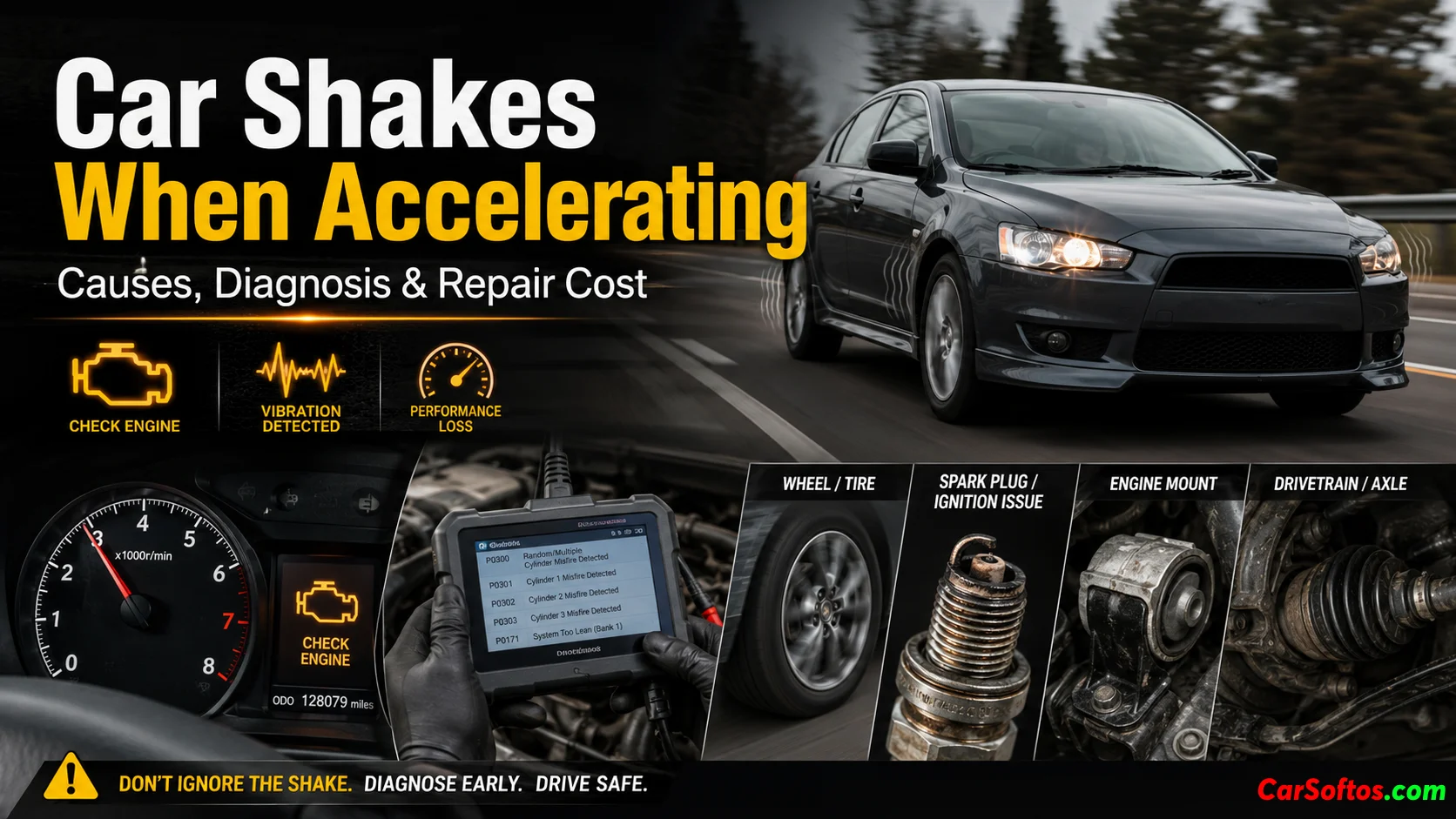
A car that shakes when accelerating is more than just annoying. In many cases, it is a warning sign that something is wrong with the engine, ignition system, drivetrain, tires, suspension, or transmission.
Sometimes the problem is simple, such as a tire imbalance or worn spark plugs. But in other cases, acceleration vibration can point to a serious issue like an engine misfire, bad CV axle, failing engine mount, or transmission shudder.
The key is to understand when the shaking happens, where you feel it, and whether it comes with other symptoms like a Check Engine Light, power loss, jerking, clicking, or rough idle.
⚡ Quick Answer: Why Does My Car Shake When Accelerating?
Your car may shake when accelerating because one or more components cannot handle the extra load created when you press the gas pedal.
The most common causes include:
- ⚠️ Engine misfire
- 🔥 Bad spark plugs
- ⚡ Faulty ignition coils
- 🛞 Wheel or tire imbalance
- 🔩 Worn CV axle or CV joints
- 🧱 Bad engine or transmission mounts
- ⛽ Fuel delivery problems
- 🌬️ Vacuum leaks or intake leaks
- ⚙️ Transmission shudder or slipping
- 🛠️ Suspension or drivetrain wear
If the car shakes only while accelerating and becomes smoother when you release the gas pedal, the problem is often related to engine load, drivetrain load, or power transfer to the wheels.
🚨 Is It Safe to Drive a Car That Shakes When Accelerating?
In many cases, you should not keep driving for long if your car shakes during acceleration.
A mild vibration caused by wheel imbalance may not be immediately dangerous at low speed, but a strong shake, misfire, drivetrain vibration, or transmission shudder can quickly become expensive or unsafe.
Stop driving or reduce speed immediately if:
- 🚨 The Check Engine Light is flashing
- 🚗 The car loses power while accelerating
- 🔊 You hear clicking, clunking, grinding, or banging
- 🛞 The steering wheel shakes violently
- ⚙️ The transmission slips or jerks
- 💨 You smell fuel, burning oil, or burning clutch
- 🌡️ The engine overheats
- 🛑 The car feels unstable at highway speed
A flashing Check Engine Light usually means an active misfire. Driving with a severe misfire can damage the catalytic converter, which may turn a small repair into a very expensive one.
🧠 How to Understand the Type of Shaking
Before replacing parts, pay attention to how the car shakes. This can help narrow down the cause.
| Symptom | Most Likely Cause |
|---|---|
| Car shakes only when accelerating | Misfire, CV axle, engine mount, drivetrain issue |
| Car shakes at highway speed | Wheel balance, tire defect, bent wheel |
| Steering wheel shakes | Front tires, wheels, suspension, alignment |
| Whole car shakes | Engine misfire, mounts, CV axle, transmission |
| Car shakes and Check Engine Light is on | Misfire, ignition coil, spark plug, injector |
| Car shakes when accelerating uphill | Weak ignition, fuel delivery, CV joint, transmission |
| Car shakes when shifting gears | Transmission, clutch, mounts |
| Car shakes at idle and acceleration | Engine mount, misfire, vacuum leak |
| Car shakes when turning and accelerating | CV joint or axle issue |
| Car shakes after new tires | Wheel balance, tire defect, improper installation |
🔍 Common Causes of Car Shaking When Accelerating
1️⃣ Engine Misfire
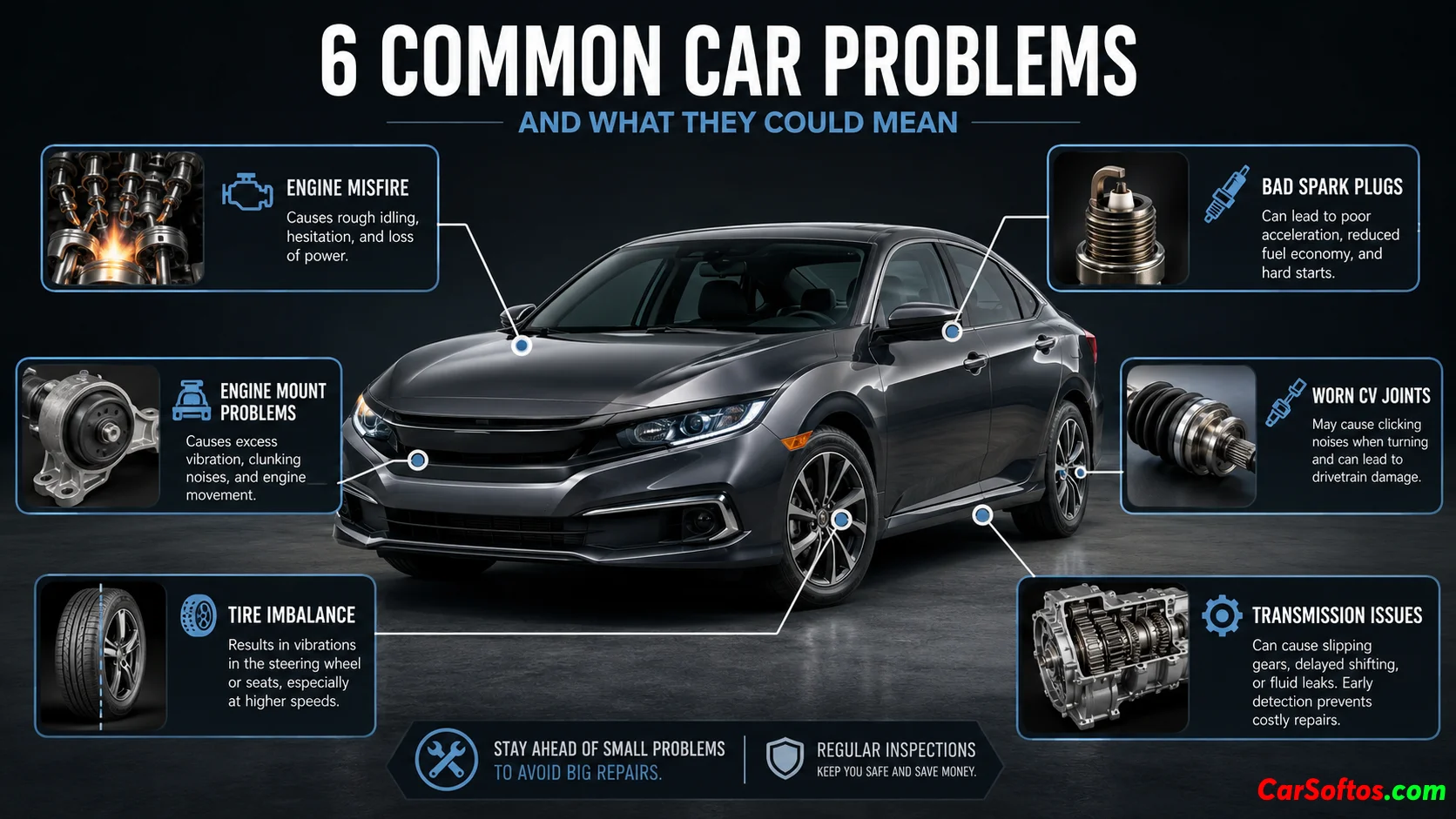
An engine misfire is one of the most common reasons a car shakes when accelerating.
A misfire happens when one or more cylinders fail to burn the air-fuel mixture correctly. Instead of producing smooth power, the engine fires unevenly. That uneven combustion creates vibration, hesitation, jerking, and shaking.
Misfires often feel worse during acceleration because the engine is under heavier load. A weak spark or fuel issue may not be obvious at idle, but once you press the gas, the fault becomes much more noticeable.
Symptoms of an engine misfire:
- ⚠️ Check Engine Light on
- 🚨 Flashing Check Engine Light
- 🚗 Car shakes when accelerating
- 🔥 Rough idle
- ⛽ Poor fuel economy
- 💨 Fuel smell from exhaust
- 🐢 Loss of power
- 🔊 Popping or uneven exhaust sound
- 📉 Engine feels weak under load
Common misfire-related OBD2 codes:
- P0300 — Random/Multiple Cylinder Misfire
- P0301 — Cylinder 1 Misfire
- P0302 — Cylinder 2 Misfire
- P0303 — Cylinder 3 Misfire
- P0304 — Cylinder 4 Misfire
- P0305–P0308 — Cylinder-specific misfires on larger engines
Repair cost:
| Repair | Estimated Cost |
|---|---|
| Diagnostic scan | $50–$150 |
| Spark plugs | $100–$300 |
| Ignition coil replacement | $150–$500 |
| Injector cleaning | $80–$250 |
| Injector replacement | $150–$600+ |
| Compression test | $100–$250 |
✅ Important:
If the Check Engine Light is flashing, do not continue hard acceleration. A severe misfire can overheat and damage the catalytic converter.
2️⃣ Bad Spark Plugs
Worn or fouled spark plugs can easily cause shaking during acceleration.
Spark plugs ignite the air-fuel mixture inside the cylinder. When they wear out, the spark becomes weaker. Under light driving, the engine may still feel acceptable. But under acceleration, cylinder pressure increases, and a weak spark may fail.
That is why many bad spark plug symptoms first appear when accelerating uphill, merging onto a highway, or pressing the gas harder than usual.
Symptoms of bad spark plugs:
- 🚗 Car shakes under acceleration
- ⚠️ Check Engine Light
- 🔥 Misfire codes
- 🐢 Slow acceleration
- ⛽ Increased fuel consumption
- 🔊 Rough idle
- 🕯️ Hard starting
- 💨 Unburned fuel smell
What spark plugs can reveal:
When removed, spark plugs can show a lot about engine condition:
| Spark Plug Condition | Possible Meaning |
|---|---|
| Black dry carbon | Rich mixture or weak ignition |
| Wet fuel smell | Misfire or no spark |
| Oily deposits | Oil burning or worn seals/rings |
| White blistered tip | Overheating or lean condition |
| Worn electrode | Old spark plug |
| Cracked porcelain | Plug damage or improper installation |
Repair cost:
- Spark plug replacement: usually $100–$300
- On some V6/V8 or difficult-access engines: $300–$600+
3️⃣ Faulty Ignition Coils
Ignition coils create the high voltage needed to fire the spark plugs. A weak or failing coil may work at idle but fail under acceleration.
A bad coil often causes shaking, jerking, or misfire under load. In modern vehicles, each cylinder may have its own coil. If one coil fails, the engine may shake badly, especially when accelerating.
Symptoms of a bad ignition coil:
- ⚡ Car shakes when pressing the gas
- ⚠️ Check Engine Light
- 🔥 Cylinder misfire code
- 🚗 Hesitation
- 🐢 Poor acceleration
- ⛽ Bad fuel economy
- 🔊 Rough idle
Simple diagnostic trick:
If you have a misfire code like P0302, swap the ignition coil from cylinder 2 to another cylinder. If the code moves, the coil is likely bad.
Example:
- Before swap: P0302
- Move coil from cylinder 2 to cylinder 3
- After test drive: P0303
That usually means the ignition coil is the problem.
Repair cost:
- One ignition coil: about $80–$200
- Full set of coils: about $150–$500+
- Luxury or performance vehicles may cost more.
4️⃣ Worn CV Axle or Inner CV Joint
A worn CV axle or inner CV joint is another very common cause of shaking when accelerating, especially on front-wheel-drive and all-wheel-drive vehicles.
The CV axle transfers power from the transmission to the wheels. When the inner CV joint wears out, it may vibrate under load. This vibration often appears only when accelerating and may disappear when coasting.
Symptoms of a worn CV axle:
- 🔩 Car shakes when accelerating
- 🚗 Vibration disappears when letting off the gas
- 🔊 Clicking noise when turning
- 🛞 Grease around the inside of the wheel
- 🧰 Torn CV boot
- ⚠️ Vibration worse uphill or under load
Inner vs outer CV joint symptoms:
| Part | Typical Symptom |
|---|---|
| Inner CV joint | Vibration during acceleration |
| Outer CV joint | Clicking noise when turning |
| Torn CV boot | Grease leak and future joint failure |
Repair cost:
- CV axle replacement: about $250–$700
- Some AWD vehicles or luxury cars: $700–$1,200+
✅ Important:
A failing CV axle should not be ignored. If it fails completely, the vehicle may lose drive power.
5️⃣ Wheel or Tire Imbalance
Wheel and tire problems are also common, but they usually behave differently from engine or drivetrain problems.
A tire imbalance often causes vibration at specific speeds, usually around 50–75 mph. The vibration may be felt mostly through the steering wheel if the front wheels are affected.
Symptoms of wheel/tire imbalance:
- 🛞 Steering wheel shake
- 🚗 Vibration increases with speed
- 📍 Vibration appears at a specific mph range
- 🧱 Car may feel smooth at low speed
- 🔁 Vibration may continue even when coasting
Possible tire or wheel causes:
- Wheel imbalance
- Bent wheel
- Tire with broken belt
- Uneven tire wear
- Flat spot on tire
- Low tire pressure
- Damaged sidewall
- Poor-quality or old tires
Repair cost:
| Repair | Estimated Cost |
|---|---|
| Wheel balancing | $50–$100 |
| Tire rotation | $20–$60 |
| New tire | $100–$400 per tire |
| Wheel repair | $100–$250 |
| Wheel replacement | $150–$600+ |
✅ Tip:
If the vibration started right after new tires were installed, suspect wheel balance, tire defect, or improper installation first.
6️⃣ Bad Engine Mounts
Engine mounts hold the engine in place and absorb vibration. When a mount wears out, cracks, collapses, or leaks, the engine can move too much.
Acceleration creates torque. The engine twists when you press the gas. If the mounts are weak, that movement becomes vibration, shaking, or clunking.
Symptoms of bad engine mounts:
- 🧱 Vibration at idle
- 🚗 Shaking when accelerating
- 🔊 Clunk when shifting into Drive or Reverse
- ⚙️ Excessive engine movement
- 🧍 Vibration felt through seat or cabin
- 🔨 Thump when pressing or releasing gas
How to check mounts:
A mechanic may inspect the mounts visually and perform a controlled engine movement test. The engine should move slightly, but not jump excessively.
Repair cost:
- Engine mount replacement: about $200–$600
- Hydraulic/electronic mounts: $500–$1,000+
7️⃣ Bad Transmission Mount
A bad transmission mount can feel similar to a bad engine mount. It may cause vibration, clunking, or shaking when accelerating or changing gears.
Symptoms:
- ⚙️ Shaking under acceleration
- 🔊 Clunk during shifting
- 🚗 Vibration through the floor
- 🧱 Harsh drivetrain movement
- 🛠️ Transmission feels unstable
Repair cost:
- Transmission mount replacement: about $150–$500
- Some vehicles: $500–$900+
8️⃣ Transmission Shudder or Slipping
Transmission problems can also cause shaking when accelerating. This is especially true if the shaking feels more like a shudder, surge, or jerk rather than a vibration.
Automatic transmissions may shudder because of torque converter problems, worn clutch packs, dirty fluid, low fluid, or valve body issues.
Symptoms of transmission-related shaking:
- ⚙️ Shudder during acceleration
- 🔁 RPM rises but speed does not increase normally
- 🔊 Harsh gear shifts
- ⏳ Delayed engagement
- 🚗 Jerking when shifting
- 🌡️ Transmission overheating
- ⚠️ Transmission warning light
Common transmission-related codes:
- P0700 — Transmission Control System
- P0740 — Torque Converter Clutch Circuit
- P0741 — Torque Converter Clutch Performance
- P0750 — Shift Solenoid A
- P0796 — Pressure Control Solenoid Performance
Repair cost:
| Repair | Estimated Cost |
|---|---|
| Transmission fluid service | $150–$300 |
| Solenoid repair | $250–$800 |
| Torque converter repair | $600–$1,500 |
| Valve body repair | $500–$1,500 |
| Transmission rebuild | $1,500–$4,000+ |
9️⃣ Fuel Delivery Problems
The engine needs the correct amount of fuel under acceleration. If fuel pressure drops or injectors are clogged, the engine may run lean, hesitate, stumble, or shake.
Fuel delivery problems often feel worse when accelerating uphill or at higher RPM.
Common causes:
- Weak fuel pump
- Clogged fuel filter
- Dirty fuel injectors
- Bad fuel pressure regulator
- Low fuel pressure
- Contaminated fuel
Symptoms:
- ⛽ Hesitation under acceleration
- 🚗 Shaking when pressing gas
- 🐢 Loss of power
- 🔥 Lean codes
- 🕯️ Hard starting
- 📉 Engine stalls under load
Common OBD2 codes:
- P0087 — Fuel Rail/System Pressure Too Low
- P0171 — System Too Lean Bank 1
- P0174 — System Too Lean Bank 2
- P0191 — Fuel Rail Pressure Sensor Range/Performance
- P0200–P0208 — Injector circuit faults
Repair cost:
| Repair | Estimated Cost |
|---|---|
| Fuel pressure test | $80–$150 |
| Injector cleaning | $80–$250 |
| Fuel filter replacement | $50–$200 |
| Fuel pump replacement | $300–$1,000 |
| Injector replacement | $150–$600+ |
🔟 Vacuum Leak or Intake Leak
A vacuum leak allows unmetered air into the engine. This can make the air-fuel mixture too lean and cause rough running, shaking, or hesitation.
Sometimes the car may idle rough and then shake more when accelerating.
Symptoms of vacuum/intake leak:
- 🌬️ Rough idle
- 🚗 Shaking under acceleration
- ⚠️ Check Engine Light
- 🔥 Lean codes P0171/P0174
- 📉 Unstable RPM
- 🔊 Hissing sound
- 🐢 Poor throttle response
Common leak locations:
- Intake manifold gasket
- Vacuum hoses
- PCV hose
- Brake booster hose
- Turbo/intercooler pipe
- Throttle body gasket
- MAF sensor boot
Repair cost:
- Vacuum leak diagnosis: $80–$200
- Hose replacement: $20–$150
- Intake gasket repair: $150–$600
- Turbo/intercooler pipe repair: $100–$700
1️⃣1️⃣ Dirty Throttle Body or MAF Sensor Problem
A dirty throttle body can cause unstable airflow. A dirty or faulty MAF sensor can send incorrect air measurement data to the ECU.
Both can cause hesitation, rough acceleration, and shaking.
Symptoms:
- 🌬️ Poor throttle response
- 🚗 Shaking or hesitation when accelerating
- 📉 RPM fluctuation
- ⚠️ Check Engine Light
- ⛽ Bad fuel economy
- 🔥 Lean or rich mixture codes
Common OBD2 codes:
- P0100 — MAF Circuit
- P0101 — MAF Range/Performance
- P0102 — MAF Low Input
- P0103 — MAF High Input
- P0068 — MAP/MAF Throttle Position Correlation
Repair cost:
| Repair | Estimated Cost |
|---|---|
| Throttle body cleaning | $80–$200 |
| MAF cleaning | $20–$100 |
| MAF sensor replacement | $100–$400 |
| Throttle body replacement | $250–$700 |
1️⃣2️⃣ Suspension or Drivetrain Wear
Sometimes acceleration vibration is caused by worn suspension or drivetrain components. These problems can be harder to identify because they may overlap with tire, axle, or mount symptoms.
Possible causes:
- Worn control arm bushings
- Bad ball joints
- Bad wheel bearing
- Worn driveshaft joint
- Bad differential mount
- Loose subframe bolts
- Worn suspension bushings
Symptoms:
- 🔊 Clunking noise
- 🚗 Vibration on acceleration
- 🛞 Uneven tire wear
- 📍 Car pulls to one side
- ⚠️ Instability at speed
- 🔩 Vibration from under the car
Repair cost:
| Repair | Estimated Cost |
|---|---|
| Control arm replacement | $200–$700 |
| Ball joint replacement | $150–$500 |
| Wheel bearing replacement | $250–$700 |
| Driveshaft repair | $300–$1,200 |
| Suspension bushing repair | $200–$800+ |
🧪 How to Diagnose a Car That Shakes When Accelerating
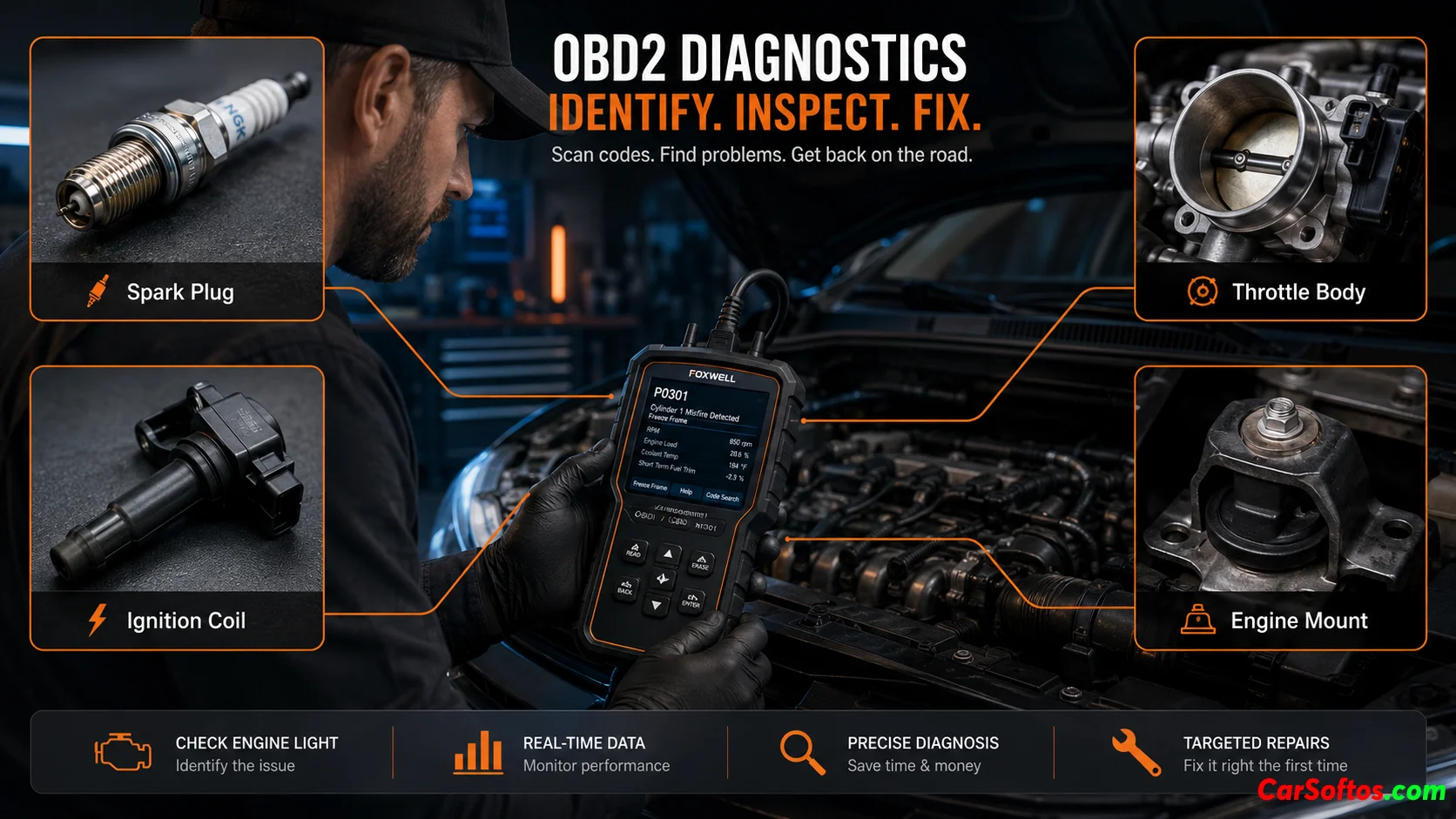
Step 1: Scan for Codes
Start with an OBD2 scan.
Even if the Check Engine Light is off, there may be stored or pending codes.
Look especially for:
- P0300 misfire codes
- P0171/P0174 lean codes
- P0101 MAF codes
- P0087 fuel pressure codes
- P0200 injector codes
- P0700 transmission codes
✅ Do not just clear the codes. Save them first.
Step 2: Check When the Vibration Happens
Ask yourself:
- Does it happen only when pressing the gas?
- Does it disappear when coasting?
- Does it happen at a certain speed?
- Does it happen in a certain gear?
- Does the steering wheel shake?
- Does the whole body shake?
- Does it happen more uphill?
- Does the Check Engine Light flash?
This information is very important.
Step 3: Inspect Spark Plugs and Ignition Coils
If there are misfire symptoms, inspect the ignition system.
Check:
- Spark plug condition
- Spark plug gap
- Coil connectors
- Oil in spark plug wells
- Cracked coil boots
- Burn marks
- Loose wiring
A weak ignition system is one of the most common causes of shaking under acceleration.
Step 4: Check Tires and Wheels
Inspect all tires carefully.
Look for:
- Uneven tread wear
- Bulges
- Flat spots
- Low pressure
- Missing wheel weights
- Bent wheels
- Tire age cracks
If the shake is mostly speed-related, wheel balance should be checked.
Step 5: Inspect CV Axles
Look under the vehicle for torn CV boots or grease leaks.
A bad inner CV joint can cause a very specific vibration that appears under acceleration and goes away when coasting.
Step 6: Inspect Engine and Transmission Mounts
Bad mounts are often overlooked.
A mechanic can check for:
- Cracked rubber
- Collapsed mount
- Leaking hydraulic mount
- Excessive engine movement
- Clunking under throttle
Step 7: Check Fuel Pressure
If the car feels weak, hesitates, or shakes uphill, check fuel pressure.
Fuel pressure problems may not always trigger a code immediately.
Step 8: Test Drive Safely
During a test drive, note:
- Speed range
- Gear
- RPM
- Load
- Steering wheel vibration
- Seat/floor vibration
- Noise
- Check Engine behavior
Never perform aggressive testing if the Check Engine Light is flashing or the car feels unsafe.
🧾 Diagnosis by Symptom
🚗 Car shakes when accelerating but not when coasting
Most likely:
- CV axle
- Engine misfire
- Engine mount
- Transmission mount
- Fuel delivery problem
Steering wheel shakes when accelerating
Most likely:
- Front wheel imbalance
- Bent wheel
- Tire defect
- Front suspension issue
- Front CV axle
🧱 Whole car shakes when accelerating
Most likely:
- Engine misfire
- Bad engine mount
- Bad transmission mount
- Inner CV joint
- Driveshaft issue
⚠️ Car shakes and Check Engine Light is on
Most likely:
- Misfire
- Ignition coil
- Spark plugs
- Injector fault
- Lean condition
- MAF/MAP issue
🚨 Car shakes and Check Engine Light flashes
Most likely:
- Severe active misfire
This can damage the catalytic converter. Avoid driving hard and diagnose immediately.
🔊 Car shakes and clicks when turning
Most likely:
- Outer CV joint
- CV axle boot failure
⚙️ Car shakes when shifting gears
Most likely:
- Transmission mount
- Engine mount
- Transmission shudder
- Clutch issue
- Torque converter issue
💵 Repair Cost Guide
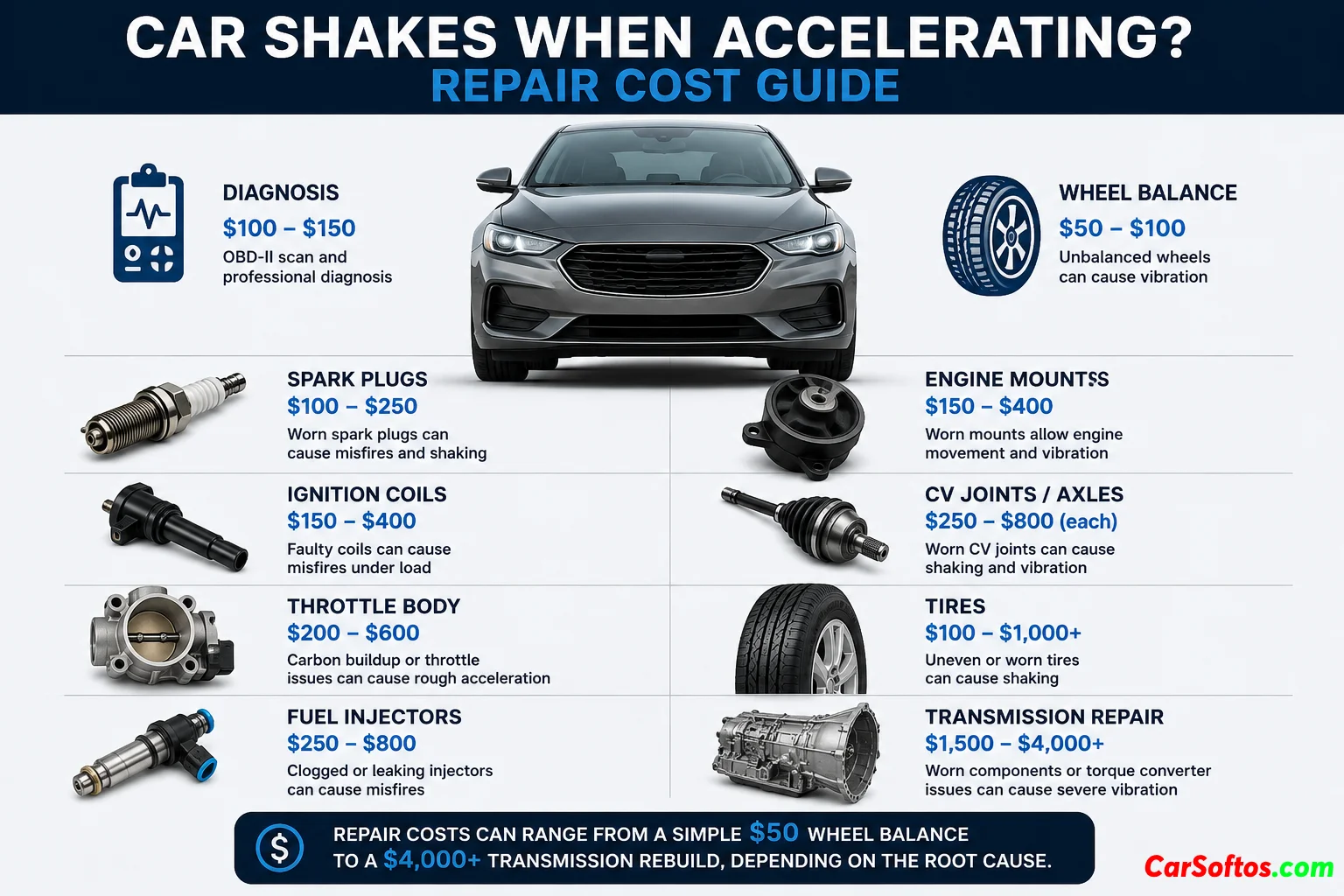
Estimated Repair Costs in US Dollars
| Problem / Repair | Estimated Cost |
|---|---|
| OBD2 diagnostic scan | $50–$150 |
| Full diagnostic inspection | $100–$250 |
| Spark plug replacement | $100–$300 |
| Ignition coil replacement | $150–$500 |
| Fuel injector cleaning | $80–$250 |
| Fuel injector replacement | $150–$600+ |
| Fuel pump replacement | $300–$1,000 |
| Fuel filter replacement | $50–$200 |
| Vacuum leak repair | $50–$600 |
| Throttle body cleaning | $80–$200 |
| MAF sensor replacement | $100–$400 |
| Wheel balancing | $50–$100 |
| Tire replacement | $100–$400 per tire |
| Wheel repair/replacement | $100–$600+ |
| CV axle replacement | $250–$700 |
| Engine mount replacement | $200–$600 |
| Transmission mount replacement | $150–$500 |
| Wheel bearing replacement | $250–$700 |
| Control arm / suspension repair | $200–$800+ |
| Transmission fluid service | $150–$300 |
| Torque converter repair | $600–$1,500 |
| Transmission repair | $300–$1,500+ |
| Transmission rebuild/replacement | $1,500–$4,000+ |
🧰 Cheapest vs Most Expensive Causes
✅ Cheapest possible fixes:
- Wheel balancing: $50–$100
- MAF cleaning: $20–$100
- Vacuum hose repair: $20–$150
- Spark plugs: $100–$300
⚠️ Medium-cost repairs:
- Ignition coils: $150–$500
- Engine mount: $200–$600
- CV axle: $250–$700
- Wheel bearing: $250–$700
🚨 Expensive repairs:
- Fuel pump: $300–$1,000
- Torque converter: $600–$1,500
- Transmission repair: $300–$1,500+
- Transmission rebuild: $1,500–$4,000+
🧠 Mechanic’s Diagnostic Shortcut
A good mechanic usually tries to answer one key question:
Is the vibration caused by engine power, wheel speed, or drivetrain load?
If it changes with engine RPM:
Likely:
- Misfire
- Spark plugs
- Ignition coils
- Fuel delivery
- Engine mounts
If it changes with vehicle speed:
Likely:
- Tires
- Wheels
- Wheel bearings
- Driveshaft
- Suspension
If it happens only under throttle:
Likely:
- CV axle
- Engine mount
- Transmission mount
- Misfire under load
- Transmission shudder
This is why guessing and replacing parts randomly is a bad idea.
❓ FAQ: Car Shakes When Accelerating
Why does my car shake only when I accelerate?
Because acceleration puts extra load on the engine, drivetrain, transmission, axles, and mounts. Weak components may only show symptoms when the vehicle is under load.
Can bad spark plugs cause shaking when accelerating?
Yes. Bad spark plugs are one of the most common causes. They may misfire under load, causing the engine to shake, hesitate, or lose power.
Can a bad ignition coil make my car shake?
Yes. A weak ignition coil can cause a cylinder misfire, especially during acceleration.
Can a bad CV axle cause vibration during acceleration?
Yes. A worn inner CV joint often causes vibration when accelerating and may become smoother when coasting.
Why does my steering wheel shake when I accelerate?
Steering wheel shake is often caused by front wheel imbalance, tire damage, bent wheels, suspension wear, or front CV axle problems.
Why does my whole car shake when accelerating?
Whole-car shaking is often linked to engine misfire, worn mounts, CV axle problems, driveshaft issues, or transmission shudder.
Is a flashing Check Engine Light serious?
Yes. A flashing Check Engine Light usually means an active misfire. Continuing to drive can damage the catalytic converter.
Can transmission problems cause shaking during acceleration?
Yes. Transmission shudder, torque converter problems, slipping, or internal wear can cause shaking or jerking under acceleration.
How much does it cost to fix a car that shakes when accelerating?
It depends on the cause. Basic repairs may cost $50–$300, while CV axle, mount, or fuel system repairs can cost $250–$1,000. Transmission repairs may cost $1,500–$4,000+.
Should I keep driving if my car shakes?
If the shaking is mild and there is no warning light, you may be able to drive slowly to a repair shop. But if the shaking is severe, the Check Engine Light is flashing, or the car loses power, stop driving and diagnose the issue immediately.
✅ Final Thoughts
A car that shakes when accelerating should not be ignored. The problem may be as simple as a wheel imbalance or worn spark plugs, but it can also point to a more serious issue like an engine misfire, worn CV axle, bad engine mount, fuel delivery problem, or transmission shudder.
The best way to diagnose the problem is to look at when the shaking happens:
- If it happens only under throttle, suspect misfire, CV axle, mounts, or transmission.
- If it happens at a specific speed, suspect tires or wheels.
- If it comes with a Check Engine Light, scan for codes immediately.
- If the Check Engine Light flashes, stop driving hard and diagnose the misfire as soon as possible.
The sooner you find the cause, the cheaper the repair usually is.
come back