Car Won’t Start But Battery Is Good: What Could Be Wrong?
29-05-2026, 05:04. Posted by: carsoftos777
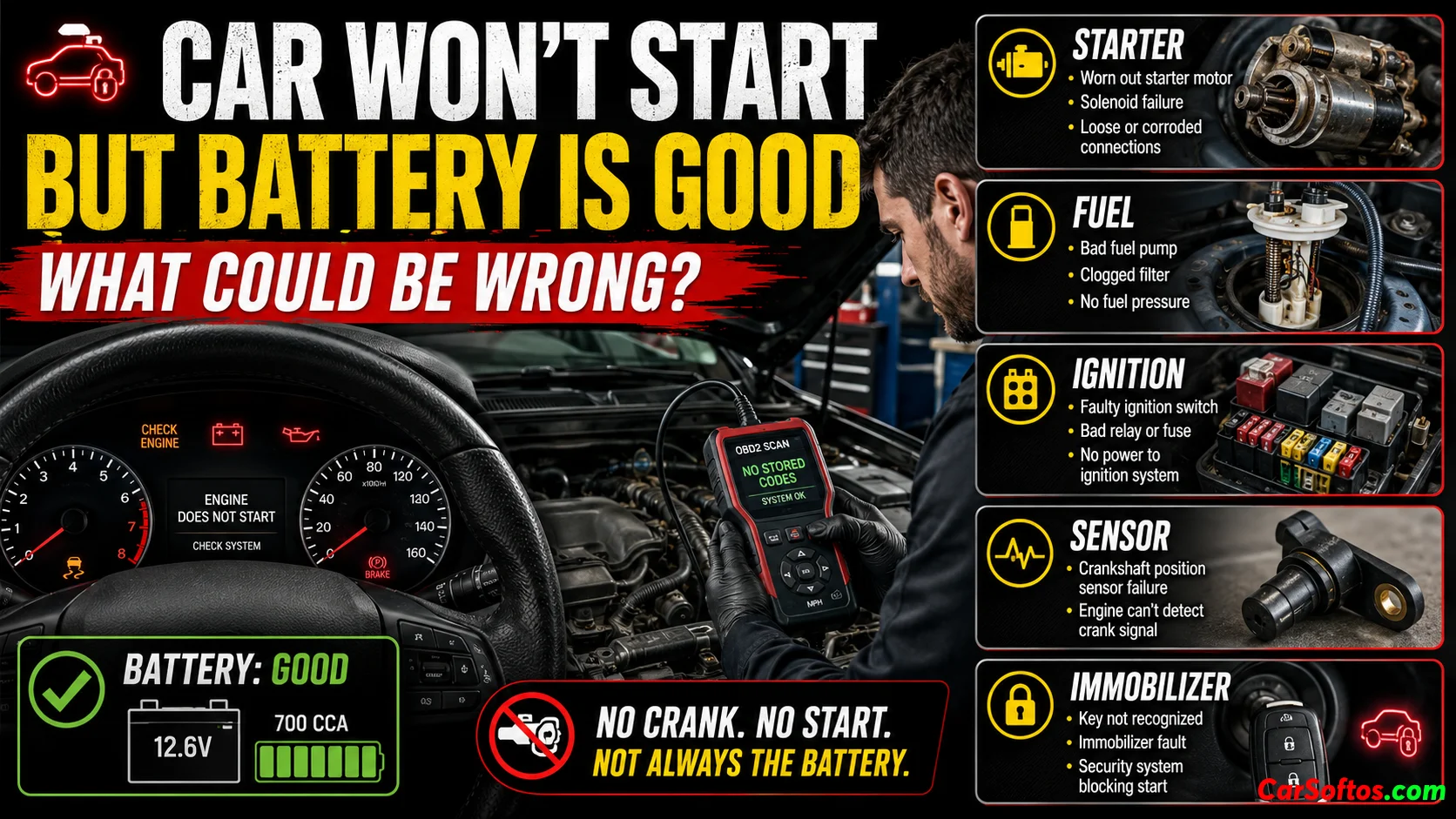
A car that won’t start even though the battery is good can be confusing. The dashboard lights may turn on, the radio may work, the headlights may look bright, and a battery tester may even say the battery is healthy — but the engine still refuses to start.
This usually means the problem is somewhere else in the starting, fuel, ignition, security, or engine management system.
In simple words, your car needs several things to start:
- 🔋 Enough battery power
- ⚡ Power reaching the starter
- 🔩 A working starter motor
- ⛽ Fuel delivery
- 🔥 Spark or ignition
- 🌬️ Correct air intake
- 🧠 Correct sensor signals
- 🔐 Immobilizer/key authorization
- ⚙️ Mechanical compression and timing
If any one of these is missing, the car may not start.
⚡ Quick Answer: Why Won’t My Car Start If the Battery Is Good?
If your battery is good but the car won’t start, the most common causes are:
- 🔩 Bad starter motor
- ⚡ Faulty starter relay or starter solenoid
- 🔑 Bad ignition switch
- 🔐 Immobilizer or key recognition problem
- ⛽ Bad fuel pump
- 🧪 Clogged fuel filter
- 🔥 No spark from ignition system
- 🧠 Bad crankshaft position sensor
- 🧯 Blown fuse or fusible link
- ⚙️ Bad neutral safety switch or clutch switch
- 🧰 Loose or corroded battery/starter cables
- 🌬️ Severe vacuum leak or air intake problem
- ⛓️ Broken timing belt/chain
- 🧱 Low compression or mechanical engine failure
The most important first step is to identify whether the engine:
- Does not crank at all
- Clicks but does not crank
- Cranks but does not start
- Starts and then dies
- Starts only with a jump
- Shows a security/key warning
Each symptom points to a different group of problems.
🧭 First: What Does “Battery Is Good” Really Mean?
Many drivers say the battery is good because:
- the lights turn on
- the radio works
- the dashboard lights up
- the car unlocks with the remote
- the battery is new
- the car starts with a jump sometimes
But that does not always prove the battery and electrical supply are truly good.
A weak battery may still power lights and radio but fail under starter load. Also, a good battery can still fail to start the car if the terminals, ground cable, starter cable, relay, fuse, or starter motor are faulty.
✅ A battery is more likely “good” if:
- voltage is around 12.6V with engine off
- voltage does not collapse badly while cranking
- battery passes a load test
- terminals are clean and tight
- ground cable is good
- starter cable has proper voltage
- alternator charges around 13.8–14.7V when running
If these have not been checked, do not completely rule out the battery circuit yet.
🚨 Is It Safe to Keep Trying to Start the Car?
Usually, you should avoid repeatedly cranking the engine for a long time.
Repeated long cranking can:
- overheat the starter motor
- drain the battery
- flood the engine with fuel
- overheat wiring or relays
- damage the catalytic converter if fuel enters the exhaust
- make diagnosis harder
Safe rule:
Crank for about 5–10 seconds, then wait at least 30–60 seconds before trying again.
If the car keeps refusing to start, stop guessing and diagnose the system step by step.
🧠 The Most Important No-Start Question
Before replacing parts, answer this:
Does the engine crank?
1. No crank / no sound
You turn the key or press the start button and nothing happens.
Most likely causes:
- bad starter relay
- bad ignition switch
- bad starter motor
- immobilizer issue
- blown fuse
- neutral safety switch
- clutch pedal switch
- wiring or ground problem
2. Click but no crank
You hear one click or repeated clicks, but the engine does not turn.
Most likely causes:
- weak battery under load
- bad starter motor
- bad starter solenoid
- loose battery cable
- poor ground connection
- seized engine accessory
- starter relay issue
3. Cranks but won’t start
The starter turns the engine, but the engine does not run.
Most likely causes:
- no fuel
- bad fuel pump
- no spark
- crankshaft position sensor
- immobilizer issue
- fuel pump relay
- blown fuse
- clogged fuel filter
- timing problem
- low compression
4. Starts then dies
The engine starts briefly, then stalls.
Most likely causes:
- immobilizer/key issue
- fuel pressure problem
- bad idle air/throttle body issue
- MAF sensor problem
- vacuum leak
- bad fuel pump
- clogged fuel filter
🔍 Common Causes: Car Won’t Start But Battery Is Good
1️⃣ Bad Starter Motor
A bad starter motor is one of the most common reasons a car will not start even when the battery is good.
The starter motor’s job is to physically turn the engine over. If it fails, the engine may not crank at all, or it may crank slowly and inconsistently.
Symptoms of a bad starter:
- 🔩 Single click when turning the key
- ⚡ No crank even though lights work
- 🔊 Grinding noise when starting
- 🔁 Intermittent no-start
- 🔥 Burning smell after repeated attempts
- 🛠️ Car starts sometimes, then suddenly does not
- 🚗 Starts after tapping the starter temporarily
Why it happens:
Starter motors wear out over time. The brushes, solenoid, internal contacts, bearings, or gear mechanism can fail. Heat can also make a weak starter worse, which is why some cars refuse to start when hot but start again after cooling down.
Quick checks:
- Do headlights dim heavily when trying to start?
- Do you hear one solid click?
- Does tapping the starter make it work once?
- Is there power at the starter signal wire?
- Is the engine ground cable good?
Repair cost:
| Repair | Estimated Cost |
|---|---|
| Starter diagnostic test | $50–$150 |
| Starter relay replacement | $50–$200 |
| Starter solenoid repair/replacement | $100–$300 |
| Starter motor replacement | $250–$800 |
| Luxury/performance vehicle starter | $700–$1,500+ |
✅ Important:
Do not replace the starter until the battery cables, ground connection, relay, ignition signal, and fuses have been checked.
2️⃣ Bad Starter Relay or Starter Solenoid
The starter relay and solenoid are responsible for sending power to the starter motor. If either one fails, the starter may not engage.
Symptoms:
- ⚡ One click or no click
- 🔁 Intermittent starting
- 🚗 Car starts after several tries
- 🧯 No power to starter signal wire
- 🔌 Starter works when jumped directly
Starter relay vs starter solenoid:
| Part | What It Does | Failure Symptom |
| Starter relay | Sends control signal to starter circuit | No crank, intermittent crank |
| Starter solenoid | Engages starter gear and sends high current | Click, no crank, starter not engaging |
Repair cost:
- Starter relay: usually $50–$200
- Starter solenoid: usually $100–$300
- If integrated into starter: full starter replacement may be needed.
3️⃣ Loose, Corroded, or Damaged Battery Cables
Even if the battery itself is good, the car may not start if power cannot travel properly through the cables.
This is very common and often overlooked.
Symptoms:
- Dashboard lights work but starter does not
- Clicking sound
- Intermittent no-start
- Lights flicker when trying to start
- Car starts after moving battery cables
- Corrosion around battery terminals
Check these areas:
- positive battery terminal
- negative battery terminal
- engine ground strap
- chassis ground
- starter power cable
- fuse box power feed
- battery terminal clamps
Repair cost:
| Repair | Estimated Cost |
| Battery terminal cleaning | $20–$80 |
| Battery terminal replacement | $50–$150 |
| Ground cable replacement | $50–$200 |
| Starter cable replacement | $100–$350 |
| Electrical diagnosis | $100–$250 |
✅ Tip:
A clean-looking terminal can still be loose. Always check that the cable is physically tight.
4️⃣ Bad Ignition Switch
The ignition switch sends power to the starter circuit and other vehicle systems. If the switch fails, the battery may be good, but the car may not receive the command to start.
This can happen with both traditional keys and push-button systems.
Symptoms of a bad ignition switch:
- 🔑 Key turns but nothing happens
- ⚡ Accessories may work, but engine does not crank
- 🚗 Car starts only in certain key positions
- 🔁 Intermittent no-start
- 📴 Dashboard lights behave strangely
- 🧯 No signal to starter relay
- 🔥 Engine may stall while driving in severe cases
Common signs:
If turning the key feels loose, sticky, or inconsistent, the ignition switch or ignition lock cylinder may be worn.
Repair cost:
| Repair | Estimated Cost |
| Ignition switch diagnosis | $80–$150 |
| Ignition switch replacement | $150–$450 |
| Ignition lock cylinder replacement | $200–$600 |
| Key programming if required | $100–$300 |
5️⃣ Immobilizer or Key Recognition Problem
Modern cars use an immobilizer system to prevent theft. If the car does not recognize the key, it may block starting.
Sometimes the engine cranks but does not start. In other cases, it may start and immediately die.
Symptoms of immobilizer problems:
- 🔐 Security light flashing
- 🔑 Key warning on dashboard
- 🚗 Engine starts then dies
- ⚡ No crank with push-button start
- 📴 “Key not detected” message
- 🔁 Spare key works but main key does not
- 📡 Remote works, but car does not start
Common causes:
- weak key fob battery
- damaged transponder chip
- key programming lost
- immobilizer antenna failure
- steering column module issue
- body control module fault
- aftermarket alarm problem
What to try:
- Try the spare key
- Replace key fob battery
- Hold key fob near start button
- Lock/unlock the car and try again
- Check for security light behavior
- Scan for immobilizer/body control module codes
Repair cost:
| Repair | Estimated Cost |
| Key fob battery | $5–$20 |
| Key reprogramming | $80–$250 |
| New key/fob | $150–$500 |
| Immobilizer antenna repair | $150–$500 |
| Module diagnosis/repair | $200–$1,000+ |
✅ Important:
If the security light flashes while starting, do not replace fuel pumps or starters before checking the immobilizer system.
6️⃣ Bad Fuel Pump
If the engine cranks normally but does not start, a bad fuel pump is one of the main suspects.
The fuel pump sends fuel from the tank to the engine. If it fails, the engine may crank strongly but never fire.
Symptoms of a bad fuel pump:
- ⛽ Engine cranks but won’t start
- 🔇 No fuel pump prime sound
- 🐢 Loss of power before failure
- 🚗 Car stalls while driving
- 🔁 Intermittent no-start
- 🌡️ Worse when hot
- ⚠️ Lean codes may appear
- 🧯 Low or no fuel pressure
Fuel pump prime test:
Turn the key to ON without starting. In many cars, you should hear a quiet hum from the fuel tank area for 1–3 seconds.
No sound does not always prove the pump is bad, but it is an important clue.
Repair cost:
| Repair | Estimated Cost |
| Fuel pressure test | $80–$150 |
| Fuel pump relay replacement | $50–$200 |
| Fuel pump replacement | $300–$1,000 |
| Fuel tank removal labor, if needed | $200–$600 |
| Luxury/direct-injection pump repairs | $500–$2,000+ |
7️⃣ Bad Fuel Pump Relay or Fuse
A fuel pump can be good but still not run if the relay or fuse fails.
The fuel pump relay controls power to the fuel pump. If it fails, the engine may crank but not start because no fuel reaches the injectors.
Symptoms:
- ⛽ Cranks but won’t start
- 🔇 No fuel pump sound
- 🔁 Intermittent start/stall
- 🚗 Car may stall while driving
- 🧯 Fuel pressure is zero
- ⚠️ Sometimes no Check Engine Light
Quick diagnostic idea:
On some cars, you can swap the fuel pump relay with another identical relay from the fuse box. If the car starts, the relay may be bad.
Repair cost:
- Fuel pump fuse: $5–$30
- Fuel pump relay: $20–$150
- Diagnosis/labor: $50–$150
8️⃣ Clogged Fuel Filter
A clogged fuel filter can restrict fuel flow enough to prevent starting or cause hard starting.
This is more common on older vehicles or vehicles with external serviceable fuel filters. Many newer vehicles have filters integrated into the fuel pump module.
Symptoms:
- ⛽ Hard start
- 🚗 Cranks but won’t start
- 🐢 Loss of power before failure
- 🔁 Starts then stalls
- 📉 Low fuel pressure
- 🧯 Engine struggles under load
Repair cost:
- Fuel filter replacement: $50–$250
- If integrated with pump module: may require fuel pump assembly replacement.
9️⃣ No Spark / Ignition System Failure
Gasoline engines need spark to start. If the ignition system fails, the engine may crank normally but never start.
Common causes of no spark:
- bad ignition coil
- failed coil pack
- bad crankshaft position sensor
- bad camshaft position sensor
- ignition module failure
- blown ignition fuse
- ECU/PCM issue
- wiring problem
Symptoms:
- 🔥 Cranks but does not start
- ⛽ Fuel smell from exhaust
- ⚠️ Misfire codes before failure
- 🚗 Sudden stall and no restart
- 📉 Tachometer does not move while cranking
- 🧯 No spark at plugs
Repair cost:
| Repair | Estimated Cost |
| Spark test / ignition diagnosis | $80–$150 |
| Ignition coil replacement | $100–$500 |
| Ignition module replacement | $150–$600 |
| Camshaft sensor replacement | $100–$400 |
| Crankshaft sensor replacement | $150–$500 |
| ECU/PCM repair/replacement | $500–$2,000+ |
🔟 Bad Crankshaft Position Sensor
A bad crankshaft position sensor is a classic cause of a crank-no-start condition.
The engine computer uses this sensor to know engine speed and crankshaft position. Without that signal, the ECU may not trigger spark or fuel injection.
Symptoms of a bad crankshaft position sensor:
- 🧠 Engine cranks but won’t start
- 🚗 Engine stalls randomly
- 🌡️ No-start when hot
- 🔁 Starts again after cooling
- 📉 Tachometer stays at zero while cranking
- ⚠️ Check Engine Light may be on
- 🔥 No spark and/or no injector pulse
Common OBD2 codes:
- P0335 — Crankshaft Position Sensor A Circuit
- P0336 — Crankshaft Position Sensor Range/Performance
- P0337 — Crankshaft Position Sensor Low Input
- P0338 — Crankshaft Position Sensor High Input
- P0339 — Crankshaft Position Sensor Intermittent
Repair cost:
- Crankshaft position sensor replacement: $150–$500
- Hard-access sensors may cost more due to labor.
1️⃣1️⃣ Bad Camshaft Position Sensor
The camshaft position sensor helps the ECU control fuel injection and ignition timing. On some engines, a failed cam sensor can cause extended cranking, rough starting, or a no-start.
Symptoms:
- Long crank before start
- Cranks but won’t start
- Rough start
- Check Engine Light
- Poor performance before failure
- Engine stalls
Common codes:
- P0340 — Camshaft Position Sensor Circuit
- P0341 — Camshaft Position Sensor Range/Performance
- P0342 — Camshaft Position Sensor Low Input
- P0343 — Camshaft Position Sensor High Input
Repair cost:
- Camshaft position sensor replacement: $100–$400
1️⃣2️⃣ Neutral Safety Switch or Clutch Pedal Switch
Automatic vehicles usually require the shifter to be in Park or Neutral before starting. Manual vehicles usually require the clutch pedal to be pressed.
If the switch fails, the car may not crank even though the battery is good.
Symptoms:
- No crank
- Car starts in Neutral but not Park
- Car starts after moving shifter
- Manual car starts only after pressing clutch hard
- Reverse lights may not work correctly
- Gear indicator may be wrong
What to try:
For automatic transmission:
- shift to Neutral and try starting
- move shifter slightly while holding brake
- check gear indicator
For manual transmission:
- press clutch fully
- check clutch pedal switch
- inspect floor mat interference
Repair cost:
| Repair | Estimated Cost |
| Neutral safety switch replacement | $150–$500 |
| Clutch pedal switch replacement | $80–$250 |
| Shifter adjustment | $80–$250 |
1️⃣3️⃣ Blown Fuse, Fusible Link, or Bad Main Relay
A blown fuse can stop power from reaching the starter, ignition coils, fuel pump, injectors, ECU, or other critical systems.
Symptoms:
- No crank
- Cranks but won’t start
- No fuel pump sound
- No spark
- No communication with scanner
- Dashboard warning lights missing
- ECU not powering up
Important fuses/relays to check:
- starter fuse
- fuel pump fuse
- ignition fuse
- ECU/PCM fuse
- injector fuse
- main relay
- starter relay
- fuel pump relay
Repair cost:
| Repair | Estimated Cost |
| Fuse replacement | $5–$30 |
| Relay replacement | $20–$150 |
| Electrical diagnosis | $100–$300 |
| Wiring repair | $100–$800+ |
⚠️ If the same fuse blows again, do not keep replacing it. There may be a short circuit.
1️⃣4️⃣ Bad Alternator or Charging System Problem
You may think the battery is good, but if the alternator failed before the car was parked, the battery may not have been recharged properly.
A failing alternator can also cause the car to start once, then fail later.
Symptoms of alternator problems:
- Battery warning light
- Dimming lights while driving
- Electrical accessories acting strange
- Car stalls while driving
- Battery tests low after driving
- Starts with jump but later dies again
- Burning smell or whining noise
Repair cost:
| Repair | Estimated Cost |
| Charging system test | $50–$150 |
| Alternator replacement | $350–$900 |
| Serpentine belt replacement | $80–$250 |
| Battery replacement if damaged | $120–$300 |
1️⃣5️⃣ Bad Ground Connection
A bad ground can create very strange starting problems. The battery may be fully charged, but if the ground path is weak, the starter and ECU may not work correctly.
Symptoms:
- Click but no crank
- No crank
- Random electrical problems
- Flickering dashboard lights
- Starter works intermittently
- Engine cranks slowly
- ECU communication problems
Common ground points:
- battery negative terminal
- engine ground strap
- transmission ground strap
- body/chassis ground
- ECU ground
Repair cost:
- Ground cleaning/repair: $50–$200
- Ground cable replacement: $50–$250
- Complex electrical diagnosis may cost more.
1️⃣6️⃣ Flooded Engine
A flooded engine has too much fuel and not enough air. This can happen after repeated failed start attempts, especially in cold weather or with older vehicles.
Symptoms:
- Engine cranks but won’t start
- Strong fuel smell
- Wet spark plugs
- Engine almost starts but fails
- Happens after many short start attempts
What to try:
In many modern cars, pressing the gas pedal fully while cranking activates “clear flood mode,” reducing fuel injection. But this depends on the vehicle.
Repair cost:
- Usually $0–$150 if it only needs clearing/drying
- Spark plug replacement may cost $100–$300 if plugs are fouled.
1️⃣7️⃣ Broken Timing Belt or Timing Chain Problem
If the timing belt or chain fails, the engine may crank but not start. In many engines, this is a serious failure.
Symptoms:
- Engine cranks faster than normal
- No compression sound
- Sudden stall while driving
- No start after stall
- Backfiring
- Timing-related codes
- Unusual mechanical noise
Why it is serious:
If the engine is an interference engine, a broken timing belt/chain can cause valve and piston damage.
Repair cost:
| Repair | Estimated Cost |
| Timing inspection | $100–$250 |
| Timing belt replacement | $500–$1,200 |
| Timing chain replacement | $1,000–$3,000+ |
| Engine valve damage repair | $1,500–$5,000+ |
1️⃣8️⃣ Low Compression or Mechanical Engine Failure
If fuel, spark, and cranking are all present but the engine still does not start, mechanical engine health must be checked.
Possible causes:
- low compression
- burned valves
- blown head gasket
- broken timing belt/chain
- washed cylinders from flooding
- severe internal engine damage
Symptoms:
- Cranks but won’t start
- Uneven cranking sound
- Very fast cranking
- White smoke before failure
- Overheating history
- Coolant loss
- Oil contamination
Repair cost:
| Repair | Estimated Cost |
| Compression test | $100–$250 |
| Leak-down test | $150–$300 |
| Head gasket repair | $1,200–$3,000+ |
| Valve repair | $1,000–$3,500+ |
| Engine replacement | $3,000–$8,000+ |
🧪 Diagnosis by Sound and Symptom
🔇 No sound at all when trying to start
Most likely:
- ignition switch
- starter relay
- neutral safety switch
- clutch switch
- immobilizer
- blown fuse
- wiring issue
🔁 Rapid clicking
Most likely:
- weak battery under load
- loose/corroded terminals
- bad ground
- bad starter connection
🔩 One solid click
Most likely:
- bad starter motor
- bad starter solenoid
- poor starter cable connection
- engine seized, rarely
🔊 Grinding noise
Most likely:
- starter gear problem
- flywheel/flexplate tooth damage
- starter not engaging correctly
🚗 Cranks normally but won’t start
Most likely:
- fuel pump
- fuel pump relay
- no spark
- crankshaft sensor
- immobilizer
- blown ECU/fuel/ignition fuse
- timing problem
🧯 Starts then dies
Most likely:
- immobilizer
- fuel pressure loss
- bad MAF sensor
- dirty throttle body
- vacuum leak
- idle control issue
🛠️ Step-by-Step Diagnostic Guide
Step 1: Confirm the Battery and Connections
Even if the battery is “good,” check:
- battery voltage
- terminals
- ground cable
- starter cable
- corrosion
- loose clamps
- voltage drop during crank
A battery can show 12V at rest and still fail under load.
Step 2: Watch the Dashboard
When you turn the key or press Start, look for:
- security light flashing
- key warning
- check engine light
- battery light
- gear indicator
- immobilizer message
- no dashboard lights at all
If the security light is flashing, diagnose the key/immobilizer before fuel or starter parts.
Step 3: Listen Carefully
Sound tells you the diagnostic direction:
- no sound = command/power issue
- click = starter circuit issue
- crank no start = fuel/spark/sensor issue
- starts dies = immobilizer/fuel/air issue
Step 4: Try Park and Neutral
For automatic cars:
- Press brake
- Shift to Neutral
- Try starting
- Move shifter slightly while trying
If it starts in Neutral but not Park, suspect the neutral safety switch or shifter range sensor.
Step 5: Try the Spare Key
If you have a spare key, try it.
If the spare key starts the car, the original key or fob may have a transponder problem.
Step 6: Scan for Codes
Use an OBD2 scanner.
Important: a basic scanner may not show immobilizer, body control module, or starter authorization codes. For deeper diagnosis, a professional scan tool may be needed.
Look for:
- crankshaft sensor codes
- camshaft sensor codes
- immobilizer codes
- fuel pressure codes
- communication codes
- ECU power codes
- transmission range sensor codes
Step 7: Check Fuel Pump Prime
Turn the key to ON and listen for a short hum from the fuel tank.
No sound may mean:
- bad fuel pump
- bad relay
- blown fuse
- wiring issue
- immobilizer/fuel cutoff
Step 8: Check for Spark
If the engine cranks but won’t start, check spark.
No spark may indicate:
- crankshaft sensor
- ignition coil
- ignition module
- ECU issue
- blown fuse
- wiring problem
Step 9: Check Fuel Pressure
A fuel pump can make noise but still not create enough pressure.
Use a fuel pressure gauge where possible.
Low fuel pressure may indicate:
- weak fuel pump
- clogged filter
- bad pressure regulator
- leaking injector
- wiring voltage drop to pump
Step 10: Check Compression and Timing
If fuel and spark are present but the engine still will not start, check mechanical condition.
A compression test can reveal:
- timing belt/chain failure
- low compression
- valve damage
- head gasket problems
- washed cylinders
🧾 Diagnosis Table: Symptom → Likely Cause
| Symptom | Most Likely Cause |
| Lights work, no crank | Starter relay, ignition switch, neutral safety switch, immobilizer |
| One click, no crank | Starter motor, starter solenoid, cable, ground |
| Rapid clicking | Battery load failure, loose terminals, bad ground |
| Cranks but won’t start | Fuel pump, no spark, crank sensor, immobilizer |
| Starts then dies | Immobilizer, fuel pressure, MAF, throttle body |
| Starts only in Neutral | Neutral safety switch/range sensor |
| Starts with spare key | Key transponder/fob issue |
| No fuel pump sound | Fuel pump relay, fuse, pump, wiring |
| No spark | Crank sensor, coil, ignition module, ECU |
| Cranks very fast | Timing belt/chain, low compression |
| Security light flashing | Immobilizer/key problem |
| No scanner communication | ECU power/ground/fuse/network issue |
💵 Repair Cost Guide
Estimated Repair Costs in US Dollars
| Problem / Repair | Estimated Cost |
| Basic diagnostic scan | $50–$150 |
| Full no-start diagnostic | $100–$300 |
| Battery terminal cleaning | $20–$80 |
| Battery terminal replacement | $50–$150 |
| Ground cable repair | $50–$250 |
| Starter relay replacement | $50–$200 |
| Starter solenoid repair | $100–$300 |
| Starter motor replacement | $250–$800 |
| Ignition switch replacement | $150–$450 |
| Ignition lock cylinder | $200–$600 |
| Key fob battery | $5–$20 |
| Key programming | $80–$250 |
| New key/fob | $150–$500 |
| Immobilizer diagnosis/repair | $150–$1,000+ |
| Fuel pump relay | $20–$150 |
| Fuel pump replacement | $300–$1,000 |
| Fuel filter replacement | $50–$250 |
| Fuel pressure test | $80–$150 |
| Ignition coil replacement | $100–$500 |
| Crankshaft sensor replacement | $150–$500 |
| Camshaft sensor replacement | $100–$400 |
| Neutral safety switch | $150–$500 |
| Clutch pedal switch | $80–$250 |
| Alternator replacement | $350–$900 |
| Fuse/relay replacement | $5–$150 |
| Electrical wiring repair | $100–$800+ |
| Timing belt replacement | $500–$1,200 |
| Timing chain replacement | $1,000–$3,000+ |
| Engine mechanical repair | $1,500–$8,000+ |
🧠 Cheapest vs Most Expensive Causes
✅ Cheapest possible fixes:
- Key fob battery: $5–$20
- Fuse replacement: $5–$30
- Relay replacement: $20–$150
- Battery terminal cleaning: $20–$80
- Clutch switch: $80–$250
⚠️ Medium-cost repairs:
- Starter replacement: $250–$800
- Fuel pump replacement: $300–$1,000
- Ignition switch: $150–$450
- Crankshaft sensor: $150–$500
- Alternator: $350–$900
🚨 Expensive repairs:
- Immobilizer/module repair: $500–$1,500+
- ECU/PCM replacement: $500–$2,000+
- Timing chain repair: $1,000–$3,000+
- Engine mechanical repair: $1,500–$8,000+
🧰 Quick DIY Checks Before Calling a Mechanic
You can safely check a few things before towing the car:
✅ Check 1: Battery terminals
Make sure terminals are clean and tight.
✅ Check 2: Try spare key
A bad key chip can prevent starting.
✅ Check 3: Try Neutral
If automatic, try starting in Neutral.
✅ Check 4: Listen for fuel pump
Turn key ON and listen near fuel tank.
✅ Check 5: Check dashboard security light
A flashing security light may mean immobilizer lockout.
✅ Check 6: Check fuses
Inspect starter, fuel pump, ignition, and ECU fuses.
✅ Check 7: Scan for codes
Do not clear codes before writing them down.
⚠️ What Not to Do
Avoid these mistakes:
- ❌ Do not keep cranking for long periods
- ❌ Do not replace the battery just because the car won’t start
- ❌ Do not replace the fuel pump without checking relay/fuse/power
- ❌ Do not replace the starter without checking signal and ground
- ❌ Do not ignore security/immobilizer warning lights
- ❌ Do not clear codes before saving them
- ❌ Do not use starting fluid on engines where it may be unsafe
- ❌ Do not bypass safety switches permanently
🔧 Mechanic’s Diagnostic Shortcut
A professional diagnosis usually asks:
1. Does it crank?
If no, focus on starter circuit, switch, relay, immobilizer, cables, safety switches.
2. Does it have fuel pressure?
If no, check pump, relay, fuse, wiring, fuel filter.
3. Does it have spark?
If no, check crank sensor, ignition coils, fuses, ECU signals.
4. Does it have injector pulse?
If no, check crank/cam sensor, ECU, immobilizer, wiring.
5. Does it have compression?
If no, check timing belt/chain and mechanical engine condition.
This method avoids random parts replacement.
❓ FAQ: Car Won’t Start But Battery Is Good
Why won’t my car start if the battery is good?
Because the battery is only one part of the starting system. A good battery cannot start the car if the starter, ignition switch, starter relay, fuel pump, immobilizer, crankshaft sensor, or wiring has failed.
Why do my lights work but the car won’t start?
Lights and radio require much less power than the starter motor. Also, the problem may not be the battery at all. It may be a starter, relay, ignition switch, neutral safety switch, immobilizer, or wiring issue.
What does one click mean when trying to start?
One solid click often points to a bad starter motor, bad starter solenoid, poor cable connection, or bad ground. The starter is receiving a signal but may not be able to turn the engine.
What does rapid clicking mean?
Rapid clicking often means voltage is dropping under load. The battery may be weak under load, the terminals may be loose/corroded, or the ground connection may be bad.
What if the engine cranks but won’t start?
If the engine cranks normally but does not start, check fuel, spark, injector pulse, crankshaft sensor signal, immobilizer status, and compression.
Can a bad key stop a car from starting?
Yes. If the immobilizer does not recognize the key, the engine may not crank, may crank but not start, or may start and immediately shut off.
Can a bad fuel pump cause no start with a good battery?
Yes. If the fuel pump does not provide pressure, the engine can crank normally but fail to start.
Can the starter be bad even if the battery is good?
Yes. A good battery can provide power, but a worn starter motor or solenoid may still fail to turn the engine.
Can a bad alternator cause a no-start?
Yes. A bad alternator may fail to recharge the battery while driving. The car may start once, then later refuse to start. It can also cause electrical symptoms before failure.
How much does it cost to fix a car that won’t start but has a good battery?
It depends on the cause. A fuse or relay may cost $5–$150, a starter may cost $250–$800, a fuel pump may cost $300–$1,000, and immobilizer or engine mechanical problems can cost $500–$3,000+.
✅ Final Thoughts
If your car won’t start but the battery is good, do not assume the problem is mysterious. A no-start condition can usually be diagnosed logically by separating the symptom into:
- no crank
- click but no crank
- cranks but won’t start
- starts then dies
- immobilizer/key warning
- intermittent no-start
The most common causes are a bad starter, starter relay, ignition switch, fuel pump, fuel pump relay, immobilizer issue, crankshaft position sensor, bad ground, blown fuse, or neutral safety switch.
The best approach is simple:
- Confirm battery and cable condition.
- Listen to what happens when you try to start.
- Check for security/key warnings.
- Scan for codes.
- Check starter signal, fuel pressure, spark, and sensor data.
- Only replace parts after confirming the failed system.
A proper diagnosis can save hundreds or even thousands of dollars in unnecessary repairs.
come back