P0338 — Bad Crankshaft Sensor, Short to Voltage or Wiring Problem?
3-06-2026, 02:34. Posted by: carsoftos777
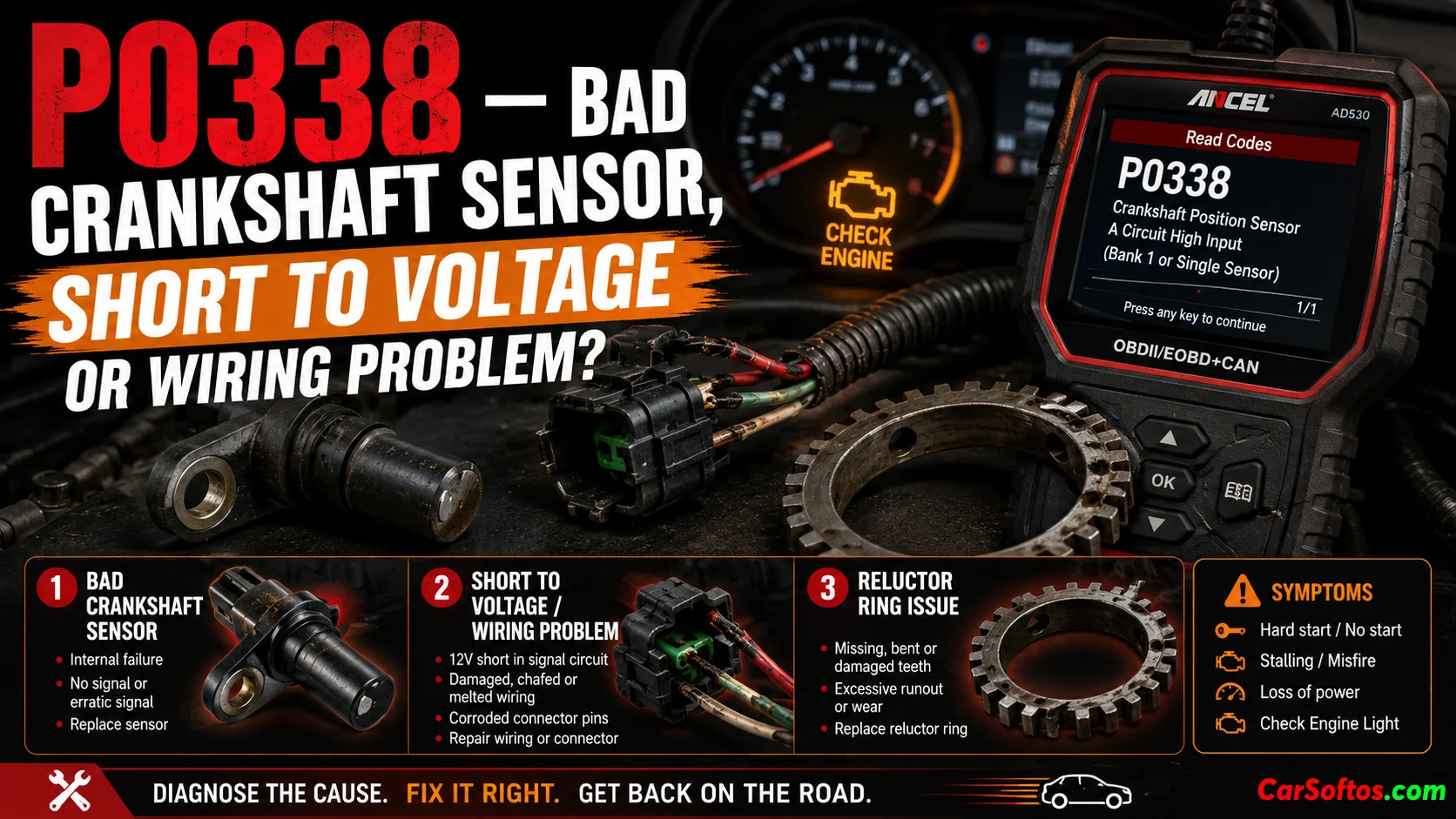
In simple terms, the engine computer sees the crankshaft position sensor signal as too high, stuck high, shorted to voltage, or outside the expected high-side limit. CarParts describes P0338 as a code set when the PCM detects a CKP sensor voltage signal that is too high, and Kovsh describes it as a high signal level or short to +12V in the CKP “A” circuit.
👉 Simple explanation:
The ECU is saying:
- the crankshaft sensor signal is higher than expected
- the signal may be stuck near battery voltage or reference voltage
- the signal wire may be shorted to power
- the sensor may be internally faulty
- the ECU may not trust engine RPM / crank position
- the engine may stall, misfire, or fail to start
P0338 is different from P0337. P0337 means the crank sensor signal is too low. P0338 means the signal is too high. Diagnostic references commonly associate P0338 with short-to-voltage, open/shorted wiring, damaged connectors, failed CKP sensor, reluctor/air-gap issues, or rare ECU/PCM faults.
⚙️ What the Crankshaft Position Sensor Does
The crankshaft position sensor, also called the CKP sensor, tells the ECU:
- engine RPM
- crankshaft position
- piston position reference
- ignition timing reference
- fuel injection timing reference
- misfire detection reference
The CKP sensor reads a reluctor wheel, tone ring, trigger wheel, crank pulley target, flywheel target, or crankshaft teeth. As the teeth pass the sensor, the sensor creates a signal that the ECU uses as the engine’s timing reference. The CKP sensor scans the grooves/teeth of the reluctor ring, and the PCM translates that signal into crankshaft speed and position.
💡 Why this matters:
If the crank signal is stuck high or electrically corrupted, the ECU may not know the true crankshaft position. That can cause:
- no start
- hard start
- sudden stalling
- random misfires
- loss of injector pulse
- loss of spark control
- unstable RPM signal
- limp mode on some vehicles
⚠️ How Serious Is P0338?
Severity: ⭐⭐⭐⭐⭐ High / Critical
P0338 should be treated seriously because the crankshaft position signal is one of the most important signals in the engine-management system.
🚨 Why it matters:
- the engine may crank but not start
- the engine can stall while driving
- ignition and fuel injection timing can be disrupted
- misfires can damage the catalytic converter
- the car may become unreliable or leave you stranded
- if the signal wire is shorted to voltage, ECU input damage is possible in rare cases
P0338 as severe because it may trigger a no-start condition and may prevent the engine from starting in the future even if it currently starts.
🚫 Stop driving if:
- engine stalls randomly
- tachometer drops or jumps
- car is hard to restart
- engine misfires badly
- Check Engine Light flashes
- vehicle loses power in traffic
🚨 Common Symptoms of P0338
Typical symptoms include:
- ⚠️ Check Engine Light
- ⚠️ hard starting
- ⚠️ crank-no-start
- ⚠️ intermittent stalling
- ⚠️ engine shuts off when hot
- ⚠️ rough idle
- ⚠️ random misfires
- ⚠️ poor acceleration
- ⚠️ reduced engine power
- ⚠️ tachometer jumps or drops
- ⚠️ unstable RPM signal on scan tool
- ⚠️ no injector pulse / no spark on some vehicles
Even general CKP circuit fault references describe similar symptoms: no start, rough or unstable idle, stalling or hesitation, reduced acceleration, and poor fuel economy.
🔥 Real-World Pattern
| Pattern | Most likely direction |
|---|---|
| P0338 + no-start | CKP signal stuck high, short to voltage, bad sensor, ECU input issue |
| P0338 after engine wiring repair | signal wire shorted to 5V/12V, wrong pinout, connector issue |
| P0338 after sensor replacement | wrong sensor, bad aftermarket sensor, poor connector fit, wiring still faulty |
| Stalls when hot, restarts later | heat-sensitive CKP sensor or connector |
| Tachometer jumps high/erratic | noisy or high CKP signal, wiring interference |
| P0338 + P0340/P0341 | crank/cam synchronization or shared wiring issue |
| P0338 appears immediately KOEO | short to voltage, sensor signal stuck high, ECU input problem |
| Code only at high RPM | waveform distortion, air gap, reluctor damage, electrical noise |
| P0338 with misfire codes | CKP signal corruption affecting ignition/fuel timing |
🧠 Most Common Causes of P0338
1️⃣ Short to voltage in the CKP signal circuit — very important 🔌
Because P0338 = high input, the signal wire being shorted to voltage is one of the most important checks.
Possible causes:
- signal wire shorted to 5V reference
- signal wire shorted to battery voltage
- melted harness near exhaust
- rubbed-through insulation touching another powered wire
- pinched harness after engine/transmission work
- wrong connector pinout
- poor previous wiring repair
- water intrusion causing voltage cross-feed
In lists open/shorted wiring, including short to battery or ignition voltage, and short to an accessory power feed or ignition-switched supply as P0338 causes.
2️⃣ Faulty crankshaft position sensor — common
The CKP sensor can fail internally and produce a signal that is too high, stuck high, or electrically implausible.
Signs of a bad CKP sensor:
- code returns quickly after clearing
- signal stays high on scope
- engine stalls when hot
- no reliable RPM signal
- sensor power/ground are OK but output is wrong
- known-good sensor fixes the issue
Shop-style diagnostic references commonly list the CKP sensor itself as one of the top causes of P0338.
3️⃣ Corroded, loose or damaged CKP connector 🧩
A poor connector can distort the sensor signal or create intermittent high input.
Check for:
- green corrosion
- oil contamination
- water intrusion
- bent pins
- spread terminals
- loose connector lock
- broken connector shell
- wires pulling out of the back of connector
P0338 references list corroded, loose, or damaged sensor connector pins as a common cause.
4️⃣ Open circuit on some sensor designs
This sounds strange, but some circuits can read high when the signal path is open because the ECU input is pulled up internally or the sensor output floats high.
Possible signs:
- signal reads high with sensor unplugged
- no real waveform on scope
- ECU sees high voltage but no RPM
- continuity test fails between sensor and ECU
This is why P0338 diagnosis must include both short-to-voltage and open-circuit testing. Diagnostic cause lists for P0338 include open or shorted wiring.
5️⃣ Damaged reluctor wheel / tone ring ⚙️
The sensor may be electrically good, but the target wheel may produce a bad waveform.
Possible reluctor problems:
- missing teeth
- bent teeth
- cracked tone ring
- shifted reluctor
- damaged flywheel/flexplate
- wrong flywheel after repair
- rust buildup
- excessive crankshaft endplay
- sensor contacting the reluctor
This explains that the CKP sensor reads the reluctor ring as it spins with the crankshaft, while P0338 cause references include damaged, missing, or cracked tone wheel/reluctor issues and air-gap problems.
6️⃣ Incorrect sensor air gap or wrong sensor installation 📏
The CKP sensor must be mounted at the correct distance from the reluctor/tone wheel. If the gap is wrong, the waveform can become distorted and interpreted as invalid or high.
Possible causes:
- sensor not fully seated
- dirt/rust under mounting surface
- wrong sensor length
- missing spacer/shim
- damaged bracket
- sensor touching the reluctor
- aftermarket sensor with wrong dimensions
This is especially important if P0338 appeared after replacing the crank sensor.
7️⃣ Electrical noise / shielding problem 📡
Some CKP circuits are sensitive to electrical interference. A noisy waveform can create extra pulses or high spikes that the ECU interprets as high input.
Possible sources:
- damaged shielded wiring
- poor sensor ground
- alternator ripple
- ignition coil interference
- harness routed near high-current wires
- bad engine ground
- aftermarket alarm/remote-start wiring
- ECU calibration sensitivity
A crank sensor waveform should be clean and consistent; oscilloscope examples show how waveform shape and pulse pattern are central to CKP diagnosis.
8️⃣ Poor PCM/ECU ground or rare ECU input fault
If the ECU ground reference is poor, it may misread the CKP signal. A failed ECU input circuit is possible, but it is much less common than sensor, wiring, connector, air-gap, or reluctor problems.
Suspect ECU only after:
- CKP sensor tests good
- connector is good
- wiring continuity is good
- no short to voltage exists
- waveform is correct at sensor but wrong at ECU
- ECU powers and grounds test correctly
P0338 references list PCM/ECU internal fault or poor ground at PCM as possible causes, but this should be a late-stage diagnosis.
⚡ P0338 vs P0335 / P0336 / P0337 / P0339
| Code | Meaning | Simple explanation |
|---|---|---|
| P0335 | CKP Sensor “A” Circuit | general crank sensor circuit fault |
| P0336 | CKP Sensor “A” Range/Performance | signal pattern is implausible/out of range |
| P0337 | CKP Sensor “A” Low Input | signal voltage is too low or missing |
| P0338 | CKP Sensor “A” High Input | signal voltage is too high or stuck high |
| P0339 | CKP Sensor “A” Intermittent | signal cuts in and out |
👉 Simple explanation:
- P0335 = general CKP circuit problem
- P0336 = wrong/implausible crank signal pattern
- P0337 = crank signal too low
- P0338 = crank signal too high
- P0339 = crank signal intermittent
P0338 should make you think first about short to voltage, signal stuck high, wrong sensor output, connector/wiring problems, or ECU input misreading the signal.
🔧 Step-by-Step Diagnosis
1️⃣ Scan all codes and freeze-frame data
Do not diagnose P0338 alone.
Look for:
- P0335 / P0336 / P0337 / P0339
- P0340 / P0341 camshaft sensor codes
- P0016–P0019 cam/crank correlation codes
- P0300–P0308 misfire codes
- low-voltage or ECU power/ground codes
- immobilizer or no-start codes
Freeze-frame data tells you when the code appeared:
- key on / engine off
- cranking
- hot restart
- idle
- high RPM
- acceleration
- after engine/transmission repair
2️⃣ Check RPM signal while cranking
Use a scan tool.
| Scan tool RPM while cranking | Likely direction |
|---|---|
| 0 RPM | ECU is not receiving usable crank signal |
| erratic RPM | noisy/high CKP signal, wiring, reluctor, sensor issue |
| RPM jumps unrealistically | signal spikes, short, noise, wrong waveform |
| normal RPM but no start | check fuel, spark, cam sync, immobilizer too |
P0338 can still allow a temporary start, but the risk of future no-start is high.
3️⃣ Inspect connector and harness visually
Before replacing the sensor, inspect:
- CKP connector fully seated
- connector lock broken
- oil/coolant/water intrusion
- bent or spread pins
- corrosion
- harness touching exhaust
- harness near starter or alternator
- harness near crank pulley
- pinched wires after repair
- previous splices or non-OEM wiring
High input is often electrical, so visual inspection is not optional.
4️⃣ Identify sensor type: Hall-effect or magnetic/VR
Testing depends on sensor type.
Hall-effect CKP sensor
Usually has:
- power
- ground
- signal
It often produces a digital square-wave signal.
Magnetic / VR CKP sensor
Usually has:
- two signal wires
- AC waveform
- amplitude increases with RPM
Why it matters:
A Hall sensor signal stuck high often points to short to voltage, missing ground, failed sensor, or open signal return. A VR sensor high/abnormal signal may be related to waveform spikes, air gap, wiring noise, or reluctor problems.
5️⃣ Test for short to voltage
This is the key test for P0338.
With wiring diagram:
- unplug CKP sensor
- check signal wire voltage
- compare to expected spec
- check for short to 5V reference
- check for short to battery voltage
- check continuity to ECU
- check resistance to power wires
- wiggle harness while monitoring voltage
If the signal wire has voltage when it should not, repair the harness before replacing the sensor.
6️⃣ Check power and ground
For 3-wire sensors:
- verify 5V or 12V feed
- verify sensor ground
- check voltage drop on ground
- check signal pull-up behavior
- compare sensor output while cranking
A bad ground can make the signal appear high because the sensor cannot pull the signal low correctly.
7️⃣ Use an oscilloscope if possible
A scope is the best tool for P0338 because it shows whether the signal is truly high, stuck, noisy, or distorted.
Look for:
- signal stuck high
- no low transitions
- voltage spikes
- abnormal amplitude
- missing pulses
- extra pulses
- waveform changes when harness is moved
- waveform drops out when hot
A proper crank waveform should have a consistent pattern that matches the reluctor wheel; waveform analysis is one of the strongest methods for crank sensor diagnosis.
8️⃣ Inspect sensor mounting and air gap
Remove the sensor if accessible.
Check:
- correct sensor part number
- sensor fully seated
- mounting surface clean
- no rust under sensor
- no broken O-ring
- no rub marks on sensor tip
- correct air gap
- no metal debris on sensor tip
If the sensor has physical damage or rub marks, inspect the reluctor wheel carefully.
9️⃣ Inspect reluctor wheel / tone ring
If wiring and sensor look good, inspect the target.
Look for:
- cracked reluctor ring
- shifted tone ring
- bent teeth
- missing teeth
- rust buildup
- damaged flexplate/flywheel
- harmonic balancer movement
- crank pulley damage
- wrong parts after repair
This is crucial if P0338 returns after a new sensor.
🔟 Check cam/crank sync and related timing codes
If P0338 appears with camshaft or correlation codes:
- verify timing belt/chain alignment
- check cam sensor signal
- compare cam and crank waveforms
- inspect VVT actuator behavior
- check reluctors on cam and crank
The ECU may reject crank signal data if it does not make sense compared with camshaft position.
🛠️ How to Fix P0338
✔️ Repair CKP signal wire short to voltage
If the signal wire is shorted to 5V, 12V, or another powered circuit.
💰 Typical cost: $80–$500+
✔️ Replace crankshaft position sensor
If the sensor output is stuck high or fails testing.
💰 Typical cost: $120–$400 installed
✔️ Repair CKP connector
If terminals are corroded, loose, bent, or oil/water contaminated.
💰 Typical cost: $50–$250
✔️ Correct ground problem
If poor sensor/ECU ground causes the signal to read high.
💰 Typical cost: $50–$300+
✔️ Correct sensor air gap or installation
If the sensor is wrong, not seated, or mounted with an incorrect gap.
💰 Typical cost: $50–$250
✔️ Repair reluctor wheel / tone ring / flywheel
If the target wheel is damaged, cracked, shifted, or rubbing.
💰 Typical cost: $300–$1,500+
✔️ Perform crankshaft relearn / software procedure if required
Some vehicles require a relearn after CKP sensor replacement, ECU replacement, timing work, or engine repair.
💰 Typical cost: $80–$200
✔️ ECU/PCM repair or replacement
Rare, only after full circuit diagnosis.
💰 Typical cost: $500–$1,500+
💰 Repair Cost Summary
| Repair | Typical cost |
|---|---|
| Diagnostic scan / RPM check | $80–$200 |
| CKP sensor replacement | $120–$400 |
| Signal wire / harness repair | $80–$500+ |
| Connector pigtail repair | $50–$250 |
| Ground repair | $50–$300+ |
| Air gap / mounting correction | $50–$250 |
| Crank relearn / software procedure | $80–$200 |
| Reluctor / flywheel / tone ring repair | $300–$1,500+ |
| ECU/PCM repair or replacement | $500–$1,500+ |
❗ Common Mistakes
❌ Replacing the crank sensor without checking for short to voltage
P0338 specifically points toward a high input. Wiring must be checked.
❌ Confusing P0338 with P0337
- P0337 = low signal / short to ground
- P0338 = high signal / short to voltage
The diagnostic direction is different.
❌ Ignoring connector ground problems
A missing ground can make a Hall-effect signal stay high.
❌ Using cheap incorrect sensors
Wrong sensor length, wrong internal design, or poor aftermarket waveform quality can bring P0338 back.
❌ Skipping oscilloscope testing
A multimeter may miss signal spikes, stuck-high waveform behavior, and intermittent dropouts.
❌ Ignoring reluctor wheel damage
A damaged reluctor can create abnormal pulses even when the sensor is new.
❌ Replacing ECU too early
ECU input failure is possible, but sensor/wiring/connector/ground faults are far more common.
🚗 Can You Drive With P0338?
Usually not recommended.
You might be able to drive briefly if the engine runs normally, but P0338 can become a sudden stall or no-start problem.
You may drive only short-term if:
- engine starts normally
- RPM signal is stable
- no stalling
- no heavy misfire
- Check Engine Light is steady
- vehicle is not losing power
Do not drive if:
- engine stalls
- car is hard to restart
- tachometer jumps or drops
- engine misfires badly
- Check Engine Light flashes
- vehicle shuts off when hot
- scan tool RPM is erratic
🚨 Risks of ignoring P0338:
- sudden engine stall
- crank-no-start
- incorrect ignition/fuel timing
- misfire damage
- catalytic converter damage
- possible ECU input damage if the circuit is shorted
- being stranded
📌 Final Verdict
P0338 means the ECU sees the crankshaft position sensor “A” signal as too high or stuck high. This can be caused by a failed crank sensor, but the most important diagnostic direction is checking for short to voltage, damaged wiring, poor ground, connector problems, wrong sensor installation, or a corrupted waveform.
Most common real causes:
- faulty crankshaft position sensor
- CKP signal wire shorted to voltage
- corroded or loose connector
- open circuit causing signal to float high
- missing sensor/ECU ground
- incorrect sensor air gap
- damaged reluctor wheel / tone ring
- electrical noise on CKP signal
- rare ECU/PCM input fault
💡 Key takeaway:
- P0338 = crank sensor high input
- Check for short to voltage first
- Inspect connector, ground and wiring before replacing parts
- Use scan-tool RPM and oscilloscope waveform
- A new sensor will not fix a damaged reluctor or shorted harness
- Do not ignore stalling or no-start symptoms
come back