P0336 — Bad Crankshaft Sensor, Wiring Problem or Reluctor Ring Damage?
30-05-2026, 02:46. Posted by: carsoftos777
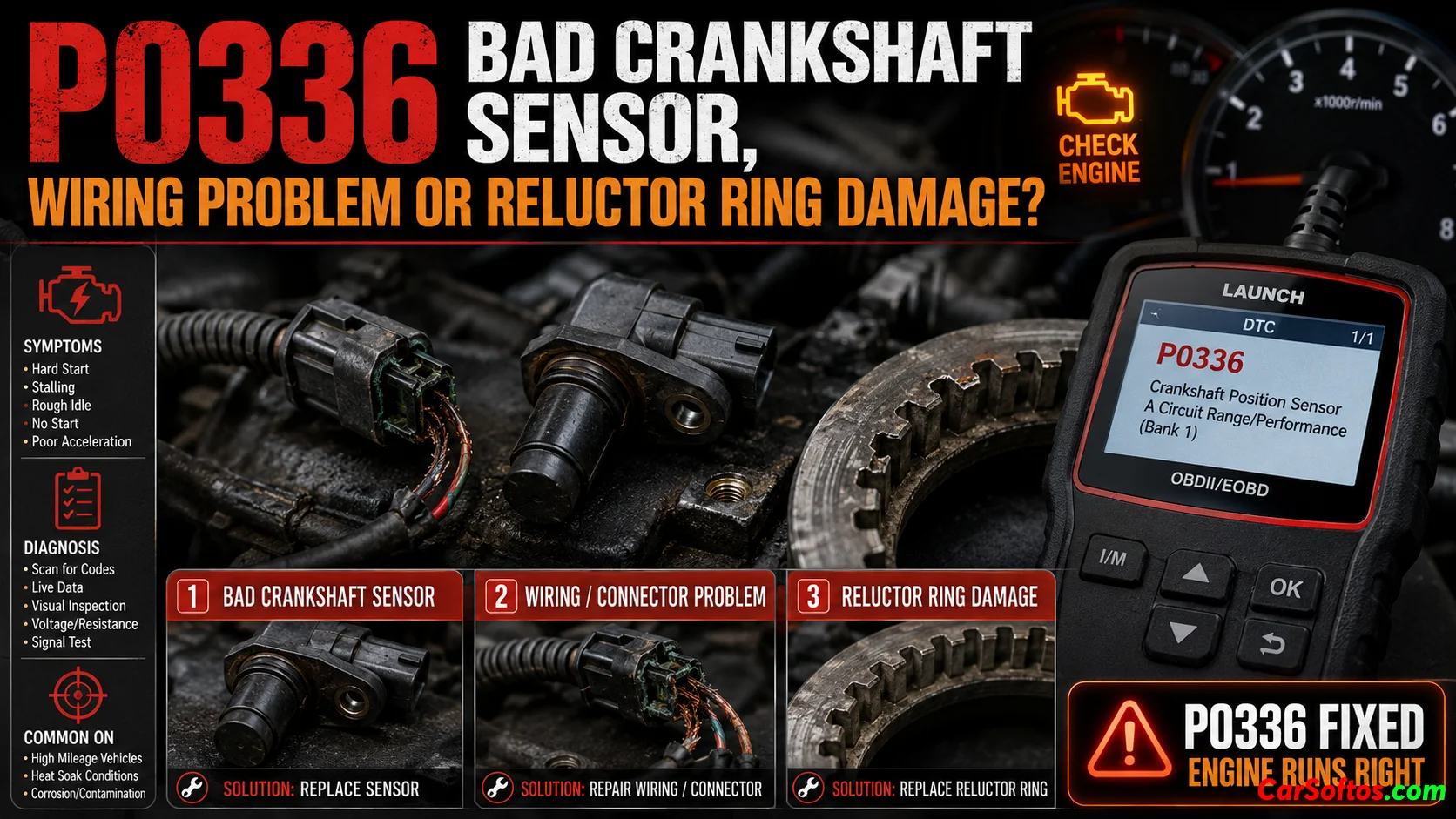
🔍 What Does P0336 Mean?
P0336 is the generic OBD-II code for:
Crankshaft Position Sensor “A” Circuit Range/Performance
In simple terms, the engine computer sees a crankshaft position signal that is not within the expected range, is irregular, or does not match what the ECU expects from engine speed and camshaft timing. Toyota hybrid service information describes P0336 as a crankshaft position sensor “A” circuit range/performance fault, where the control ECU detects a malfunction by comparing communication values or pulse inputs.
👉 Simple explanation:
The ECU is saying:
- the crankshaft sensor signal exists, but it does not look correct
- the signal may be missing pulses, adding extra pulses, or arriving at the wrong time
- the crankshaft and camshaft signals may not agree
- the engine may start badly, stall, misfire, or not start at all
This is why P0336 is different from a simple “sensor unplugged” code. It is often about signal quality, timing accuracy, or pulse pattern plausibility.
⚙️ What the Crankshaft Position Sensor Does
The crankshaft position sensor, often called the CKP sensor, tells the ECU:
- crankshaft speed
- crankshaft position
- engine RPM
- piston position reference
- when to fire ignition
- when to inject fuel
- whether the engine is misfiring
Most CKP systems read a reluctor wheel, tone ring, trigger wheel, or teeth on the crankshaft/flywheel. As the teeth pass the sensor, the sensor generates a signal. The ECU uses that signal to synchronize ignition timing, fuel injection, camshaft correlation and misfire detection.
A service bulletin from GM explains P0336 logic well: the crank sensor performance diagnostic compares crank sensor pulses to cam sensor pulses and sets the fault if pulses are out of range; in that bulletin, electrical noise caused too many crank pulses.
💡 Why this matters:
If the crank signal is wrong, the ECU may not know exactly where the engine is in its rotation. That can cause:
- no start
- hard start
- stalling
- random misfire
- wrong ignition timing
- poor fuel injection timing
- limp mode
- unstable RPM signal
⚠️ How Serious Is P0336?
Severity: ⭐⭐⭐⭐⭐ High / Critical
P0336 can be serious because the crankshaft position signal is one of the most important signals in the entire engine-management system.
🚨 Why it matters:
- engine may stall suddenly
- vehicle may crank but not start
- misfires can damage the catalytic converter
- timing/fuel synchronization may be wrong
- intermittent CKP signal can leave the driver stranded
- some engines may shut off when the signal drops out
Symptoms listed by diagnostic references include MIL illumination, hard starting, crank-no-start, stalling, rough idle, misfire, reduced power and erratic RPM signal.
🚫 Stop driving if:
- engine stalls while driving
- tachometer drops suddenly
- Check Engine Light flashes
- engine misfires badly
- vehicle loses power in traffic
- car starts only sometimes
🚨 Common Symptoms of P0336
Typical symptoms include:
- ⚠️ Check Engine Light
- ⚠️ hard starting
- ⚠️ crank-no-start
- ⚠️ intermittent stalling
- ⚠️ engine shuts off when hot
- ⚠️ rough idle
- ⚠️ misfires
- ⚠️ hesitation under load
- ⚠️ reduced power
- ⚠️ poor fuel economy
- ⚠️ tachometer drops or jumps
- ⚠️ RPM signal missing or erratic on scan tool
P0336 guide lists Check Engine Light, misfires, stalling, rough idle, difficulty starting, reduced power and possible no-start as symptoms.
🔥 Real-World Pattern
| Pattern | Most likely direction |
|---|---|
| Crank-no-start + P0336 | CKP sensor signal missing/invalid, wiring, reluctor |
| Stalls when hot, restarts later | heat-sensitive CKP sensor or connector |
| P0336 after timing work | reluctor/timing/cam-crank correlation issue |
| Erratic RPM on scan tool | CKP signal dropout, noise, wiring issue |
| P0336 + P0340/P0341 | crank/cam correlation or timing issue |
| P0336 after sensor replacement | air gap, wrong sensor, wiring, relearn needed |
| P0336 only at high RPM | signal noise, damaged reluctor, sensor gap issue |
| P0336 with misfires | CKP signal instability affecting timing/misfire detection |
| P0336 after engine repair | connector not seated, harness pinched, reluctor damage |
🧠 Most Common Causes of P0336
1️⃣ Faulty crankshaft position sensor — very common
The sensor itself can fail internally, especially when hot. Some crank sensors work cold but fail as temperature rises.
Signs of a bad CKP sensor:
- engine stalls when hot
- starts again after cooling
- no RPM signal while cranking
- waveform drops out
- code returns after clearing
- sensor resistance or signal is out of spec
Diagnostic references list a faulty CKP sensor as one of the primary causes of P0336.
2️⃣ Damaged wiring or corroded connector 🔌
Because P0336 is a circuit range/performance code, wiring and connector inspection are critical.
Possible wiring issues:
- open circuit
- short to ground
- short to power
- high resistance
- poor terminal tension
- corrosion
- oil contamination
- heat-damaged insulation
- harness rubbing near pulleys or exhaust
- pinched harness after repairs
P0336 diagnostic references list damaged or corroded sensor connectors and wiring, including open/short/high resistance, as common causes.
Pattern clue:
If the engine cuts out when the harness is moved, suspect connector or wiring before replacing the ECU.
3️⃣ Incorrect sensor air gap or misalignment 📏
The crank sensor must sit at the correct distance from the reluctor wheel. If the air gap is wrong, the signal can be weak, noisy or distorted.
Possible reasons:
- sensor not fully seated
- dirt/rust under mounting surface
- wrong aftermarket sensor
- damaged sensor bracket
- missing spacer/shim
- reluctor wheel wobble
- incorrect installation
P0336 cause lists commonly include incorrect sensor air gap or sensor misalignment.
Important:
This is a big reason why P0336 can return after replacing the sensor.
4️⃣ Damaged reluctor / trigger wheel teeth ⚙️
The reluctor wheel creates the pulse pattern the ECU reads. If teeth are missing, bent, cracked, rusty, contaminated or misaligned, the ECU may see an incorrect pulse pattern.
Possible reluctor issues:
- missing tooth
- bent tooth
- cracked tone ring
- damaged flywheel/flexplate teeth
- reluctor shifted on crankshaft
- excessive crankshaft endplay
- metal debris on magnetic sensor
- incorrect trigger wheel after engine swap
Generic diagnostic references list damaged or missing teeth on the reluctor/trigger wheel as a P0336 cause.
Pattern clue:
If the sensor and wiring test good but the waveform has one distorted section every revolution, inspect the reluctor wheel.
5️⃣ Metal debris, oil or contamination on the sensor tip 🧲
Many crank sensors are magnetic or sit near rotating metal. Metal shavings can collect on the sensor tip and distort the signal.
Common contamination sources:
- clutch/flywheel debris
- timing chain wear particles
- engine metal debris
- rust particles
- oil sludge
- damaged reluctor wheel material
P0336 cause lists include oil, metal debris or contamination on the sensor or reluctor.
6️⃣ Crank/cam signal disagreement
The ECU often compares crankshaft position to camshaft position. If the signals disagree, P0336 can appear even when the crank sensor is not the only problem.
Possible causes:
- stretched timing chain
- jumped timing belt
- camshaft sensor fault
- VVT actuator issue
- damaged cam/crank reluctor
- incorrect timing after repair
- sensor synchronization issue
GM’s bulletin explains that P0336 diagnostic logic compares crank pulses to cam pulses and sets the fault if the pulses are out of range.
7️⃣ Electrical noise on the CKP signal line 📡
Sometimes the crank sensor signal is not missing — it is noisy. Electrical interference can create extra pulses or distorted waveform patterns.
Possible sources:
- damaged shielding
- bad sensor ground
- ignition coil interference
- alternator noise
- poor engine ground
- harness routed near high-voltage wires
- aftermarket alarm/remote-start wiring
- ECU calibration sensitivity
GM published a bulletin where P0336 could be set because noise on the crank sensor line resulted in too many pulses; the correction was an ECM calibration update.
8️⃣ Weak battery, starter or cranking-speed issue 🔋
During starting, the ECU needs a clean CKP signal. Low voltage or slow/irregular cranking can make the signal unstable.
Check:
- battery voltage
- starter draw
- engine ground straps
- voltage drop during cranking
- corroded battery terminals
- weak alternator
This is especially important if P0336 appears mostly during starting.
9️⃣ ECU/PCM software or module issue — rare, but real
A failed ECU/PCM input circuit is possible, but should be diagnosed last. However, software can matter on specific vehicles.
GM service bulletins show that some P0336 conditions were corrected by ECM calibration updates rather than sensor replacement. One bulletin states that revised calibration was released to address P0336 caused by crank sensor line noise.
Rule:
Do not replace the ECU before checking:
- sensor
- wiring
- connector
- air gap
- reluctor
- waveform
- battery/grounds
- relevant TSBs
⚡ P0336 vs Related Crank/Cam Codes
| Code | Meaning | Simple explanation |
|---|---|---|
| P0335 | CKP Sensor “A” Circuit | general crank sensor circuit fault |
| P0336 | CKP Sensor “A” Range/Performance | signal exists but is implausible/out of range |
| P0337 | CKP Sensor “A” Low Input | signal too low |
| P0338 | CKP Sensor “A” High Input | signal too high |
| P0339 | CKP Sensor “A” Intermittent | signal cuts in and out |
| P0340 | Camshaft Position Sensor Circuit | cam sensor circuit issue |
| P0341 | Camshaft Position Sensor Range/Performance | cam signal implausible |
| P0016 | Crank/Cam Correlation | crank and cam timing do not agree |
👉 Simple explanation:
- P0335 = crank sensor circuit problem
- P0336 = crank signal pattern/performance problem
- P0337/P0338 = signal too low/high
- P0339 = intermittent crank signal
- P0016 = crank/cam timing correlation problem
🔧 Step-by-Step Diagnosis
1️⃣ Scan all codes and freeze-frame data
Do not diagnose P0336 alone.
Look for:
- P0335 / P0337 / P0338 / P0339
- P0340 / P0341 cam sensor codes
- P0016–P0019 crank/cam correlation codes
- misfire codes P0300–P0308
- low-voltage codes
- immobilizer or no-start codes
Freeze-frame data tells you when the fault happened:
- during cranking
- at idle
- while hot
- under acceleration
- at high RPM
- during deceleration
2️⃣ Check RPM signal while cranking
Use a scan tool.
During cranking, the ECU should show a stable RPM value. If RPM stays at 0, the ECU may not be receiving a valid crank signal.
Result clues:
| Scan tool RPM during crank | Likely direction |
|---|---|
| 0 RPM | missing CKP signal, sensor/wiring/ECU input |
| erratic RPM | noisy signal, damaged reluctor, wiring issue |
| normal RPM but no start | check fuel/spark/cam sync/immobilizer too |
3️⃣ Inspect CKP sensor connector and wiring
Look carefully at:
- connector lock
- oil contamination
- corrosion
- bent pins
- loose terminals
- broken shielding
- harness near crank pulley
- harness near exhaust
- harness near starter
- previous repair splices
Wiggle-test the harness while watching RPM or waveform.
4️⃣ Check sensor power, ground and signal
Different sensors work differently:
- Hall-effect CKP sensor: usually has power, ground and signal
- Magnetic/VR CKP sensor: often has two wires and generates AC voltage
Use the correct wiring diagram.
Check:
- 5V or 12V supply if used
- sensor ground
- signal output
- continuity to ECU
- short to ground
- short to power
- resistance if service manual specifies it
- voltage drop during cranking
5️⃣ Use an oscilloscope if possible
A scope is the best tool for P0336 because this is often a signal quality problem.
Look for:
- missing pulses
- extra pulses
- weak amplitude
- distorted waveform
- noise spikes
- dropout when hot
- irregular pattern once per crank revolution
FS1 notes that the sensor generates a voltage waveform that the ECM expects to stay within a defined range, and spikes or drops can trigger P0336.
6️⃣ Inspect sensor air gap and mounting
Remove and inspect the sensor if accessible.
Check:
- sensor seated fully
- mounting bolt tight
- no rust/debris under sensor
- no cracked sensor body
- correct sensor length
- correct O-ring
- no physical contact with reluctor
- no excessive gap
If the sensor has rub marks, inspect the reluctor and crank/flywheel movement.
7️⃣ Inspect reluctor wheel / flywheel / crank pulley
If the signal waveform is distorted, inspect the target wheel.
Check for:
- missing teeth
- bent teeth
- cracked reluctor
- rust buildup
- metal debris
- shifted tone ring
- damaged flexplate
- wrong flywheel after repair
- crankshaft endplay
This step is critical when a new sensor does not fix P0336.
8️⃣ Check cam/crank correlation
If P0336 appears with cam sensor or correlation codes:
- check timing belt/chain alignment
- check VVT actuator operation
- inspect cam/crank reluctors
- compare cam and crank waveforms
- verify mechanical timing
A crank sensor can be good, but the ECU may still reject the signal if it does not agree with cam timing.
9️⃣ Check battery, grounds and starter behavior
Especially if the code appears during start.
Test:
- battery voltage while cranking
- starter current draw
- engine ground voltage drop
- ECU ground voltage drop
- alternator ripple
- battery terminal condition
Poor voltage can create weak or unstable sensor signals.
🔟 Check TSBs and relearn requirements
Some vehicles need a crankshaft variation relearn after sensor replacement, engine work, crankshaft work, timing work or ECU replacement. Some platforms also have software updates for P0336 sensitivity or signal noise.
GM has published P0336 bulletins involving ECM calibration updates and crank sensor performance diagnostics.
🛠️ How to Fix P0336
✔️ Replace crankshaft position sensor
If the sensor fails testing or signal drops out.
💰 Typical cost: $120–$400 installed
✔️ Repair CKP wiring or connector
If wiring is open, shorted, corroded or heat damaged.
💰 Typical cost: $80–$500+
✔️ Clean sensor tip / reluctor area
If metal debris or contamination is present.
💰 Typical cost: $50–$200
✔️ Correct sensor air gap / installation
If sensor is not seated, wrong sensor is installed, or mounting surface is dirty.
💰 Typical cost: $50–$250
✔️ Repair reluctor wheel / flywheel / tone ring
If teeth are damaged, missing or the ring is shifted.
💰 Typical cost: $300–$1,500+
✔️ Repair timing problem
If crank/cam correlation shows timing belt/chain/VVT issue.
💰 Typical cost: $500–$2,500+
✔️ Perform crankshaft variation relearn / calibration update
If required after repair or by service bulletin.
💰 Typical cost: $80–$200
✔️ Repair ECU/PCM input circuit
Rare, only after full diagnosis.
💰 Typical cost: $500–$1,500+
💰 Repair Cost Summary
| Repair | Typical cost |
|---|---|
| Diagnostic scan / RPM check | $80–$200 |
| CKP sensor replacement | $120–$400 |
| Connector / wiring repair | $80–$500+ |
| Sensor cleaning / debris removal | $50–$200 |
| Air gap / mounting correction | $50–$250 |
| Crank relearn / software update | $80–$200 |
| Reluctor / flywheel / tone ring repair | $300–$1,500+ |
| Timing chain/belt/VVT repair | $500–$2,500+ |
| ECU/PCM repair or replacement | $500–$1,500+ |
❗ Common Mistakes
❌ Replacing the CKP sensor without checking the reluctor wheel
If the trigger wheel has a damaged tooth or shifted ring, a new sensor will not fix the waveform.
❌ Ignoring wiring near the starter or exhaust
Heat and vibration can damage CKP wiring.
❌ Not checking RPM while cranking
A scan tool RPM check is one of the fastest no-start clues.
❌ Using a cheap wrong sensor
Incorrect sensor length, weak signal quality or wrong connector can cause P0336 to return.
❌ Skipping crankshaft variation relearn
On some vehicles, relearn is needed after sensor or engine work.
❌ Ignoring cam/crank correlation codes
If P0336 appears with P0016/P0340/P0341, the issue may be timing or synchronization, not only the crank sensor.
❌ Driving with intermittent stalling
A crank sensor signal dropout can shut the engine off unexpectedly.
🚗 Can You Drive With P0336?
Only if the engine runs normally and does not stall — but repair it soon.
You may drive carefully for a short time if:
- engine starts normally
- no stalling
- no heavy misfire
- tachometer is stable
- Check Engine Light is steady, not flashing
Do not drive if:
- engine stalls randomly
- vehicle loses power
- RPM signal drops
- engine misfires badly
- car is hard to restart
- Check Engine Light flashes
- the vehicle cranks but sometimes will not start
🚨 Risks of ignoring P0336:
- sudden engine stall
- no-start condition
- misfire damage
- catalytic converter damage
- timing/fuel injection errors
- being stranded
📌 Final Verdict
P0336 means the ECU sees a crankshaft position sensor “A” signal that is out of expected range or not performing correctly. The crank signal may be weak, noisy, missing pulses, adding extra pulses, or not matching the camshaft signal.
Most common real causes:
- faulty crankshaft position sensor
- damaged CKP wiring or connector
- incorrect sensor air gap
- dirty sensor tip or metal debris
- damaged reluctor / trigger wheel
- crank/cam timing disagreement
- electrical noise on the signal line
- weak battery or poor ground during cranking
- rare ECU/PCM calibration or input-circuit issue
💡 Key takeaway:
- P0336 = crank signal range/performance problem
- Check scan-tool RPM while cranking
- Inspect wiring and connector before replacing parts
- Use oscilloscope if the fault is intermittent
- A damaged reluctor wheel can mimic a bad sensor
- Cam/crank correlation matters if timing codes are also present
come back