Can You Drive With P17D0? Audi DSG Clutch Slip Warning Guide
3-05-2026, 00:52. Posted by: carsoftos777
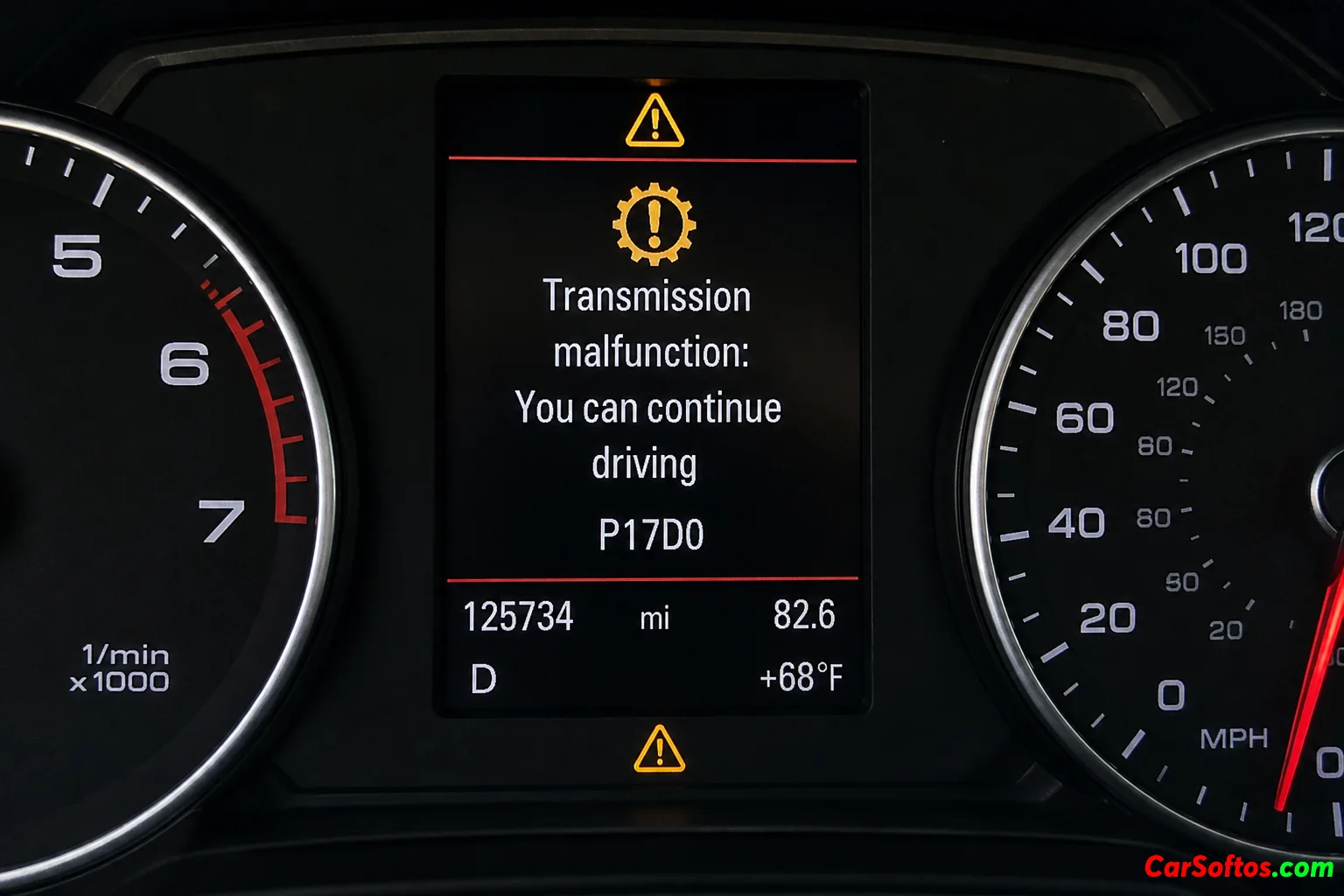
🔍 What Does P17D0 Mean?
P17D0 is a VAG / Audi-specific transmission fault code, most commonly linked to the 0B5 / DL501 7-speed S tronic gearbox.
The common meaning is:
P17D0 — Slippage Too High
Often described as: Clutch 2 Slip Too High
Common 0B5 reference number: 18446
0B5 / DL501 quick-reference material lists P17D0 = Slippage Too High / 18446 and says the repair direction is usually replace clutch, especially when it appears together with P17D8 with DFCC 23235.
👉 In simple words:
The transmission control unit sees that clutch 2 is slipping more than allowed.
That usually means:
- clutch 2 friction plates are worn
- clutch 2 is overheated or glazed
- clutch pressure is not high enough to hold torque
- mechatronic pressure control is unstable
- adaptation has reached its limit
- fluid or hydraulic problems are causing clutch slip
⚙️ What “Clutch 2 Slippage” Means
Audi 0B5 / DL501 S tronic is a wet dual-clutch gearbox. It uses two clutch circuits:
- Clutch 1 / K1
- Clutch 2 / K2
When the gearbox commands clutch 2 to hold torque, input speed and output behavior should match the expected ratio. If clutch 2 cannot hold, the TCU sees excessive slip and stores P17D0.
👉 Simple explanation:
- TCU commands clutch 2 to engage
- clutch 2 should hold torque
- RPM difference stays too high
- TCU detects slip
- P17D0 is stored
Specialist repair references describe P17D0 in the 0B5/DL501 family as Clutch 2 slippage too high, usually near clutch wear, clutch overheating and adaptation-limit faults.
⚠️ How Serious Is P17D0?
Severity: ⭐⭐⭐⭐⭐ Critical
P17D0 is one of the more serious Audi S tronic codes because it means the clutch is not holding properly.
🚨 Why it matters:
- clutch slip creates heat
- heat damages friction plates
- slipping can contaminate fluid
- mechatronic pressure compensation can reach its limit
- the gearbox may enter limp mode
- ignored slip can lead to no-drive condition
A DSG specialist source lists common P17D0 causes as critical clutch 2 wear, clutch overheating under city/load conditions, mechatronic hydraulic block faults, and clutch adaptation errors.
🚨 Common Symptoms of P17D0
Typical symptoms include:
- ⚠️ Gearbox malfunction warning
- ⚠️ PRNDS / transmission warning light
- ⚠️ clutch slip under acceleration
- ⚠️ RPM rises but acceleration is weak
- ⚠️ jerking when pulling away
- ⚠️ shudder / vibration
- ⚠️ delayed Drive or Reverse engagement
- ⚠️ burnt clutch smell
- ⚠️ limp mode
- ⚠️ adaptation/basic settings failure
- ⚠️ worse when hot or in traffic
A specialist P17D0 article lists jerks during takeoff/shifting, burnt clutch smell, delayed throttle response and DSG emergency mode as common signs.
🔥 Real-World Pattern
| Symptom | What it may suggest |
|---|---|
| Slip under hard acceleration | worn clutch 2 / K2 |
| Worse hot or in traffic | clutch overheating or fluid issue |
| P17D0 + P17D8 | clutch slip with temperature protection |
| P17D0 + P1741 | adaptation limit reached |
| P17D0 + P17D7 | pressure compensation issue on clutch 2 |
| Adaptation aborts | clutch wear or hydraulic/mechatronic issue |
In forum support for a 2012 A6 0B5 case advised replacing the clutch set and readapting after oil/actuator checks, which matches the “clutch slip too high” repair direction.
🧠 Most Common Causes of P17D0
1️⃣ Worn clutch 2 / K2 clutch pack — most common
This is the biggest cause.
When clutch 2 friction material wears out, the clutch cannot hold torque properly. The mechatronic may increase pressure to compensate, but eventually the slip becomes too high and P17D0 appears.
Signs of clutch wear:
- slipping under load
- shudder from stop
- adaptation values near limit
- burnt smell
- P1741 / P17D8 nearby
- fluid with friction material contamination
A 0B5 quick-reference source directly lists P17D0 Slippage Too High / Replace Clutch.
2️⃣ Clutch 2 overheating
Clutch slip creates heat, and heat creates more slip — it becomes a cycle.
Common triggers:
- stop-and-go city driving
- aggressive launches
- towing / heavy load
- driving with existing clutch wear
- low or wrong fluid
- poor adaptation
P17D0 is especially serious when it appears with P17D8, because P17D8 means torque limitation due to clutch temperature. The quick-reference material specifically links P17D0 repair direction to cases where it appears together with P17D8/DFCC 23235.
3️⃣ Mechatronic hydraulic pressure problem
P17D0 is often clutch wear, but the mechatronic can also be part of the cause.
Possible mechatronic problems:
- pressure solenoid fault
- valve body hydraulic leakage
- clutch pressure sensor feedback error
- blocked hydraulic passage
- mechatronic repair-kit issue
- clutch pressure regulation instability
A JustAnswer Audi Q5 0B5 case says P17D0 indicates excessive clutch 2 slip and recommends inspecting clutch packs and hydraulic circuits for proper pressure.
4️⃣ Clutch pressure adaptation limit reached
P17D0 often lives close to P1741.
P1741 means the system reached the clutch pressure adaptation limit. In simple words, the mechatronic can no longer compensate for clutch wear by adapting pressure.
👉 Important:
If you see P17D0 + P1741, clutch wear is much more likely than a simple software glitch.
5️⃣ Wrong fluid level, wrong fluid type or degraded fluid
The 0B5/DL501 depends heavily on correct S tronic fluid.
Fluid problems can cause:
- poor clutch cooling
- unstable hydraulic pressure
- increased slip
- failed adaptation
- clutch overheating
- mechatronic valve sticking
Check for:
- wrong fluid
- low fluid
- overfilled fluid
- incorrect fill temperature
- burnt smell
- metal/friction debris
- service history problems
6️⃣ Bad adaptation / basic settings after repair
If P17D0 appears after:
- clutch replacement
- mechatronic repair
- valve body repair
- fluid service
- gearbox swap
then basic settings/adaptation may be incomplete or blocked.
But adaptation alone will not fix:
- worn clutch plates
- burnt clutch material
- hydraulic leakage
- bad pressure sensor
- incorrect clutch pack installation
Forum cases describe clutch slipping and adaptation aborting after valve-body/circuit-board replacement, showing why repair + adaptation must be done correctly together.
7️⃣ Internal clutch piston / seal issue
Even if friction plates are not completely worn, clutch 2 may slip if pressure cannot be applied correctly.
Possible internal causes:
- piston seal leakage
- clutch basket wear
- damaged steel plates
- warped plates from heat
- hydraulic cross-leak
- wrong clutch clearance
These are especially likely if the clutch was already repaired but P17D0 returns.
⚡ P17D0 vs Related Audi Codes
| Code | Meaning |
|---|---|
| P17D0 | Clutch 2 Slippage Too High |
| P17D7 | Clutch 2 Pressure Too High |
| P17D8 | Torque limitation because of clutch temperature |
| P1741 | Clutch Pressure Adaptation Limit Reached |
| P2873 | Clutch 2 Intervention / Pressure Too High |
| P0730 | Incorrect Gear Ratio / Slip |
Specialist Audi transmission repair listings group P17D0, P17D6, P17D7, P1741 and P2873 together as clutch-pressure/slip faults on 0B5/DL501.
👉 Simple explanation:
- P17D0 = clutch 2 is slipping
- P17D7 = clutch 2 pressure is too high
- P17D8 = clutch temperature protection
- P1741 = pressure adaptation limit reached
🔧 Step-by-Step Diagnosis
1️⃣ Scan with VCDS / ODIS
Do not rely only on a generic scanner.
Record:
- full code: P17D0 / P17D000
- fault number: 18446 or other shown symptom code
- static/intermittent status
- freeze-frame data
- clutch temperature
- clutch pressure
- adaptation values
- related DTCs
- gearbox type
A public Audi gearbox DTC document lists P17D000 18446 Clutch 2 slip too high and also P17D000 8963 Clutch 2 slip too high, so exact symptom/fault number matters.
2️⃣ Check related codes
Look for:
- P17D8 — torque limitation because of clutch temperature
- P1741 — clutch pressure adaptation limit reached
- P17D7 — clutch 2 pressure too high
- P2873 — clutch 2 intervention / high pressure
- P0730 — incorrect gear ratio
- P176A–P176D — selector regulation faults
If P17D0 appears with P17D8 or P1741, clutch replacement becomes much more likely.
3️⃣ Check clutch slip live data
With VCDS/ODIS or specialist tools, compare:
- clutch 2 slip
- clutch 2 pressure
- requested vs actual clutch behavior
- RPM difference during acceleration
- clutch temperature
- gear engagement timing
🚨 Red flag:
If slip increases under load while clutch 2 is commanded to hold, the code is likely real clutch slip, not just a sensor problem.
4️⃣ Check clutch adaptation values
Review:
- K1 / K2 adaptation values
- clutch pressure adaptation
- adaptation limits
- whether basic settings complete
- whether clutch 2 reaches limit faster than clutch 1
Quick-reference material provides example adaptation pressure ranges and says values outside range should lead to clutch checks first, then pressure sensor checks if clutch hardware is good.
5️⃣ Inspect fluid level and condition
Check:
- correct S tronic fluid
- correct fill temperature
- low or overfilled level
- burnt smell
- dark fluid
- friction material debris
- metal particles
If the clutch has been slipping, the fluid may show contamination.
6️⃣ Road test gently and log data
During a controlled road test:
- avoid aggressive acceleration
- monitor clutch slip
- monitor clutch temperature
- note whether slip happens hot or cold
- check if slip is worse under load
- compare clutch 1 vs clutch 2 behavior
Do not keep driving hard once slip is confirmed.
7️⃣ Inspect clutch and mechatronic hydraulics
If P17D0 returns:
- inspect clutch 2 pack
- check friction plates and steel plates
- inspect clutch piston/seals
- check clutch basket wear
- inspect mechatronic pressure control
- check hydraulic circuits
- verify repair kit and adaptation procedure
In forums advice in a 0B5 case was to replace the clutch set and readapt after checking oil and actuators.
🛠️ How to Fix P17D0
✔️ Correct fluid level + adaptation
If P17D0 appeared after service or repair, correct fluid level and basic settings first.
💰 Typical cost: $150–$600
But if the clutch is worn, this will not be enough.
✔️ Replace clutch pack / clutch set
This is the most common repair when P17D0 is confirmed.
💰 Typical cost: $1,200–$3,500+
0B5 quick-reference material lists P17D0 as Slippage Too High / Replace Clutch.
✔️ Repair mechatronic hydraulic control
If clutch slip is caused by pressure-control problems:
- repair pressure solenoid
- repair valve body
- repair hydraulic leakage
- repair mechatronic seals
- check pressure sensor feedback
💰 Typical cost: $800–$2,000+
✔️ Replace clutch + mechatronic repair kit together
Often the best repair when both clutch wear and mechatronic pressure problems are present.
💰 Typical cost: $1,800–$4,000+
✔️ Internal gearbox repair
If there is severe clutch damage, warped steel plates, basket damage or internal wear.
💰 Typical cost: $2,500–$6,000+
💰 Repair Cost Summary
| Repair | Typical cost |
|---|---|
| VCDS / ODIS diagnosis | $100–$250 |
| Fluid level correction + adaptation | $150–$600 |
| S tronic fluid service | $250–$600 |
| Mechatronic hydraulic repair | $800–$2,000+ |
| Clutch pack / clutch set replacement | $1,200–$3,500+ |
| Clutch + mechatronic repair together | $1,800–$4,000+ |
| Internal gearbox repair | $2,500–$6,000+ |
❗ Common Mistakes
❌ Treating P17D0 like a simple adaptation issue
If the clutch is physically slipping, adaptation cannot restore worn friction plates.
❌ Replacing only mechatronic when clutch 2 is worn
P17D0 often points strongly to clutch slip. If clutch material is worn, mechatronic repair alone may not last.
❌ Ignoring P17D8 or P1741
P17D8 means clutch temperature protection, and P1741 means pressure adaptation limit. Together with P17D0, they strongly suggest real clutch wear/overheat.
❌ Driving aggressively after the code appears
Every slip event creates heat and damages the clutch further.
❌ Not checking fluid contamination
Slipping clutch can contaminate S tronic fluid with friction material.
❌ Using generic scanner only
You need VCDS/ODIS data for clutch slip, pressure, temperature and adaptation.
🚗 Can You Drive With P17D0?
Only short-term and very gently.
If the car still moves, you may be able to drive slowly to a workshop. But normal driving is risky.
🚨 Avoid:
- hard acceleration
- towing
- launch control
- stop-and-go abuse
- long highway pulls
- driving after gearbox warning returns
Risks of ignoring:
- clutch 2 burns further
- fluid contamination spreads
- mechatronic damage
- no-drive condition
- full gearbox repair
📌 Final Verdict
P17D0 usually means Clutch 2 slip is too high inside the Audi 0B5 / DL501 S tronic gearbox.
Most common real causes:
- worn clutch 2 friction plates
- clutch 2 overheating
- clutch pressure adaptation at limit
- mechatronic hydraulic pressure fault
- wrong fluid level or degraded fluid
- internal leakage or clutch piston seal issue
- failed adaptation after repair
💡 Key takeaway:
- P17D0 = clutch 2 is slipping
- P17D7 = clutch 2 pressure too high
- P17D8 = clutch temperature protection
- P1741 = clutch pressure adaptation limit
come back