P0798 Trouble Code: Pressure Control Solenoid C Electrical Fault Explained
23-04-2026, 01:59. Posted by: carsoftos777
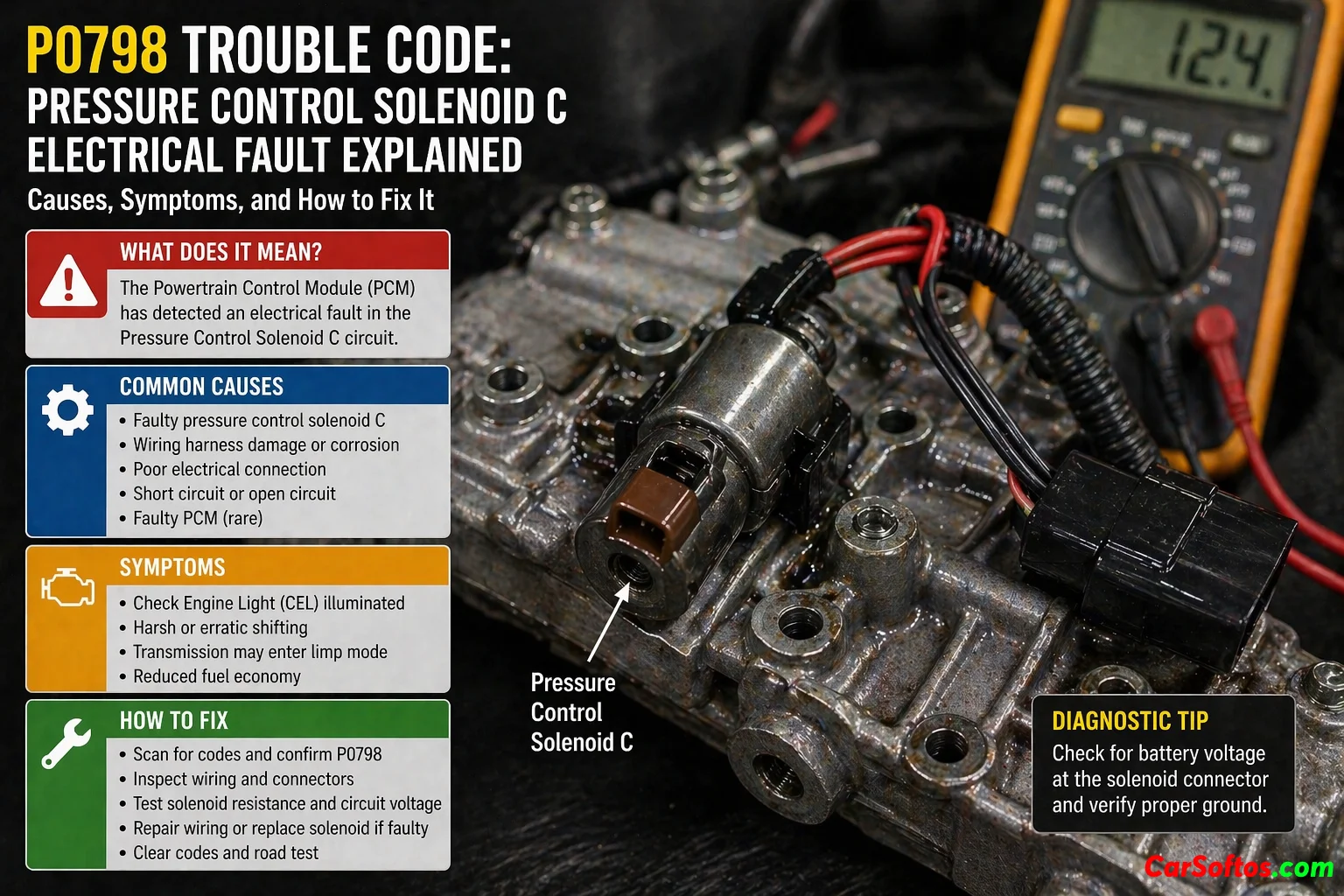
P0798 means Pressure Control Solenoid “C” Electrical. Toyota-style OEM service material for this code family uses the electrical-fault wording when the controller detects an open or short circuit in the solenoid path. One Toyota/Lexus document for the related pressure-control-solenoid C electrical fault states that when an open or short circuit occurs in the solenoid circuit, the ECM detects the issue, stores the code, and activates a fail-safe strategy.
👉 Simple explanation
The controller is not just saying pressure is wrong. It is saying the electrical circuit for solenoid C itself has a problem:
- open circuit
- short circuit
- bad internal solenoid coil
- damaged connector/harness
- sometimes control-module-side fault
⚙️ Why this code matters
Pressure solenoid C is part of the line-pressure control system. If its circuit fails electrically:
- line pressure may default to fail-safe behavior
- shifts may become harsh or delayed
- the transmission may enter limp mode
- some gears may not engage correctly
Toyota-style documents explicitly note that when a shift/pressure solenoid circuit has an open or short, the ECM performs a fail-safe function using the remaining normal solenoids.
⚠️ How serious is P0798?
Severity: High 🚨
P0798 is serious because it is a direct electrical control fault, not just a mild adaptation issue. Generic repair references describe harsh shifting, delayed engagement, limp mode, limited gears, and drivability problems as common results.
🚨 Common symptoms of P0798
Typical symptoms include:
- ⚠️ Check Engine Light or transmission warning light
- ⚠️ harsh shifting
- ⚠️ delayed engagement
- ⚠️ limp mode or backup mode
- ⚠️ inability to shift into some gears
- ⚠️ reduced fuel economy
- ⚠️ unusual transmission noise or abnormal operation on some vehicles
🔥 Real-world pattern
If the transmission suddenly switches to a very harsh or restricted shift pattern and the code is specifically electrical, think solenoid coil / wiring / connector before assuming internal clutch damage. That inference is supported by the OEM wording around open/short detection and fail-safe strategy.
🧠 Most common causes of P0798
1️⃣ Pressure control solenoid C coil failure
The solenoid itself can fail electrically. This is one of the top direct causes because the code specifically targets the solenoid C electrical path.
2️⃣ Open circuit in the harness
An open in the wiring between the TCM/ECM and the solenoid will trigger this kind of code. Toyota/Lexus material explicitly frames the code around open/short detection.
3️⃣ Short circuit to power or ground
A short can also produce the electrical fault condition. Again, this is directly consistent with OEM descriptions of open/short circuit detection.
4️⃣ Corroded or fluid-contaminated connector
Transmission connectors live in a harsh environment. Corrosion, fluid intrusion, spread terminals, or broken locks can create an electrical fault even if the solenoid itself is still good.
5️⃣ Internal transmission harness issue
On many units, the solenoid wiring is partly internal. That means the correct fix may involve an internal harness, not just an external plug repair. This is an inference supported by how OEM transmission-solenoid electrical faults are commonly serviced.
6️⃣ Control module fault, rarely
If the circuit and solenoid test good, the controller side remains possible, though it is usually a later-stage diagnosis.
🔧 Step-by-step diagnosis for P0798
1️⃣ Check for companion transmission codes
Look for:
- P0796 → performance / stuck off
- P0797 → stuck on
- ratio, solenoid, or limp-mode related transmission faults
This helps determine whether the issue is isolated to the solenoid circuit or part of a larger transmission problem.
2️⃣ Inspect connector and harness first
Check:
- corrosion
- fluid intrusion
- broken lock tabs
- rubbed-through insulation
- poor pin fit
Because P0798 is explicitly electrical, this step is higher priority than for P0797.
3️⃣ Measure solenoid resistance
If service information is available, compare solenoid resistance to spec. A failed coil often reveals itself here. This is a standard implication of OEM open/short-circuit fault logic.
4️⃣ Check continuity from module to solenoid
Confirm there is no open or short in the harness. This is one of the most load-bearing tests for an electrical solenoid code.
5️⃣ Only then judge hydraulic / internal issues
P0798 starts with the electrical path. If that path fails testing, repairing it comes before condemning the valve body or transmission. That distinction is the main difference between P0798 and the more hydraulic/performance behavior of P0797/P0796.
🛠️ How to fix P0798
✔️ Replace pressure control solenoid C
If the coil is bad, replacement is the direct fix.
✔️ Repair the harness or connector
If continuity or pin-fit issues are found, wiring repair may solve the code completely.
✔️ Replace internal harness if needed
If the failure is inside the transmission harness path, more involved repair may be required. This is a common implication of solenoid electrical faults on many modern units.
✔️ Diagnose TCM/PCM only after the circuit and solenoid test good
Module replacement should be a later step, not the first guess.
💰 Typical repair cost for P0798
Practical market-style estimates:
| Repair | Typical cost |
|---|---|
| Connector repair / cleaning | $20–$100 |
| Wiring repair | $50–$250 |
| Solenoid replacement | $150–$500 |
| Internal harness repair | $150–$700+ |
| Module diagnosis / replacement if needed | $200–$1,000+ |
These are broad market estimates. The main swing depends on whether the problem is a simple connector issue or requires pan removal/internal harness access. That is consistent with how OEM electrical solenoid faults are diagnosed.
❗ Common mistakes with P0798
❌ Treating it like a hydraulic-only code
P0798 is electrical first. Skipping circuit testing can waste money.
❌ Replacing the whole valve body immediately
Sometimes the fault is just the solenoid or its harness.
❌ Ignoring corrosion in the connector
A small connector issue can mimic a dead solenoid.
🚗 Can you drive with P0798?
Only carefully and short-term.
If the transmission is in fail-safe and shifting harshly, continued driving can still cause wear even if the original problem is electrical.
⚖️ P0797 vs P0798 — the clean distinction
P0797
Pressure Control Solenoid C Stuck On
➡️ More hydraulic / functional behavior-focused.
P0798
Pressure Control Solenoid C Electrical
➡️ More open/short / circuit / coil focused.
👉 Simple explanation:
- P0797 = solenoid acts stuck on
- P0798 = solenoid circuit has an electrical problem
📌 Final verdict
P0798 usually means the pressure control solenoid C circuit has an electrical fault, such as an open, short, bad coil, or wiring/connector problem. OEM-style repair info strongly supports treating this as a circuit diagnosis first.
come back