P0712 Code Explained: Why Your Transmission Temp Signal Is Too Low
19-04-2026, 17:15. Posted by: carsoftos777
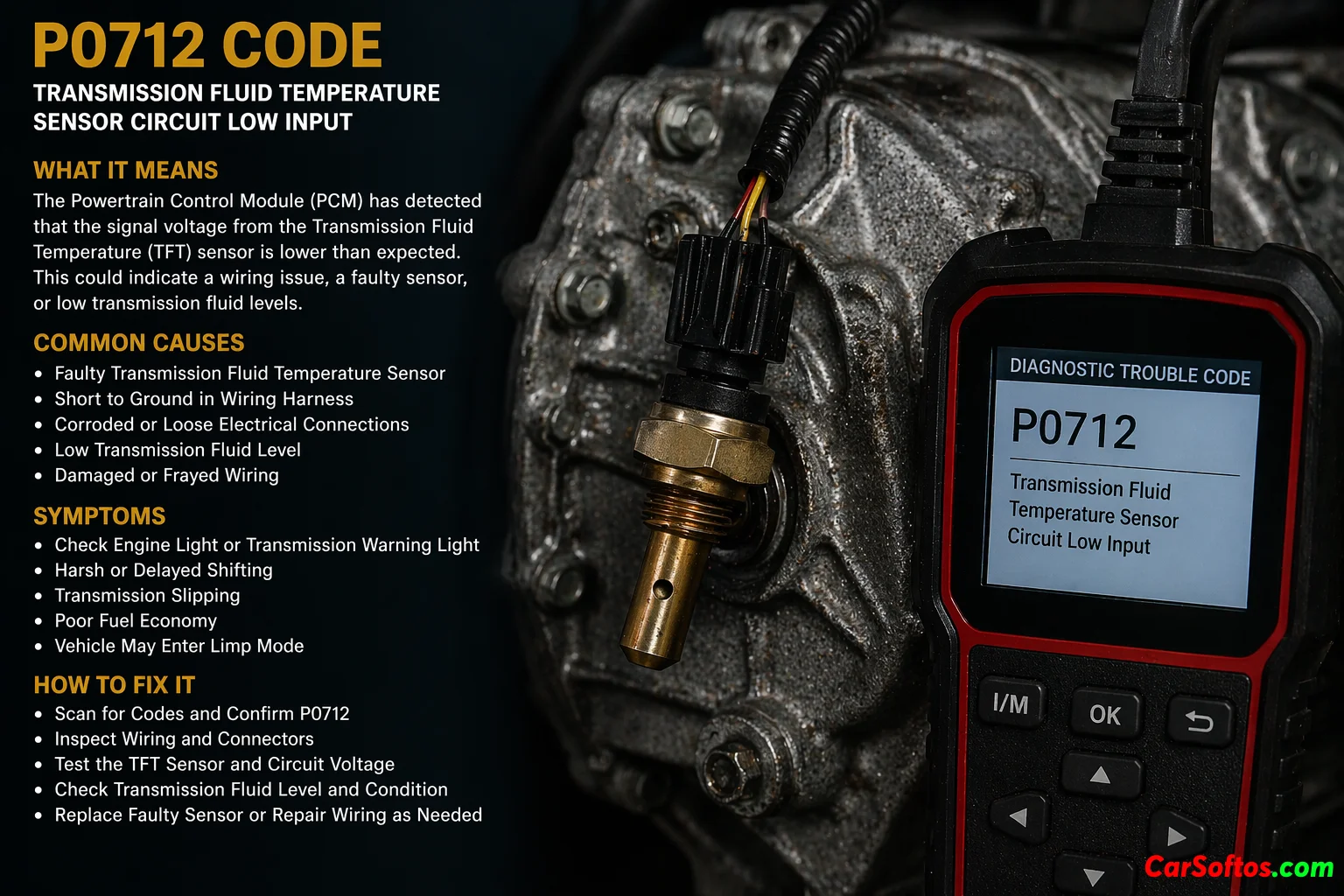
P0712 is the generic OBD-II code for Transmission Fluid Temperature Sensor “A” Circuit Low Input. OEM service information and training material use that definition consistently, and Toyota-style diagnostics specifically identify P0712 as the low-input version of the transmission temperature sensor fault family.
👉 In simple words:
The transmission computer is seeing a voltage signal that is too low from the transmission fluid temperature sensor circuit. On many systems, that makes the module calculate an extremely high transmission temperature, which can trigger harsh shifting, warning lights, or a protective strategy. Toyota documentation notes that when P0712 is present and the scan tool shows around 150°C / 302°F or higher, the circuit is typically shorted.
⚙️ How the Transmission Fluid Temperature Sensor Works
The transmission fluid temperature sensor is usually a thermistor built into the transmission or internal harness. As ATF temperature changes, resistance changes, and the TCM/ECM converts that into a temperature reading used for shift timing, torque converter clutch control, pressure strategy, and overheat protection. Toyota and Ford service information treat TFT as a core transmission-control input.
That is why a wrong TFT signal can affect much more than a warning light. A low-input fault can make the controller think fluid temperature is dangerously high and respond by changing shift behavior or limiting normal operation.
⚠️ How Serious Is P0712?
Severity: ⭐⭐⭐⭐☆ (Medium to Medium-High)
P0712 is usually not as immediately dangerous as a confirmed overheat code like P0218, but it still should not be ignored. If the TCM cannot trust the TFT signal, it may command harsh shifts, delayed shifts, limp mode, or altered torque converter behavior. Recent repair references specifically associate P0712 with hard shifting, delayed engagement, and transmission protection mode.
The important nuance is that P0712 is often a circuit fault first, not automatically proof that the transmission really overheated. But if it appears with burnt fluid, slip complaints, or overheat warnings, then a real heat problem must also be considered. That is an inference from the OEM low-input definitions plus broader transmission repair guidance.
🚨 Common Symptoms of P0712
Typical symptoms can include:
- ⚠️ Check Engine Light or transmission warning light
- ⚠️ harsh or delayed shifting
- ⚠️ limp mode on some vehicles
- ⚠️ incorrect transmission temperature reading in live data
- ⚠️ poor drivability during warm-up
- ⚠️ in some cases, no obvious drivability symptoms at first.
🔥 Real-world clue:
A strong clue is a scan tool showing unrealistically high transmission temperature from a cold start. On Toyota-style systems, that pattern strongly points toward a short circuit / low-input condition, not normal transmission operation.
🧠 Most Common Causes of P0712
1️⃣ Short to ground in the TFT sensor signal wire — very common
This is one of the most important causes. OEM diagnostic material explicitly ties P0712 to a low signal caused by a short circuit. Toyota documentation states that when P0712 is active with a very high displayed temperature, there is a short circuit in the sensor path.
2️⃣ Faulty transmission fluid temperature sensor
A failed TFT sensor itself can pull the signal into the low-input range. Hyundai service information for P0711/P0712/P0713 families specifically directs repair toward the oil-temperature sensor or integrated internal harness depending on model.
3️⃣ Damaged or corroded connector
Poor terminal contact, fluid intrusion, internal corrosion, or connector damage can distort the sensor signal enough to set P0712. Repair references consistently include poor connector or terminal condition as a cause.
4️⃣ Internal transmission harness problem
On many transmissions, the TFT sensor is part of the internal harness or E-module, not a simple external plug-in sensor. Hyundai’s TSB specifically points to replacing the related harness/sensor assembly on affected vehicles rather than replacing the entire transaxle.
5️⃣ Rarely, control module fault
This is less common, but if the sensor and circuit test good, the fault can be inside the module or calibration logic. OEM procedures generally leave this until the end.
🌡️ Why P0712 Gets Confused With P0711 and P0713
This matters a lot for correct diagnosis.
- P0711 = the temperature reading is present, but behaves implausibly or out of expected range
- P0712 = the signal is too low
- P0713 = the signal is too high.
👉 Simple explanation:
- P0711 = reading acts wrong
- P0712 = signal too low
- P0713 = signal too high
That is why P0712 often points more directly toward a shorted circuit or sensor issue than P0711 does.
🔧 Step-by-Step Diagnosis
1️⃣ Scan all codes first
Check whether P0712 appears alone or with related transmission codes such as:
- P0711 — TFT sensor range/performance
- P0713 — TFT sensor high input
- P0218 — transmission over temperature condition
- pressure or shift codes.
If P0712 appears together with real overheat or slip codes, the issue may not be only electrical. That is an inference based on how these fault families interact.
2️⃣ Check live data with a cold vehicle
This is one of the best first checks. Before the car is driven, TFT should usually be somewhere near ambient temperature. If the scan tool shows a very high temperature right away on a cold transmission, that strongly supports a low-input / shorted circuit diagnosis. Toyota’s diagnostic hints specifically point to this pattern.
3️⃣ Inspect the sensor connector and harness
Look for:
- corrosion
- fluid intrusion
- bent or spread terminals
- damaged wiring near the transmission
- rubbed insulation touching metal.
4️⃣ Check circuit integrity
If you have wiring information and a multimeter, check whether the sensor signal is being pulled low and whether the harness is shorted to ground. This is a load-bearing diagnostic step because OEM material directly connects P0712 to short-circuit conditions.
5️⃣ Verify fluid condition too
Even though P0712 is primarily a circuit-low code, you should still inspect ATF level and condition. If fluid is burnt, low, or contaminated, you may be dealing with both a sensor fault and a real transmission problem. Recent repair references emphasize fluid condition in transmission-temp-code diagnosis generally.
6️⃣ Confirm whether the sensor is separate or integrated
On some vehicles the TFT sensor is replaceable by itself. On others it is built into the internal harness or E-module. Hyundai’s TSB is a good example of why this matters: the correct repair part depends on the transmission design.
🛠️ How to Fix P0712
✔️ Replace the TFT sensor
If the sensor itself has failed and the wiring is good, replacing the temperature sensor is a common fix. OEM service material supports this on vehicles where the sensor is serviced separately.
✔️ Repair the connector or wiring
If the signal wire is shorted to ground or the connector is corroded, wiring repair can solve the fault without replacing major parts.
✔️ Replace the internal harness / module assembly when required
On some Hyundai/Kia-style applications, the proper fix is replacing the internal harness with the oil temperature sensor or the E-module, depending on build. Hyundai’s TSB specifically says to follow the repair procedure and replace the related part rather than the whole transaxle.
✔️ Service the transmission fluid if needed
If ATF is old, low, or burnt, servicing it may be necessary as part of a complete repair, though it will not fix a hard short by itself.
💰 Typical Repair Cost
Practical market-style estimates:
| Repair | Typical cost |
|---|---|
| TFT sensor | $50–$250 |
| Connector repair / cleaning | $20–$100 |
| Wiring repair | $50–$250 |
| Internal harness / E-module repair | $150–$700+ |
| ATF service | $100–$350 |
| Advanced diagnosis | $100–$250 |
These are broad market estimates, not OEM flat-rate pricing. The cost depends heavily on whether the TFT sensor is external and simple, or internal and part of a larger harness/module assembly. That conclusion is grounded in Hyundai’s service bulletin and the OEM-style repair architecture described above.
❗ Common Mistakes
❌ Replacing the whole transmission too early
Hyundai service guidance explicitly says not to replace the full transaxle for this code family before following the proper repair procedure and replacing the specific related part.
❌ Ignoring live-data checks
P0712 is one of those codes where live-data behavior is extremely revealing. If the transmission is cold and the scan tool already shows extreme heat, that is a huge clue.
❌ Confusing P0712 with real overheat
P0218 is the code more directly associated with a confirmed transmission overtemperature condition. P0712 is primarily a low-input circuit fault.
❌ Forgetting integrated sensor designs
Some vehicles do not let you replace only a tiny sensor; the proper repair can require an internal harness or module assembly.
⚖️ P0712 vs Related Codes
P0712
Transmission fluid temperature sensor low input — signal too low, often associated with a shorted circuit and an unrealistically high displayed temperature.
P0711
Transmission fluid temperature sensor range/performance — reading exists, but behaves implausibly.
P0713
Transmission fluid temperature sensor high input — signal too high, often associated with an open circuit and very low displayed temperature. Toyota-style diagnostics explicitly contrast P0712 and P0713 this way.
P0218
Transmission over temperature condition — usually a real overheating event rather than just a sensor-circuit fault.
👉 Simple explanation:
- P0711 = temp reading acts wrong
- P0712 = temp signal too low
- P0713 = temp signal too high
- P0218 = transmission actually too hot
🚗 Can You Drive With P0712?
Sometimes, yes — but not for long without diagnosis.
If the transmission still shifts acceptably and there is no real overheat warning, short-term driving may be possible. But if the car is shifting harshly, entering limp mode, or showing additional transmission faults, it should be diagnosed soon. The key question is whether the problem is only a faulty signal or whether it is hiding a real transmission issue too.
📌 Final Verdict
P0712 usually means the transmission computer is seeing a TFT signal voltage that is too low. The most common real causes are a short to ground, a failed transmission fluid temperature sensor, connector corrosion, wiring damage, or an internal harness/module issue depending on the transmission design. OEM-style diagnostic material strongly supports that pattern.
come back