P0711 Trouble Code: Transmission Fluid Temperature Sensor Range/Performance Explained
19-04-2026, 00:34. Posted by: carsoftos777
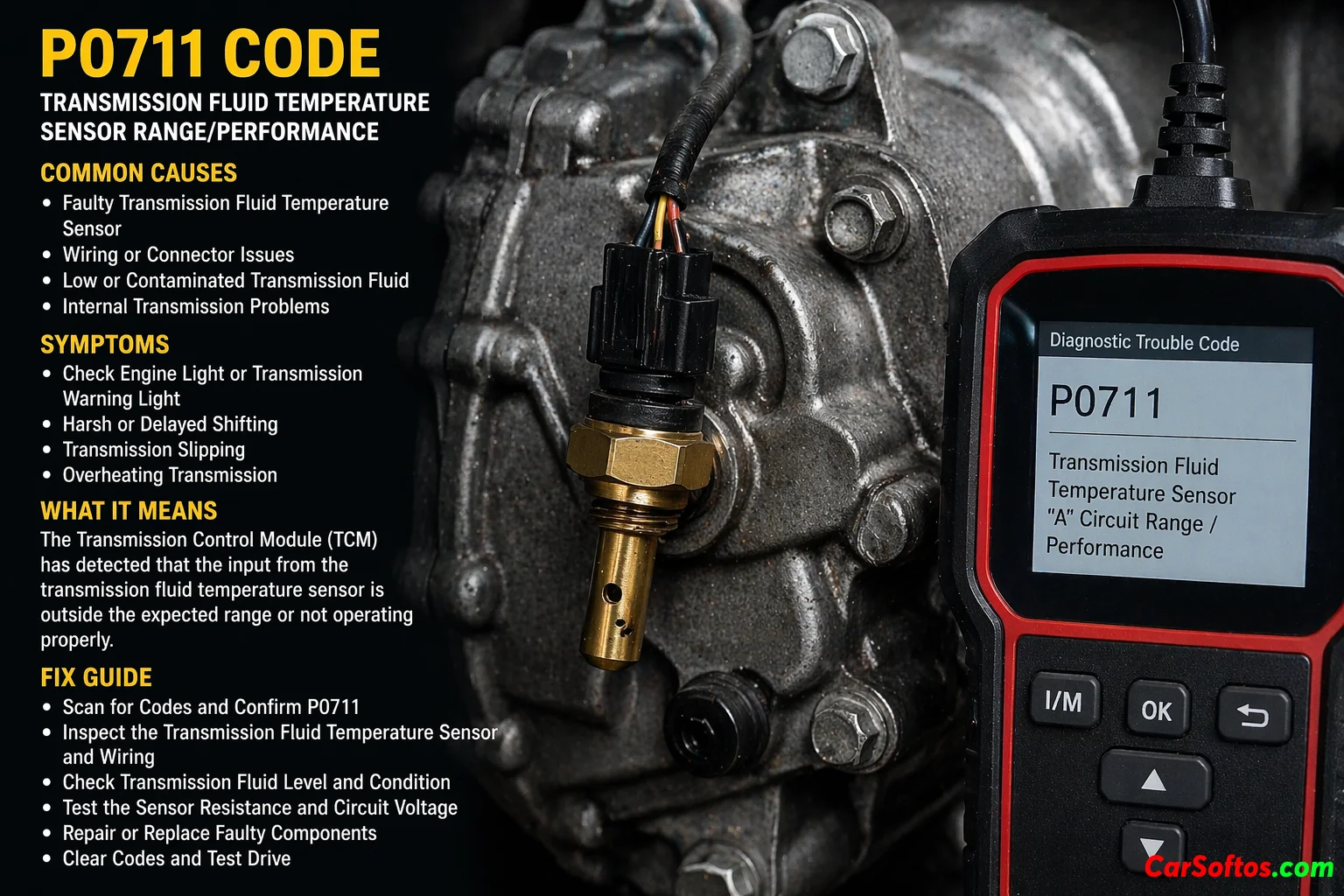
P0711 is the generic OBD-II code for Transmission Fluid Temperature Sensor “A” Circuit Range/Performance. OEM service information describes it as a fault where the transmission fluid temperature signal is present but behaves outside the expected range, or the temperature reading does not change the way the controller expects during operation. Toyota service manuals describe P0711 as a performance/rationality fault in the ATF temperature sensor output, not just a simple hard open or hard short.
👉 In simple words:
The transmission computer is saying:
- the transmission temperature signal looks wrong
- or the fluid temperature is not changing the way it should
- so the TCM/ECM cannot trust that data for normal shift and protection logic.
⚙️ How the Transmission Fluid Temperature Sensor Works
The transmission fluid temperature sensor is typically a thermistor. As ATF temperature changes, sensor resistance changes, and the control module converts that signal into a temperature value used for shift strategy, torque converter clutch control, and overheating protection. Toyota manuals explicitly describe the ATF temperature sensor this way, and Ford service material shows the TFT sensor as a core input in transmission control logic.
That is why a wrong TFT reading can affect much more than just a warning light. It can influence:
- shift timing
- torque converter clutch operation
- limp mode decisions
- line pressure behavior
- overheat protection strategy.
⚠️ How Serious Is P0711?
Severity: ⭐⭐⭐⭐☆ (Medium to Medium-High)
P0711 is usually not as immediately dangerous as P0218, but it still should not be ignored. If the controller cannot trust transmission temperature, it may shift harshly, delay shifts, enter a protective mode, or mismanage torque converter operation. Recent repair references and OEM documents tie P0711 to drivability problems and transmission protection behavior.
The bigger risk is this: sometimes P0711 is caused by the sensor or wiring, but sometimes it appears because the transmission is genuinely overheating or the fluid is in bad condition. That means ignoring it can let a maintenance problem turn into a major transmission repair.
🚨 Common Symptoms of P0711
Typical symptoms include:
- ⚠️ Check Engine Light or transmission warning light
- ⚠️ harsh, delayed, or erratic shifting
- ⚠️ limp mode on some vehicles
- ⚠️ incorrect transmission temperature reading in live data
- ⚠️ reduced fuel economy or torque converter behavior issues
- ⚠️ in some cases, transmission overheating complaints or burnt fluid smell.
🔥 Real-world clue:
If the vehicle shifts badly but the transmission is not obviously overheating, P0711 often points first to the sensor, connector, or wiring. If P0711 appears together with overheat warnings, burnt fluid, or towing-related complaints, then fluid condition or real heat problems move much higher on the list. That is an inference from the way OEM manuals and repair references describe the fault.
🧠 Most Common Causes of P0711
1️⃣ Faulty transmission fluid temperature sensor
This is one of the most common causes. Toyota manuals repeatedly describe P0711 as a problem with ATF temperature sensor output and in some applications explicitly say the sensor itself is defective when the rationality/performance test fails.
2️⃣ Wiring or connector problems
Damaged wiring, unstable terminals, corrosion, or an open/short in the sensor circuit can distort the temperature signal. Repair references and OEM-style procedures commonly include harness and connector faults as major causes for P0711.
3️⃣ Low, dirty, or burnt transmission fluid
Low or contaminated ATF can affect how the sensor reads and can also indicate a real thermal problem. Recent repair references specifically call out low or contaminated fluid as a common reason for P0711 complaints.
4️⃣ Real transmission overheating
On some vehicles, P0711 can set when the temperature behavior is not plausible because the transmission is getting too hot or too cold compared with the expected operating pattern. Toyota monitor descriptions include fault logic where very low or very high ATF temperature after a defined operating time can trigger P0711-type rationality checks.
5️⃣ Internal transmission issue affecting temperature behavior
If the transmission is slipping, line pressure is unstable, or internal wear is creating excess heat, the temperature behavior may move outside the expected pattern and help trigger P0711. This is supported by repair references that connect P0711 with broader transmission performance issues rather than only the sensor itself.
6️⃣ Rarely, TCM/PCM fault or false calibration issue
This is less common, but not impossible. Allison published a bulletin stating that on some calibrations P0711 could falsely activate even with properly functioning sensors and circuitry, and the resolution was a calibration change. That does not mean most P0711 cases are software, but it proves false activation is possible on some platforms.
🌡️ Why P0711 Gets Confused With P0712 and P0713
This matters a lot for diagnosis.
- P0711 = temperature signal exists, but the reading is out of range / implausible / not behaving correctly
- P0712 = transmission temp sensor signal is too low
- P0713 = transmission temp sensor signal is too high.
👉 Simple explanation:
P0711 is the performance/rationality code.
P0712 and P0713 are more like hard low / hard high signal faults.
That is why replacing the sensor immediately without looking at live temperature behavior can be a mistake. P0711 often needs context, not just parts swapping.
🔧 Step-by-Step Diagnosis
1️⃣ Scan all codes first
Check whether P0711 appears alone or with related transmission codes such as:
- P0712 — Transmission Fluid Temperature Sensor Low Input
- P0713 — Transmission Fluid Temperature Sensor High Input
- P0218 — Transmission Over Temperature Condition
- shift or pressure-related transmission codes.
If you also have overtemperature or slip-related codes, that increases the chance the issue is not only the sensor.
2️⃣ Check live temperature data from a cold start
This is one of the best first checks. On a cold vehicle, TFT should usually start somewhere near ambient temperature and then rise gradually as the vehicle drives. Toyota monitor descriptions for P0711 are based on whether the transmission temperature changes in a believable way over time.
👉 Red flags:
- reading starts at an unrealistic value
- reading barely changes after normal driving
- reading spikes or drops suddenly
- reading does not match the vehicle’s real operating condition.
3️⃣ Inspect the sensor and connector
Look for:
- oil-soaked connector
- green corrosion
- loose terminal fit
- broken lock tab
- damaged harness near the transmission case.
The sensor is often mounted in or near the valve body or transmission case area, depending on the design. The location examples in service material and repair illustrations show why connector contamination is common.
4️⃣ Check fluid level and condition
This is a high-value step. If the fluid is low, dark, smells burnt, or looks contaminated, that can point to real transmission heat or internal wear rather than a clean electrical-only problem. Recent repair references explicitly emphasize low/contaminated fluid in P0711 diagnosis.
5️⃣ Test sensor circuit integrity
If you have the service information and tools, verify the temperature sensor circuit, resistance behavior, and harness continuity. Toyota and Mitsubishi-style transmission diagnostics use temperature/resistance checks and circuit verification when diagnosing TFT sensor faults.
6️⃣ Decide whether the problem is sensor-side or transmission-side
If the fluid is clean, temperature data is implausible, and wiring is damaged or corroded, the fault is likely sensor/circuit side. If the fluid is burnt, shifts are bad, and the temperature reading makes sense for an overheating event, then the sensor may be telling the truth and the problem may be inside the transmission or cooling path. That distinction is an inference built from the service and repair references above.
🛠️ How to Fix P0711
✔️ Replace the transmission fluid temperature sensor
If the sensor reading is implausible and the circuit checks out otherwise, sensor replacement is a common fix. Hyundai service guidance for some applications specifically says not to replace the whole transmission for P0711 but instead to follow the service procedure and replace the referenced part.
✔️ Repair the connector or wiring
If the problem is corrosion, loose terminals, or a damaged harness, wiring repair can solve the fault completely without internal transmission work.
✔️ Service the transmission fluid
If ATF is old, contaminated, burnt, or low, correcting the level and servicing the fluid may be necessary before accurate diagnosis is even possible.
✔️ Fix real overheating or internal transmission problems
If the transmission is actually slipping or overheating, replacing the sensor alone will not solve anything. In that case, you have to address the underlying mechanical or cooling issue.
✔️ Check for software/calibration updates on affected applications
Some platforms, such as the Allison bulletin example, had known false-activation issues corrected by calibration changes. That is not common across all vehicles, but it is worth checking when the hardware tests good.
💰 Typical Repair Cost
Practical market-style estimates:
| Repair | Typical cost |
|---|---|
| TFT sensor | $50–$250 |
| Connector repair / cleaning | $20–$100 |
| Wiring repair | $50–$250 |
| ATF service | $100–$350 |
| Advanced diagnosis | $100–$250 |
| Internal transmission repair if overheating/slip is real | $1,000–$4,000+ |
These are broad market estimates, not OEM flat-rate pricing. The biggest cost swing depends on whether P0711 is a sensor/circuit problem or a symptom of real transmission overheating or wear. That conclusion is well supported by the references above.
❗ Common Mistakes
❌ Replacing the whole transmission too early
Hyundai service guidance explicitly warns not to replace the entire transaxle for listed TFT sensor-related codes without following the service procedure and replacing the specific part first.
❌ Ignoring burnt or low fluid
If the transmission fluid is in bad condition, the sensor may not be the main problem at all.
❌ Skipping live-data checks
P0711 is a rationality/performance code, so live temperature behavior is one of the fastest ways to avoid guessing. Toyota’s monitor logic for P0711 is built around how the temperature changes over time.
❌ Confusing P0711 with P0712/P0713
Those are not the same diagnosis path. P0711 is about behavior/performance, while P0712 and P0713 are more direct low/high input faults.
⚖️ P0711 vs Related Codes
P0711
Transmission fluid temperature sensor range/performance — signal exists but is not behaving plausibly.
P0712
Transmission fluid temperature sensor low input — signal too low.
P0713
Transmission fluid temperature sensor high input — signal too high.
P0218
Transmission over temperature condition — usually a real overheating event rather than a pure sensor-performance issue.
👉 Simple explanation:
- P0711 = temp reading acts wrong
- P0712 = temp signal too low
- P0713 = temp signal too high
- P0218 = transmission too hot
🚗 Can You Drive With P0711?
Sometimes, yes — but not for long without diagnosis.
If the transmission still shifts normally and there is no overheat warning, short-term driving may be possible. But if P0711 comes with harsh shifts, limp mode, burnt fluid smell, or overheating symptoms, it should be diagnosed quickly before real transmission damage occurs.
📌 Final Verdict
P0711 usually means the transmission computer sees a fluid-temperature reading that is out of range or not behaving the way it should. The most common real causes are a faulty transmission fluid temperature sensor, connector or wiring problems, low or contaminated ATF, or real transmission overheating/slip issues. The strongest OEM references make it clear that this is a performance/rationality fault, not just a simple stuck-high or stuck-low signal.
come back