P0116 Trouble Code: Engine Coolant Temperature Circuit Range/Performance
13-04-2026, 23:31. Posted by: carsoftos777
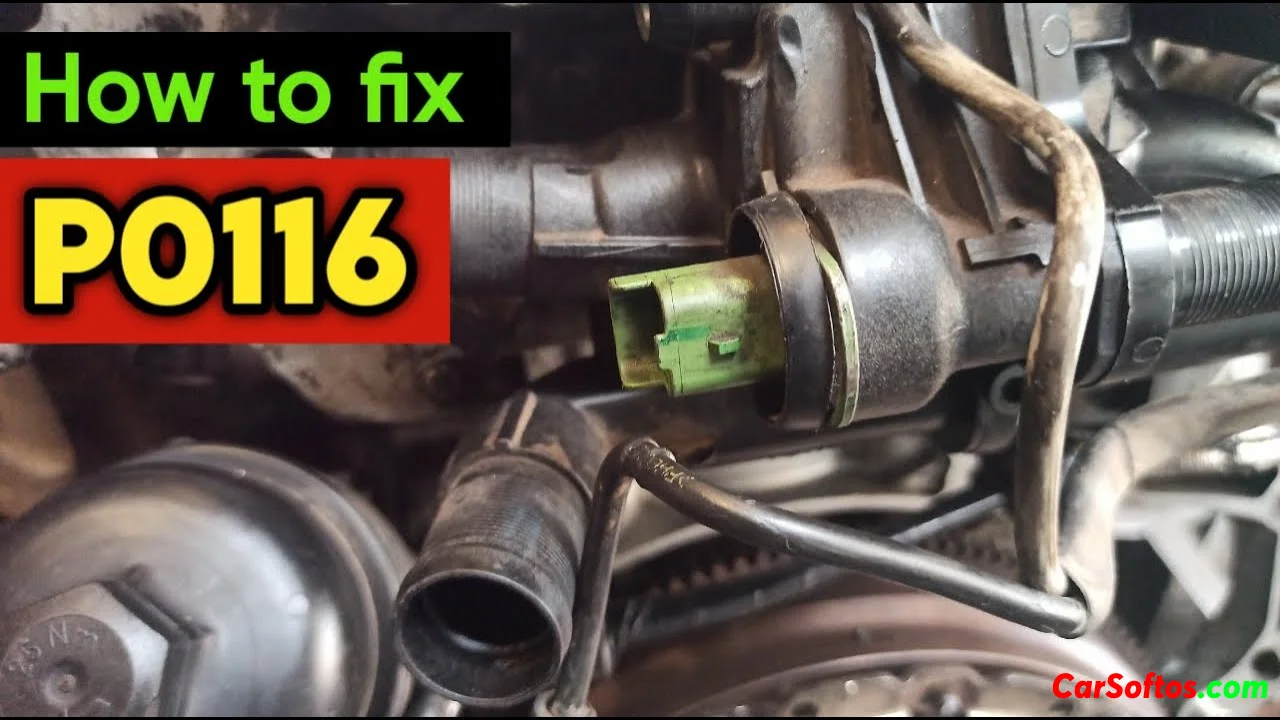
P0116 is the generic OBD-II code for Engine Coolant Temperature Circuit Range/Performance. In manufacturer service information, it is used when the PCM/ECM sees an engine coolant temperature signal that does not behave the way it should, not simply when the circuit is fully open or shorted. Toyota manuals describe P0116 as a range/performance problem, and Mitsubishi service info lists the most likely causes as the ECT sensor, harness/connector damage, or the ECM.
👉 In simple words:
- the computer watches how fast coolant temperature changes
- it compares the reading to expected warm-up behavior
- if the reading looks too slow, implausible, or out of normal range, it sets P0116.
⚙️ How the ECT Sensor Works
The engine coolant temperature sensor is typically a thermistor. As coolant temperature rises, the sensor’s resistance changes, and the ECM converts that voltage signal into a temperature reading. Toyota manuals specifically describe the ECT sensor this way, and Suzuki service info shows a typical 5-volt reference style circuit check for the sensor.
That reading affects a lot more than the gauge. The ECM uses coolant temperature for:
- fuel mixture on cold start
- ignition and idle strategy
- cooling fan logic
- emissions monitoring
- warm-up and thermostat plausibility checks.
That last point is why a bad thermostat can also trigger P0116 even when the sensor itself is not dead. Toyota diagnostic procedures for P0116 explicitly include checking the thermostat opening temperature and the cooling system.
⚠️ How Serious Is P0116?
Severity: ⭐⭐⭐⭐☆ (Medium to Medium-High)
P0116 is usually not an immediate engine-destruction code, but it should not be ignored. If the ECM does not trust coolant temperature data, it may enrich fuel mixture, affect drivability, increase fuel consumption, and in some cases hide a real cooling-system problem such as a thermostat stuck open. Toyota service information directly links P0116 to possible cooling system and thermostat faults, while Mitsubishi lists sensor and wiring as likely causes.
👉 The real risk is this:
- if it is sensor/wiring, the engine may run poorly or inefficiently
- if it is thermostat/cooling-system related, the engine may never warm up correctly or may behave unpredictably in cold weather.
🚨 Common Symptoms of P0116
Typical symptoms can include:
- ⚠️ Check Engine Light
- ⚠️ hard cold starts
- ⚠️ poor fuel economy
- ⚠️ rough idle when cold
- ⚠️ temperature gauge behaving strangely
- ⚠️ radiator fans running at the wrong time on some vehicles
- ⚠️ engine taking too long to warm up
- ⚠️ heater output weaker than normal if the thermostat is stuck open.
These symptoms line up with manufacturer diagnostics and service references that treat P0116 as an ECT performance problem rather than a simple hard-open/hard-short circuit failure.
🧠 Most Common Causes of P0116
1️⃣ Faulty engine coolant temperature sensor
This is one of the most common causes. Mitsubishi service info directly lists the engine coolant temperature sensor failed as a likely cause, and Toyota diagnostics repeatedly point to abnormal sensor output as a trigger for P0116.
2️⃣ Thermostat stuck open
This is a big one and often missed.
Toyota diagnostic procedures for P0116 specifically tell technicians to check the thermostat, and one Toyota fault chart shows a classic warm-up failure pattern where coolant temperature remains too low even long after startup. That is exactly what a stuck-open thermostat does.
👉 Very common real-world scenario:
- cold start is normal
- engine warms up very slowly
- temp gauge stays low
- heater is weak
- P0116 sets
3️⃣ Wiring or connector damage
Mitsubishi lists harness damage or connector damage among the most likely causes, and Suzuki-style diagnostics include checking connector condition, 5V reference, and harness integrity.
4️⃣ Low coolant or cooling system issue
Manufacturer diagnostics for P0116 include the cooling system as a possible trouble area. Low coolant, trapped air, or abnormal circulation can make the sensor reading unstable or misleading.
5️⃣ Corroded ECT connector
Even if the sensor is good, poor terminal contact can distort the signal. This is not always listed separately in summary definitions, but it is directly consistent with the manufacturer emphasis on harness/connector damage.
6️⃣ Rarely: ECM problem
Mitsubishi service info includes ECM failed as a possible cause, but it is typically a last-resort diagnosis after sensor, wiring, and cooling-system checks are done first.
🌡️ Why P0116 Often Gets Confused
A lot of people think P0116 always means “replace the sensor.” That is not always correct.
P0116 is a performance/range code. That means the sensor signal may still exist, but the ECM thinks the reading is not believable. Toyota service information makes this clear by including thermostat and cooling-system checks in the official diagnostic path.
👉 So the problem may be:
- bad sensor
- bad thermostat
- bad wiring
- low coolant
- cooling-system fault
—not just the sensor itself.
🔧 Step-by-Step Diagnosis
1️⃣ Scan all codes first
Check if P0116 appears by itself or with related codes like:
- P0115 — ECT circuit malfunction
- P0117 — ECT low input
- P0118 — ECT high input
- thermostat-related or fuel-trim related codes
Toyota service charts specifically note that if P0115 is present together with P0116, you should address the more basic circuit fault first.
2️⃣ Check live coolant temperature data
On a cold engine, coolant temperature should look close to ambient temperature. After startup, it should rise smoothly and at a believable rate. Toyota service info for P0116 is built around whether coolant temperature changes as expected during warm-up.
👉 Red flags:
- reading is unrealistically low or high from the start
- reading jumps suddenly
- reading warms up far too slowly
- reading does not match real engine behavior
3️⃣ Inspect the sensor and connector
Check for:
- coolant contamination
- loose fit
- broken lock tab
- green corrosion
- damaged wires near the sensor
This is directly supported by manufacturer troubleshooting that emphasizes sensor failure and harness/connector damage.
4️⃣ Check coolant level and cooling system
If coolant is low or air is trapped near the sensor, the reading can become unstable or inaccurate. Toyota fault charts include the cooling system itself as a possible cause.
5️⃣ Test the thermostat
This step matters a lot.
Toyota manuals for P0116 explicitly instruct technicians to measure thermostat opening temperature and verify proper operation.
👉 Signs of a stuck-open thermostat:
- engine takes forever to warm up
- temp gauge runs low
- cabin heat is weak
- P0116 returns after clearing
6️⃣ Verify reference voltage and signal
Suzuki-style diagnostics show checking for proper reference voltage and circuit integrity. If the sensor does not have the correct supply/ground path, replacing the sensor alone may not fix the code.
🛠️ How to Fix P0116
✔️ Replace the ECT sensor
If live data is implausible and wiring/power are okay, the sensor is a common fix. Manufacturer service info supports failed ECT sensor as one of the primary causes.
✔️ Replace the thermostat
If the engine warms up too slowly, the thermostat may be the real problem. Toyota diagnostic procedures make this one of the most important checks for P0116.
✔️ Repair wiring or connector damage
If the signal is unstable because of poor contact, broken insulation, or connector corrosion, wiring repair may solve it completely.
✔️ Fix coolant level / bleed air from the system
If low coolant or trapped air is part of the problem, correcting the cooling system can stabilize the reading. This follows directly from manufacturer fault charts that include the cooling system as a possible cause.
✔️ Rarely, diagnose the ECM
Only after sensor, thermostat, coolant level, and wiring are checked should the ECM be considered.
💰 Typical Repair Cost
A practical market-style estimate:
| Repair | Typical cost |
|---|---|
| Coolant temp sensor | $40–$180 |
| Connector / wiring repair | $20–$200 |
| Thermostat replacement | $120–$450 |
| Coolant service / bleed | $50–$180 |
| Advanced diagnosis | $80–$180 |
These are practical ranges, not manufacturer flat-rate pricing. The important point is that P0116 is often much cheaper than major engine or turbo codes, but it can still waste fuel and cause drivability issues if ignored. That cost framing is an inference based on the repair types supported by the service material.
❗ Common Mistakes
❌ Replacing the sensor without checking the thermostat
This is probably the biggest mistake. Toyota’s official diagnostic path clearly includes thermostat testing for P0116.
❌ Ignoring low coolant
If coolant level is low, the sensor may not see stable coolant temperature. Manufacturer charts include cooling-system faults as possible causes.
❌ Skipping live-data checks
P0116 is a performance/range code, so live data is one of the fastest ways to tell whether the reading is believable.
❌ Treating P0116 like P0117 or P0118
Those are usually harder low/high signal faults. P0116 is more about plausibility and behavior than a simple stuck-high or stuck-low reading.
⚖️ P0116 vs Related Codes
P0116
Engine coolant temperature circuit range/performance — signal exists, but the ECM does not trust how it behaves.
P0115
General ECT circuit malfunction — often more basic circuit fault territory. Toyota charts note to address it first if present with P0116.
P0117
ECT sensor low input — signal too low.
P0118
ECT sensor high input — signal too high.
👉 Simple explanation:
- P0116 = reading looks wrong
- P0117 = reading too low
- P0118 = reading too high
- P0115 = broader ECT circuit problem
🚗 Can You Drive With P0116?
Yes, sometimes — but not for long.
If the car still runs normally, short-term driving may be possible. But if the engine warms up badly, fuel economy drops, the heater is weak, or the temperature reading is unstable, it should be diagnosed soon. That recommendation follows from the manufacturer-backed causes: sensor, thermostat, wiring, and cooling system.
👉 Especially avoid ignoring it if:
- the gauge behaves strangely
- coolant is low
- the heater is weak
- the code comes back repeatedly after clearing
📌 Final Verdict
P0116 usually means the ECM sees a coolant temperature reading that does not behave the way it should. The most common real causes are a faulty ECT sensor, a stuck-open thermostat, wiring or connector damage, or a cooling-system issue such as low coolant. Toyota and Mitsubishi service information strongly support that pattern.
come back