P17D8 Trouble Code: Clutch Temperature Torque Limitation Explained
7-04-2026, 21:41. Posted by: carsoftos777
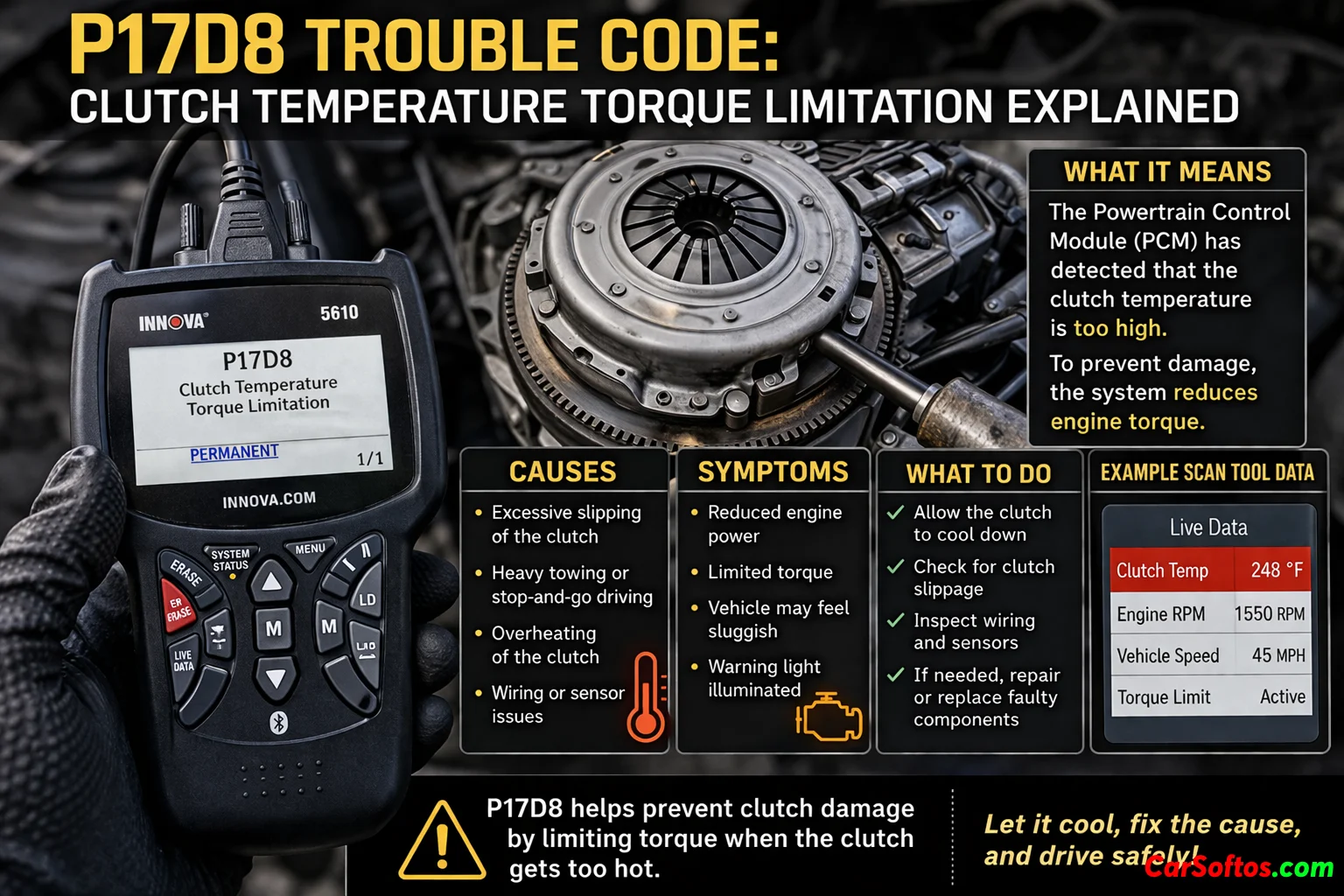
P17D8 is a manufacturer-specific transmission code, not a universal generic OBD-II code. In Audi service literature for the 7-speed S tronic / DSG 0B5 transmission, it is described as “Torque limitation because of clutch temperature”, commonly with symptom code 8040. Audi bulletins tie this code to the message “Gearbox malfunction: you can continue driving.”
In plain English, the transmission control unit is reducing allowed torque because it believes clutch temperature is too high or that the clutch-temperature-related control path is reporting a problem. On affected Audi 0B5 gearboxes, this code is often seen together with other transmission faults rather than by itself.
⚠️ How Serious Is P17D8?
Severity: High
This is not a code to ignore. Audi bulletins associate it with a gearbox malfunction warning and with related mechatronic faults in the 0B5 S tronic transmission. If the condition repeats, drivability can get worse, shifting may become harsh or limited, and the car may eventually go into a more serious protective mode.
🚨 Common Symptoms
Typical symptoms can include:
- ✅ Gearbox malfunction warning on the dash
- ✅ Reduced power / torque limitation
- ✅ Harsh shifting
- ✅ Delayed engagement
- ✅ Transmission going into a protective mode
- ✅ Intermittent or repeated clutch-temperature-related faults
- ✅ Other transmission codes stored at the same time
🧠 What Usually Causes P17D8?
1️⃣ Mechatronic circuit board fault
This is the big one on Audi 0B5 gearboxes.
Audi technical bulletins describe a poor internal contact area on the circuit board in the mechatronics unit. The bulletin says oil additives can cause the plastic circuit plates to delaminate, leading to contact loss. In the Audi service fix, the repair is focused on the mechatronics circuit board / printed circuit foil, not simply clearing codes.
2️⃣ Clutch temperature monitoring issue
P17D8 is closely tied to clutch temperature logic. Audi documentation and Ross-Tech references show it often appears alongside P1740 (Clutch Temperature Monitoring) and other related transmission faults.
3️⃣ Related electrical valve / mechatronic faults
Audi bulletins list P17D8 with codes such as:
- P0726 — engine RPM signal implausible
- P174B / P174F — valve electrical faults
- P179C / P179D — pressure-related electrical faults
- P1740 — clutch temperature monitoring
That means P17D8 often belongs to a bigger mechatronic problem, not just a simple overheating event.
4️⃣ Actual clutch overheating or repeated heavy-load operation
The code wording itself points to clutch temperature, so real thermal stress can be part of the story. But on the Audi 0B5 cases covered in the TSB, the documented technical background focuses heavily on internal mechatronic circuit board contact loss, not only on driver abuse or towing.
🏎️ Which Cars Commonly Show P17D8?
Based on the sources I found, this code shows up mainly on Audi vehicles using the 0B5 7-speed S tronic / DSG transmission, including examples discussed around Audi S4, S5, Q5 and similar applications. Ross-Tech references also connect P17D8 specifically to the 0B5 gearbox family.
🔧 Step-by-Step Diagnosis
1️⃣ Confirm the exact code and symptom code
This part is important.
Audi says the DTC and symptom code must match exactly before following the TSB repair path. For the documented bulletin, the relevant match is P17D8 with symptom code 8040.
2️⃣ Check for related transmission codes
Do not look at P17D8 in isolation. Look for:
- P1740
- P0726
- P174B
- P174F
- P179C
- P179D
- P174A / P174C in some cases
If several of these appear together, that strongly points toward a mechatronic / circuit board issue rather than a random one-off glitch.
3️⃣ Read transmission freeze frame / fault status
Check whether the code is:
- intermittent
- confirmed
- frequency increasing
- present with gearbox warning messages
Logs show P17D8 appearing as intermittent or confirmed in real 0B5 cases, so fault status matters.
4️⃣ Inspect transmission behavior
Pay attention to:
- rough shifts
- delayed takeoff
- limp behavior
- warning messages after warmup
- repeated faults after clearing
These patterns fit the real-world cases and the Audi bulletin condition language.
5️⃣ Compare against the Audi TSB path
For the Audi 0B5 cases covered by the bulletin, the official service path is not “replace random sensors first.” It specifically points to removing the mechatronics unit and replacing the circuit board / printed circuit foil if the exact code + symptom code combination matches.
🛠️ How to Fix P17D8
✔️ If the TSB match is exact: repair the mechatronic circuit board
Audi’s published service action for the matching P17D8 case is:
- remove the mechatronics unit
- replace the circuit board / printed circuit foil
- install associated seals / pipes / gasket / fluid as required by the repair procedure
✔️ Do not assume it is “just overheating”
The bulletin’s technical background says the underlying issue can be poor internal contact area and delamination of circuit plates, which means simply cooling the car down or resetting faults may not solve it long-term.
✔️ Check the rest of the mechatronic fault cluster
If P17D8 appears with multiple valve or pressure-control electrical faults, repairing only one visible symptom may not be enough. The broader pattern matters.
💰 Typical Repair Cost
Real cost depends a lot on country, labor rate, and whether you use OEM Audi parts or a transmission specialist.
Practical estimate:
- Diagnosis / scan / confirmation: $80–$180
- Mechatronic service labor: $400–$1,000+
- Circuit board / repair kit / seals / fluid: can push total repair into the mid to high hundreds or well over $1,500 depending on shop and parts pricing
- Full mechatronic or transmission-level repair: can go much higher
I’m treating these as market-style estimates, not factory flat-rate pricing. The load-bearing fact is that Audi’s documented repair involves mechatronics removal plus circuit board replacement parts and fluid, so this is usually not a cheap code.
❗ Common Mistakes
❌ Clearing the code and driving until it gets worse
Because Audi ties this code to a known 0B5 mechatronic problem pattern, repeated resets without diagnosis can delay the real fix.
❌ Ignoring the symptom code
For this fault family, symptom code matters. Audi explicitly says the TSB should not be followed unless the DTC and symptom code match exactly.
❌ Treating it like a generic OBD code
P17D8 is not one of those universal “same on every brand” engine codes. It is strongly tied here to Audi 0B5 S tronic transmission logic.
❌ Replacing parts before checking for the known 0B5 bulletin
The bulletin exists for a reason. If the car and code details line up, that repair information is more valuable than guessing.
⚖️ P17D8 vs Related Codes
P17D8
Torque limitation because of clutch temperature on Audi 0B5 cases, commonly with symptom code 8040.
P1740
Clutch temperature monitoring. Often appears in the same fault family and is specifically linked by Ross-Tech / Audi references to the 0B5 issue cluster.
P174B / P174F / P179C / P179D
Electrical / pressure-control faults in the same mechatronic cluster. These often help confirm that the problem is deeper than a one-off warning.
👉 Simple explanation:
- P17D8 = transmission is limiting torque because clutch temp logic says there is a problem
- P1740 = clutch temperature monitoring fault
- P174B / P174F / P179C / P179D = mechatronic electrical fault family nearby
🚗 Can You Drive With P17D8?
Sometimes, briefly — but it is risky to ignore.
Audi’s own warning text associated with this issue says “Gearbox malfunction: you can continue driving”, which means the car may still move. But that does not mean the problem is harmless. Continued driving can leave you with worsening shift behavior or a more serious transmission repair later.
📌 Final Verdict
P17D8 is a serious Audi S tronic / DSG transmission fault that usually points to torque reduction caused by clutch-temperature-related logic, often in the broader context of an 0B5 mechatronic problem. On the strongest source trail I found, Audi ties the matching fault pattern to mechatronic circuit board contact loss / delamination and specifies a repair path centered on the mechatronics circuit board.
come back