Audi P1556 Fault — Boost Leak, N75 Valve or Turbo Problem?
25-03-2026, 23:50. Posted by: carsoftos777
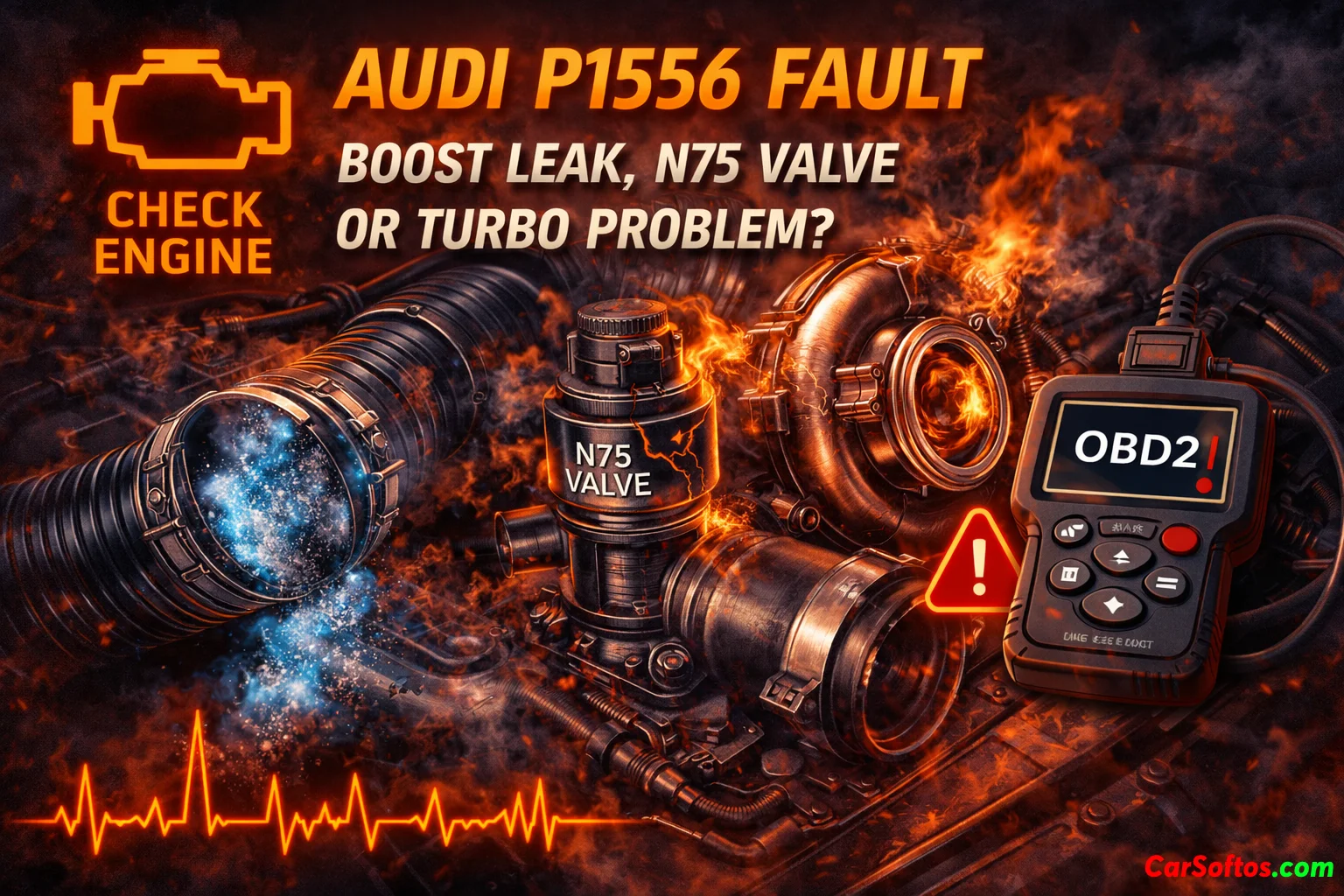
On Audi/VW applications, 17964 / P1556 is defined as “Charge Pressure Control: Negative Deviation.” In plain English, the ECU requested more boost than the turbo system actually delivered. Ross-Tech lists the main symptoms as reduced power output and limp mode. Possible causes include boost pressure too low, hoses/pipes incorrectly connected, disconnected or leaking, charge pressure control defective, turbocharger defective, wastegate/regulating valve problems, and on some applications MAF-related issues.
That makes P1556 an underboost code, but not a one-part diagnosis. It does not automatically mean the turbo is dead. On real Audi/VAG cars, the root cause is often a vacuum leak, boost leak, N75 boost control valve issue, or a wastegate / actuator control problem before it turns out to be the turbo itself.
🧠 Why this code matters
P1556 is one of those faults that can feel mild at first and then become very noticeable under load.
What the ECU is comparing
The ECU looks at:
- requested boost pressure
- actual boost pressure
- engine load
- throttle input
- turbo control response
If actual boost stays too low for the expected operating condition, the ECU stores P1556 and may put the car into limp mode to protect the engine and turbo system. Ross-Tech explicitly lists reduced power output and limp mode as typical symptoms.
🔧 How the Audi turbo control system works
A simplified Audi/VAG turbo control chain looks like this:
- The ECU requests boost.
- The N75 boost control valve regulates vacuum or pressure to the actuator.
- The wastegate or turbo control mechanism adjusts turbo output.
- Boost travels through the charge pipes, intercooler, and intake tract.
- The ECU compares measured boost to the target.
If any part of that chain leaks, sticks, responds too slowly, or reports bad airflow/pressure information, you can get P1556. Ross-Tech’s cause list and Audi/VW troubleshooting discussions consistently point to hoses, charge-pressure control, turbocharger, wastegate/regulating valve, and sometimes MAF as the main suspects.
🚨 Common symptoms of P1556
Typical real-world symptoms
- loss of power
- slow acceleration
- car feels weak at higher load
- limp mode
- engine may struggle to pull past speed/load thresholds
- sometimes a whooshing / hissing noise from a leak
- Check Engine Light or stored fault after hard acceleration
Ross-Tech lists reduced power output and limp mode as the classic symptoms. Real-world owner reports often describe severe loss of power, especially under load, and a feeling that the turbo “stops working.”
🔍 Most common causes of Audi P1556
1️⃣ Vacuum leak in the turbo control system
One of the most common causes is a split or disconnected vacuum line. If the actuator is not getting the correct control signal, the wastegate may not close properly and the turbo will not build requested boost. Audi and VW owner diagnostics repeatedly point to leaking actuator lines and vacuum plumbing as a frequent reason for P1556.
Typical vacuum-leak locations
- small vacuum hoses near the turbo control system
- lines to the wastegate actuator
- lines to the N75 valve
- brittle or heat-damaged rubber hose sections
2️⃣ Faulty N75 boost control valve
The N75 valve is one of the most common VAG-specific causes behind boost-control faults. If it sticks, leaks internally, or responds slowly, boost control becomes inaccurate and the ECU may see negative deviation. Troubleshooting sources for P1556 and boost-control faults frequently mention the N75 as a key suspect.
Typical N75 failure clues
- intermittent limp mode
- boost comes and goes
- vacuum lines test okay, but control remains poor
- underboost appears mainly during harder acceleration
3️⃣ Boost leak in intercooler or charge piping
The turbo may actually be making boost, but if the pressurized air escapes through a split hose, loose coupler, or cracked intercooler pipe, the ECU will still see low boost and trigger P1556. Ross-Tech explicitly includes hoses/pipes incorrectly connected, disconnected or leaking in the official cause list.
Common leak points
- intercooler couplers
- plastic charge pipes
- turbo outlet hoses
- intake boot connections
- loose clamps after prior repairs
4️⃣ Wastegate actuator or wastegate problem
If the wastegate actuator cannot move correctly, or the wastegate does not seal as it should, the turbo will underboost. Audi/VW underboost troubleshooting commonly includes testing the wastegate actuator and checking whether it responds at the proper vacuum/pressure levels.
Typical wastegate-related causes
- weak or leaking actuator diaphragm
- sticking wastegate arm
- maladjusted actuator rod
- worn wastegate hardware
5️⃣ Turbocharger wear or failure
Sometimes the turbo itself is the problem. Ross-Tech includes turbocharger defective among the recognized causes of P1556. Usually this is the conclusion after leaks, vacuum plumbing, and the N75 have been ruled out.
Turbo-related clues
- persistent underboost after leak repair
- oil in intake/boost path
- abnormal shaft play
- whine, siren noise, or visible turbo damage
6️⃣ MAF sensor or airflow measurement issue
Ross-Tech’s documentation and VAG community troubleshooting also mention the MAF (G70) as a possible contributor in some cases. If airflow is being measured incorrectly, boost control strategy can be thrown off, especially on older turbo-diesel and early turbo applications.
7️⃣ Incorrect hose routing after repairs
On older Audi/VW turbo setups, incorrect reconnection of vacuum or boost hoses after service can create a perfect P1556 scenario. Some troubleshooting threads specifically mention reversed or leaking hose connections as causes.
📉 What P1556 feels like in real driving
A very common pattern looks like this:
At light throttle
The car may feel mostly normal.
Under hard acceleration or climbing
Boost demand rises, but actual boost stays too low.
Result
- weak pull
- power fades suddenly
- limp mode may activate
- car may refuse to go beyond certain speed/load conditions
That exact reduced-power behavior is reflected both in Ross-Tech’s symptom list and in owner reports describing the car becoming very slow under load.
🔎 P1556 vs P1557 — very important
These two Audi/VAG codes are often confused.
| Code | Meaning |
|---|---|
| P1556 / 17964 | Negative deviation = underboost |
| P1557 / 17965 | Positive deviation = overboost |
So:
- P1556 = the system cannot make enough boost
- P1557 = the system is making too much boost or cannot control it downward
That distinction matters a lot, because the diagnosis path is different. Underboost points more strongly to leaks, weak control, or mechanical inability to build boost. Ross-Tech explicitly identifies P1556 as negative deviation.
🛠️ How to diagnose Audi P1556 properly
Step 1: Scan and confirm the exact fault
Make sure you have 17964 / P1556 — Charge Pressure Control: Negative Deviation and not an overboost or unrelated airflow code. Ross-Tech’s wording is the reference here.
Step 2: Inspect vacuum hoses first
This is one of the smartest first checks because it is cheap, common, and often overlooked. Look for:
- cracked hoses
- soft, collapsed lines
- disconnected lines
- lines leaking near the actuator or back of engine
Real owner cases have found exactly this as the root cause.
Step 3: Check the N75 valve and its plumbing
Inspect the valve, confirm hoses are routed correctly, and test operation if possible. VAG troubleshooting for underboost repeatedly points here.
Step 4: Pressure-test the boost path
Check:
- intercooler hoses
- charge pipes
- clamps
- couplers
- intake tract after turbo
Ross-Tech explicitly lists leaking hoses/pipes among likely causes.
Step 5: Evaluate the wastegate actuator
Confirm the actuator moves and holds vacuum/pressure correctly and that linkage is not sticking. This is a key step on turbo VAG engines.
Step 6: Check MAF readings if basics look okay
If the hardware path seems intact, airflow measurement may need inspection. Ross-Tech and Audi forum discussions mention the MAF as a possible contributor.
Step 7: Only then suspect the turbo
If vacuum control, N75, hoses, and boost plumbing all pass, then turbo wear/failure becomes much more likely.
⚠️ Most common mistakes
- replacing the turbo too early
- ignoring small vacuum leaks
- not pressure-testing the charge system
- replacing sensors before checking hoses
- forgetting that the N75 can cause an underboost fault
These mistakes show up repeatedly in real-world P1556 troubleshooting, where cheap hose or control-valve issues mimic expensive turbo failure.
💰 Typical repair cost range
Repair cost depends on the real cause:
- vacuum hose repair: low
- N75 valve replacement: low to moderate
- boost hose / intercooler pipe repair: low to moderate
- wastegate actuator repair: moderate
- turbo replacement: expensive
That is exactly why P1556 is such a good topic for a deep article: search intent is high, and the wrong diagnosis can cost the owner a lot of money. The source material supports the fault patterns and cause hierarchy, though exact costs vary by model and market.
🚗 Can you drive with P1556?
Sometimes yes, but it is not smart to ignore it.
If the car only shows mild power loss, it may still be drivable short-term. But if it is entering limp mode, struggling under load, or losing power badly, the issue should be fixed soon. Ross-Tech specifically lists reduced power and limp mode, which tells you this is not just a harmless stored code.
✅ Final verdict
Audi P1556 is an underboost code. The ECU is asking for more boost than the engine is actually producing. On Audi/VAG vehicles, the most common real causes are:
- vacuum leaks
- boost leaks
- N75 valve problems
- wastegate actuator issues
- turbocharger wear
- sometimes MAF-related airflow errors.
The single most important takeaway is this:
Do not replace the turbo just because you saw P1556. Check the vacuum lines, N75 valve, and boost leaks first. That diagnosis order is the most consistent with both Ross-Tech guidance and real-world Audi/VAG troubleshooting.
come back